Is it Better to be Rich or Educated?
Published in Social Sciences, Sustainability, and Behavioural Sciences & Psychology





In our research, we attempted to provide a fresh take on some age-old questions. Does money buy happiness? Is education important for health? These questions have been debated, discussed, and contested among researchers, philosophers, politicians, and members of the general public for many years. Though much is now known about how socioeconomic status (often measured by indicators of income and education) influence health and well-being, we were intrigued to find that different disciplines often addressed these questions separately. Whereas health scientists and epidemiologists have examined how socioeconomic status influences health outcomes, psychologists, economists, and sociologists have typically examined how socioeconomic status may influence well-being. Our goal was to bridge the gap between these different disciplines and directly compare how income and education may impact both health and happiness.
To do so, we conducted a study with more than 71,000 participants from more than 10 countries by having participants provide reports of their health and well-being up to three times a day over the course of three weeks. At each “check-in” they recorded their heart rate and blood pressure using an optic sensor on their phone, and they answered a few questions about their emotions. Prior to completing these assessments, all participants answered some demographic questions, including questions about their education and income. Education was assessed with a standard question about the highest level of education they had received, and income was assessed with a subjective social status question. They viewed a picture of a ladder and indicated where they stood relative to others in their country. The wealthiest were at the top and the poorest people were at the bottom.
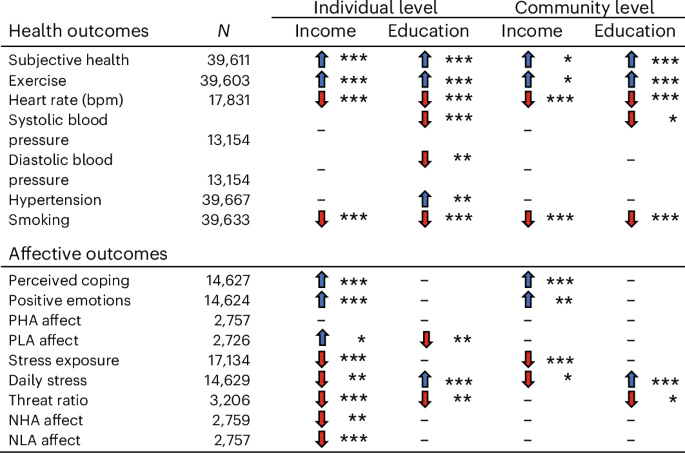
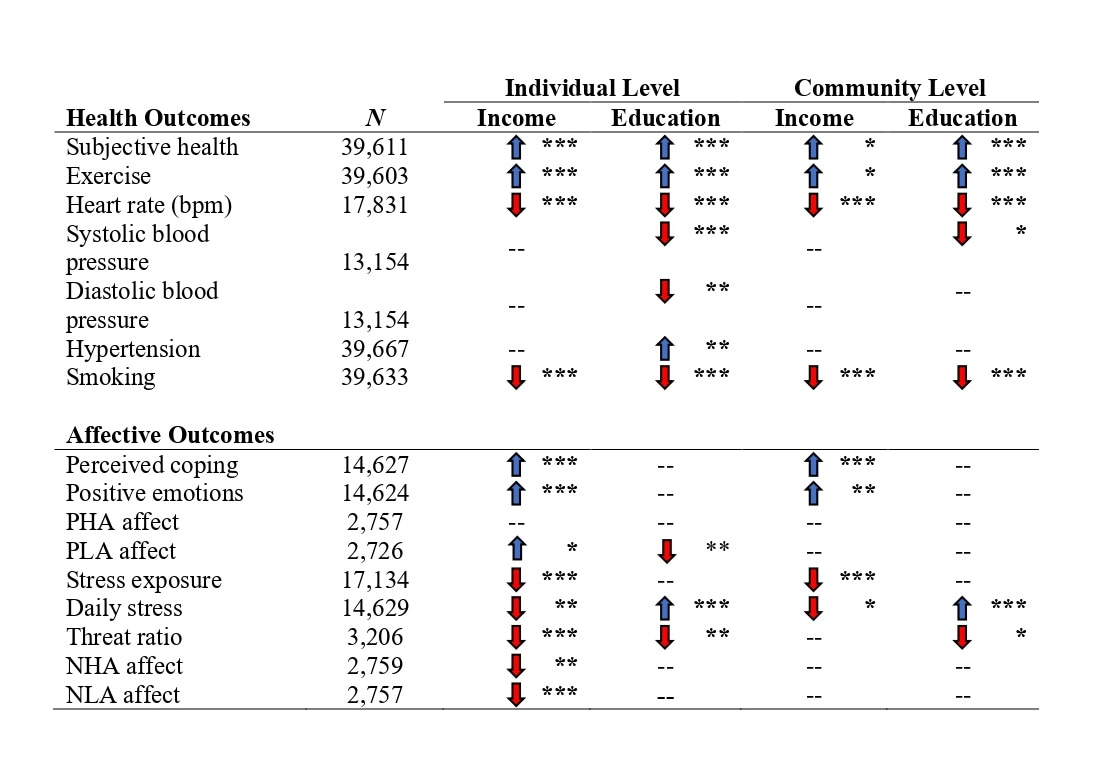
We directly compared income and education in the same model to isolate their unique effects, since income and education tend to be positively correlated. The results were quite striking. Higher levels of income consistently predicted better emotional outcomes in daily life, whereas higher education was a stronger predictor of better health. For instance, income was associated with higher levels of positive emotions like happiness and contentment, but education was not significantly associated with positive emotions. In fact, education predicted higher levels of daily stress, whereas income predicted lower levels of daily stress. In contrast, education predicted lower levels of blood pressure, whereas income was not associated with blood pressure. These findings suggest that income and education, though correlated, predict health and well-being outcomes in daily life in some interesting and distinct ways.
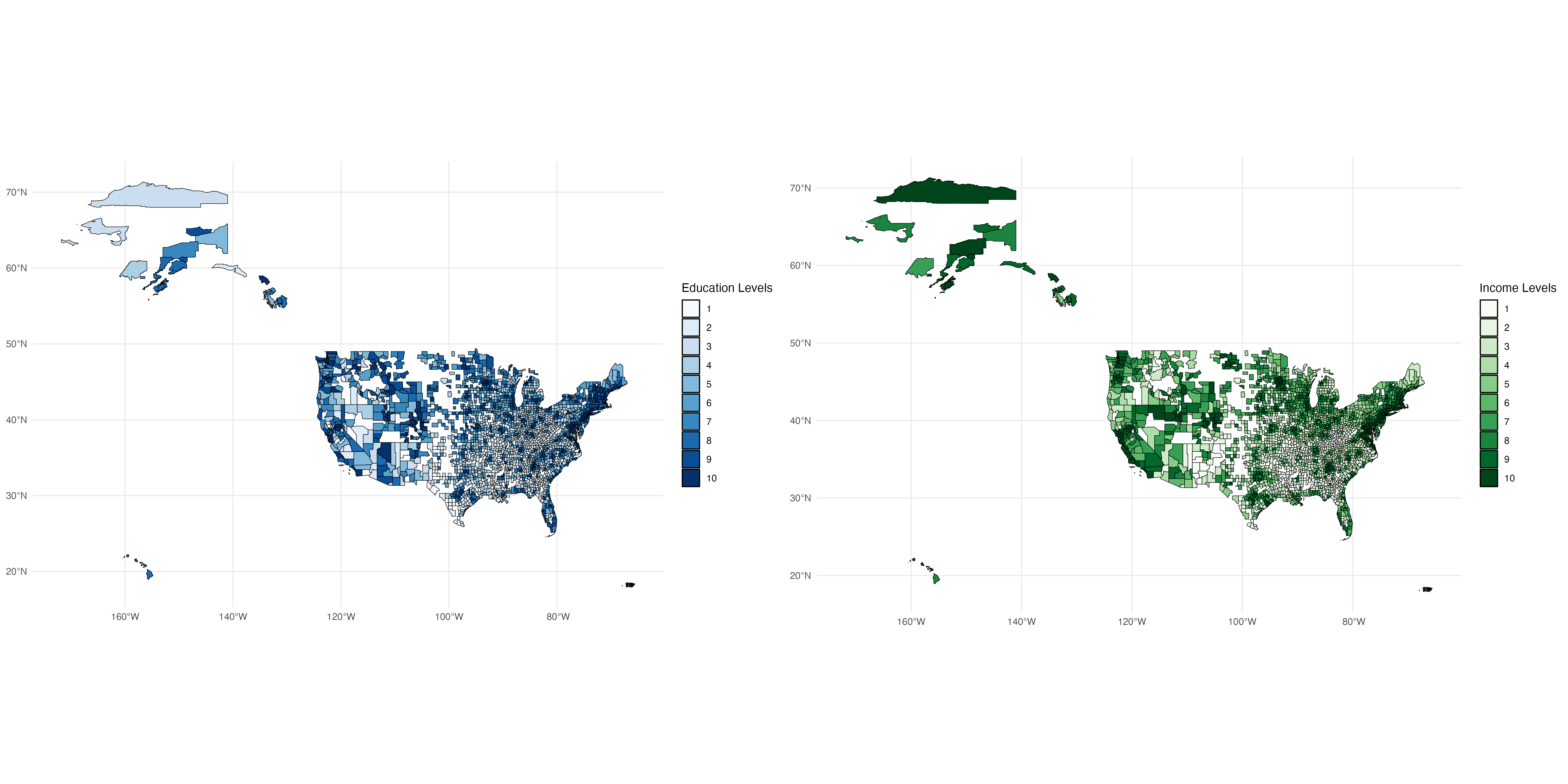
In addition to these findings at the individual level, we were able to examine how community levels of income and education related to people’s health and well-being in daily life. Just over 40,000 participants in the United States provided their ZIP Codes, which allowed us to link their data with median levels of income and education from the US census. The results at the community level were generally quite similar to those at the individual level: Living in a wealthy area predicted higher levels of emotional well-being, whereas living in areas surrounded by more educated people predicted better daily health.
Finally, we were able to compare individual and community levels of income and education in the same models. We found that though income and education were important predictors of health and education at both levels of analysis, individual levels of income and education mattered more than community levels of income and education. That is, people seem more affected by their own socioeconomic status than the status of those around them.
This study points to some interesting avenues for future research, particularly in untangling the psychological mechanisms that might underly these associations. For instance, we speculate that wealthy individuals may not experience daily stress as much as less wealthy individuals because they have the resources to handle or avoid stressful situations. In contrast, though education may provide individuals with tools to manage stressful situations, highly educated people may hold jobs or positions that involve persistent and high levels of stress. Additionally, they might be more likely to engage with news and global issues rather than unwind or disconnect.
One implication from this research is that researchers may want to examine income and education separately in future studies. Although income and education are positively related and are often treated as part of the same construct of socioeconomic status, these findings demonstrate that, when compared directly to each other, income and education can have diverging effects on various outcomes. There may be diverging patterns in other domains of life as well.
To summarize, though income and education play significant roles in shaping health and well-being, they appear to do so to differing degrees. Income is more closely linked to positive daily emotional states, while education tends to have a stronger connection to physical health.

David Newman is currently an Assistant Professor in the Department of Psychology at Loma Linda University where he also serves as the statistics consultant for students and faculty in the School of Behavioral Health. He received a B.A. in psychology at the University of Virginia, an M.A. in experimental psychology at the College of William and Mary, and a Ph.D. in social psychology at the University of Southern California. He studies the dynamic processes of well-being in daily life with a particular emphasis on daily diary and Ecological Momentary Assessment methods.
Follow the Topic
-
Nature Human Behaviour

Drawing from a broad spectrum of social, biological, health, and physical science disciplines, this journal publishes research of outstanding significance into any aspect of individual or collective human behaviour.
Ask the Editor – Collective decision-making
Got a question for the editor about Experimental Psychology and Social Psychology? Ask it here!
Continue reading announcementRelated Collections
With Collections, you can get published faster and increase your visibility.
Digital Media and Mental Health
Publishing Model: Hybrid
Deadline: Oct 30, 2026
Basic Psychological Needs and Well-Being
Publishing Model: Hybrid
Deadline: Nov 27, 2026




Please sign in or register for FREE
If you are a registered user on Research Communities by Springer Nature, please sign in