JNK–UBR5 signaling controls CDC73 stability and osteosarcoma progression
Published in Chemistry and Biomedical Research

JNK–UBR5 signaling controls CDC73 stability and osteosarcoma progression
Shile Huang1,2,3,4
- Department of Biochemistry and Molecular Biology, Louisiana State University Health Sciences Center, Shreveport, LA 71103, USA.
- Department of Hematology and Oncology, Louisiana State University Health Sciences Center, Shreveport, LA 71103, USA.
- Feist-Weiller Cancer Center, Louisiana State University Health Sciences Center, Shreveport, LA 71103, USA.
- Email: shile.huang@lsuhs.edu.
Osteosarcoma is the most common primary malignant bone tumor in children and adolescents and is characterized by aggressive local growth and a high propensity for pulmonary metastasis. Despite advances in multimodal therapy, metastatic disease remains associated with poor outcomes, emphasizing the need to identify mechanisms driving tumor progression and metastasis [1,2].
CDC73 (parafibromin) is a tumor suppressor and component of the PAF1 transcriptional complex. Alterations in CDC73 are associated with human malignancies, and CDC73 activity can also be regulated post-translationally. Notably, UBR5, an E3 ubiquitin ligase, interacts with CDC73 and promotes its degradation, contributing to breast cancer progression [3,4]. Whether upstream signaling pathways regulate the UBR5–CDC73 axis in osteosarcoma has remained unclear.
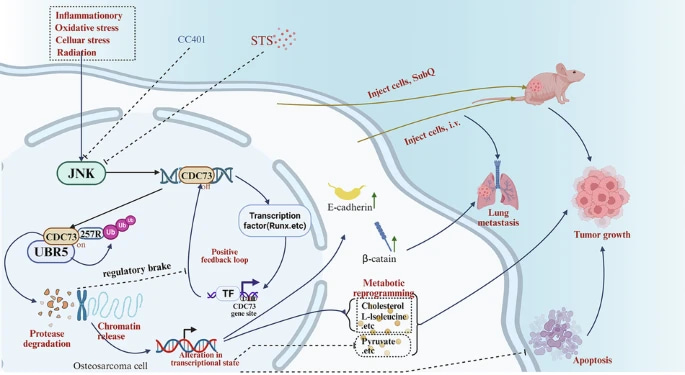
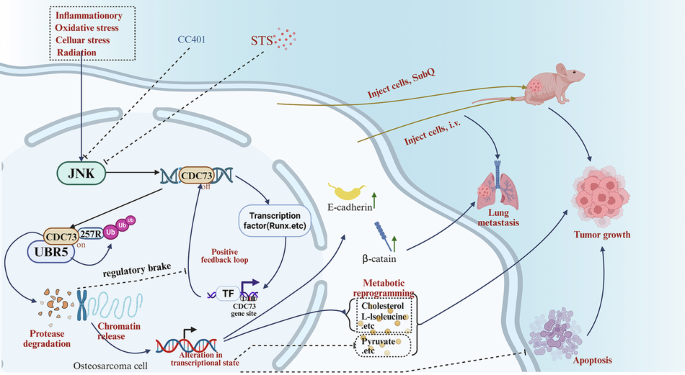
In a recent study, Li et al. [5] investigated UBR5-mediated CDC73 regulation using public datasets, metabolomics, ATAC-seq, CUT&Tag, transcriptomics, biochemical approaches, and multiple in vivo models. Their findings support a model in which JNK signaling restrains UBR5-dependent CDC73 ubiquitination and degradation, thereby affecting CDC73-associated transcriptional programs and osteosarcoma progression.
UBR5 depletion markedly suppressed osteosarcoma cell proliferation, migration, invasion, and metastatic potential. Importantly, CDC73 depletion substantially reversed these effects, identifying CDC73 as a major downstream mediator of UBR5. Consistently, UBR5 ablation inhibited tumor growth and metastasis in xenograft and orthotopic models, whereas simultaneous CDC73 depletion partially rescued these phenotypes [5]. These genetic epistasis experiments establish a functional UBR5–CDC73 relationship in osteosarcoma.
Multi-omics analyses provided additional insight into the transcriptional consequences of UBR5 loss. ATAC-seq revealed widespread changes in chromatin accessibility, while CUT&Tag demonstrated increased CDC73 occupancy near transcription start sites and promoters. Differential CDC73 binding was associated with pathways including Wnt–β-catenin and PI3K–Akt–mTOR signaling. Integration of these datasets identified potential reciprocal regulatory relationships involving transcription factors such as RUNX1, RUNX2, KLF6, and EBF2 in LM8 cells and Elk1, Elk3, and ATF3 in 143B cells. These observations suggest that CDC73 stabilization may contribute to a broader transcriptional regulatory network following UBR5 depletion.
Mechanistically, re-expression of catalytically inactive UBR5 C2768A failed to reduce CDC73 abundance, demonstrating that UBR5 catalytic activity is required for CDC73 regulation. Cycloheximide-chase experiments further showed that UBR5 depletion prolonged CDC73 half-life. The study also identified Lys257 as an important residue associated with UBR5-dependent CDC73 ubiquitination; mutation of this residue reduced ubiquitination and increased CDC73 stability [5]. These findings extend previous evidence that UBR5 regulates CDC73 turnover in cancer [4].
A particularly important finding was the identification of JNK as an upstream regulator of this pathway. Pharmacological inhibition or siRNA-mediated depletion of JNK reduced CDC73 protein abundance, increased CDC73 ubiquitination, and enhanced the UBR5–CDC73 interaction. Conversely, JNK activation increased CDC73 stability. Thus, JNK appears to function as a molecular brake on UBR5-mediated CDC73 degradation, linking stress-responsive kinase signaling to ubiquitin-dependent protein homeostasis and transcriptional regulation.
Several questions remain unresolved. First, the molecular mechanism by which JNK regulates UBR5–CDC73 interaction is unclear. JNK may directly phosphorylate UBR5 or CDC73 or regulate another factor controlling UBR5 substrate recognition. Because ERK2 has also been reported to regulate UBR5-dependent CDC73 degradation in breast cancer [4], different MAPK pathways may regulate CDC73 stability in a context-dependent manner.
Second, although ATAC-seq and CUT&Tag support a CDC73-centered transcriptional network, direct evidence for the proposed reciprocal feedback loop remains limited. Functional manipulation of the identified transcription factors and validation of their reciprocal regulation will be important. In addition, the mechanism of CDC73 turnover warrants further investigation because proteasome inhibitors did not substantially increase CDC73 abundance [5], suggesting that ubiquitination may regulate CDC73 through mechanisms beyond conventional proteasomal degradation.
Finally, whether the JNK–UBR5–CDC73 axis is osteosarcoma-specific or operates more broadly across cancers remains unknown. Given the context-dependent tumor-promoting and tumor-suppressive functions of JNK, therapeutic targeting of this pathway will require careful consideration [6,7].
In summary, Li et al. [5] identify JNK as an upstream regulator of UBR5-mediated CDC73 stability and provide evidence that this pathway influences osteosarcoma progression. The proposed JNK–UBR5–CDC73 axis connects kinase signaling, ubiquitin-dependent protein regulation, and transcriptional reprogramming. Defining the molecular link between JNK and UBR5, validating the CDC73-centered regulatory network, and determining its relevance across cancer types may reveal new therapeutic opportunities.
REFERENCES
- Du, X., Wei, H., Zhang, B. et al. Molecular mechanisms of osteosarcoma metastasis and possible treatment opportunities. Front. Oncol. 13, 1117867 (2023).
- Sheng, G., Gao, Y., Yang, Y. & Wu, H. Osteosarcoma and metastasis. Front. Oncol. 11, 780264 (2021).
- Carpten, J. D. et al. HRPT2, encoding parafibromin, is mutated in hyperparathyroidism-jaw tumor syndrome. Nat. Genet. 32, 676–680 (2002).
- Zhang, X. et al. UBR5 targets tumor suppressor CDC73 proteolytically to promote aggressive breast cancer. Cell Death Dis. 13, 446 (2022).
- Li, D. et al. JNK acts as a molecular brake of the CDC73 positive feedback loop to modulate osteosarcoma malignant progression via UBR5. Oncogene. 45, xxx (2026).
- Li, Y. S., Deng, Z. H., Zeng, C. & Lei, G. H. JNK pathway in osteosarcoma: pathogenesis and therapeutics. J. Recept. Signal Transduct. Res. 36, 465–470 (2016).
- Kansara, M., Teng, M. W., Smyth, M. J. & Thomas, D. M. Translational biology of osteosarcoma. Nat. Rev. Cancer 14, 722–735 (2014).

Follow the Topic
-
Oncogene
This journal aims to make substantial advances in our knowledge of processes that contribute to cancer by publishing outstanding research.