Leveraging body dielectric polarization for ambient electromagnetic energy recovery via e-textile
Published in Materials

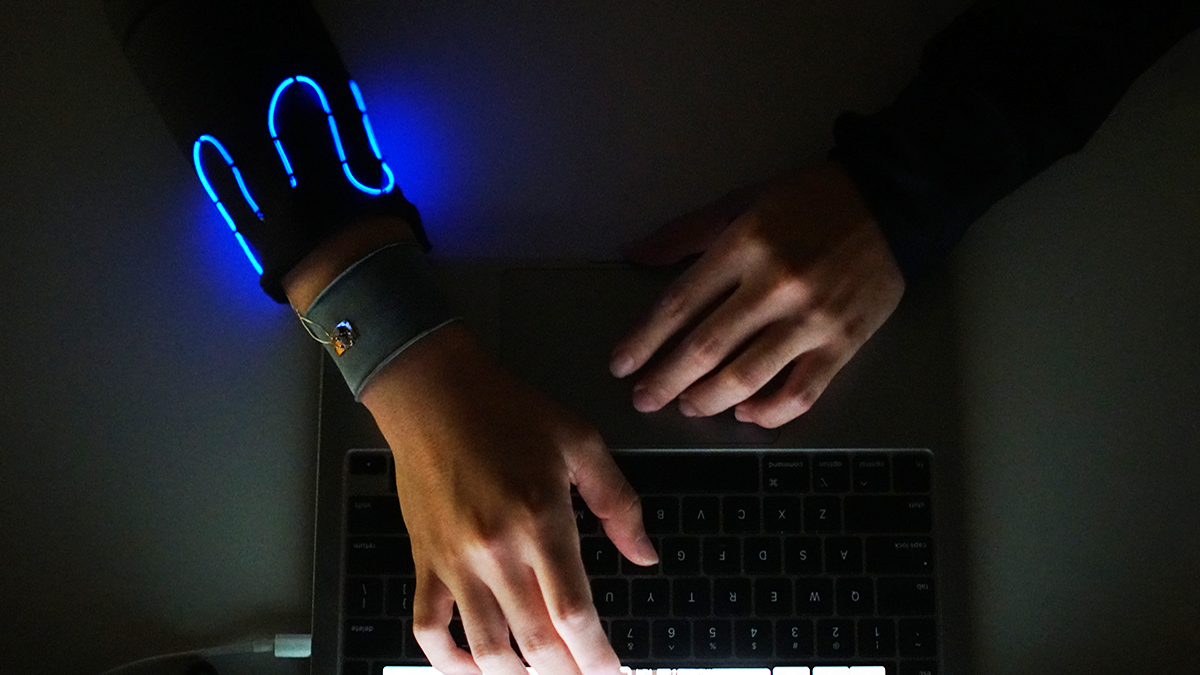




Wearable devices are steadily weaving themselves into the fabric of our daily lives, from monitoring vital health signals in clinical settings to tracking performance metrics for athletes, and even extending into lifestyle applications such as sleep quality or stress management. These miniature systems promise a future where our health and behaviors can be constantly observed, interpreted, and optimized, giving us unprecedented access to data previously confined to medical check-ups or laboratory measurements.
However, the progress of this vision is limited by a central challenge: powering such compact and mobile devices reliably. Conventional batteries are bulky, finite, and unsuited to the seamless integration demanded by wearable technologies. Yet, in the modern environment, we are surrounded by abundant ambient energy emanating from power lines, household electronics, and countless stationary devices. Our work focuses on capturing this overlooked, ever-present energy and channeling it into wearables, moving a step closer to truly autonomous systems that merge effortlessly with everyday life.
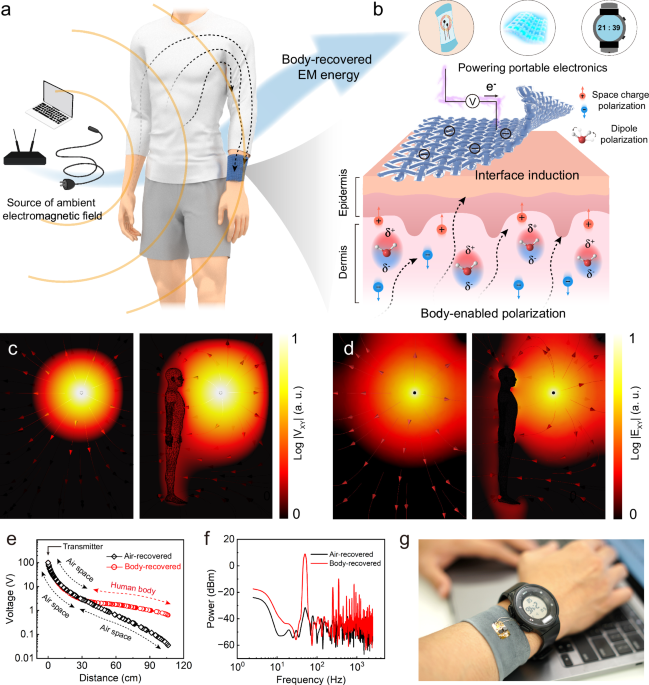
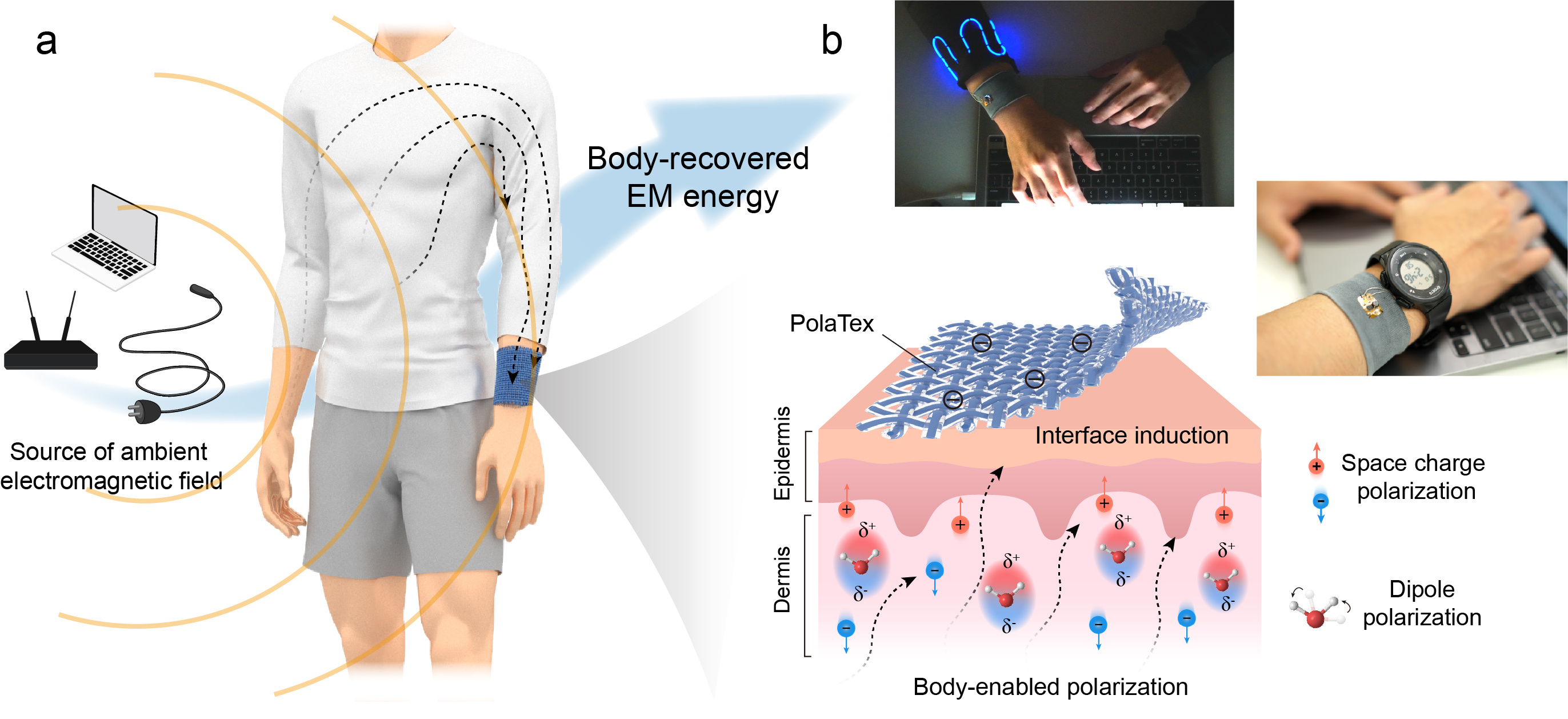
In order to collect this energy in an unobtrusive way, we have developed a smart textile solution to power the user-worn device with the ambient energy. This conductive fabric is designed to directly interface with the human body, transforming it into a functional part of the energy-harvesting system. Much like an antenna, the body becomes a large surface capable of capturing the electromagnetic energy that constantly surrounds us in modern environments.
Leveraging body dielectric polarization for ambient electromagnetic energy recovery via e-textile
By channeling this ambient energy through the e-textile, we can feed it directly into wearable devices at the place where it is needed: at the arm for bracelets, at the chest for medical sensors, and so on. This approach not only supports the creation of more autonomous wearables but also reimagines the role of clothing: shifting from a passive material to an active participant in powering the technologies we live with every day. The major findings of our work are summarized in the following:
- Harnessing the human body as an EM energy carrier to capture ambient EM energy. Through body dielectric polarization effect, dissipated EM energy is continuously collected and transmitted via textile electrodes on the skin. As a result, electrical energy can be extracted from any point on the body surface, effectively solving the challenge of multi-node power supply in distributed, flexible electronic networks.
- A new body polarization mechanism based on body Gaussian surface. Our technology utilizes the human body as a Gaussian surface, where ions and water molecules will be polarized under external EM field, enabling efficient conversion of EM waves into polarization energy.
- Enable seamless integration with flexible electronic systems such as electronic textile/skin. By directly connecting electronic devices to the human body, energy flows continuously from the skin without additional circuitry or rigid components, enabling seamless integration with electronic textiles and wearable systems.
For more details, please read our recent publication:
Nat Commun 16, 9001 (2025). https://doi.org/10.1038/s41467-025-64053-2.
Follow the Topic
-
Nature Communications
An open access, multidisciplinary journal dedicated to publishing high-quality research in all areas of the biological, health, physical, chemical and Earth sciences.

Related Collections
With Collections, you can get published faster and increase your visibility.
Women's Health
Publishing Model: Hybrid
Deadline: Ongoing
Tumor Microenvironment Crosstalk and Therapeutic Implications
Publishing Model: Hybrid
Deadline: Nov 02, 2026