Listening to Labquakes with Machine Learning
Published in Earth & Environment, Physics, and Computational Sciences


Labquakes and Acoustic Emissions
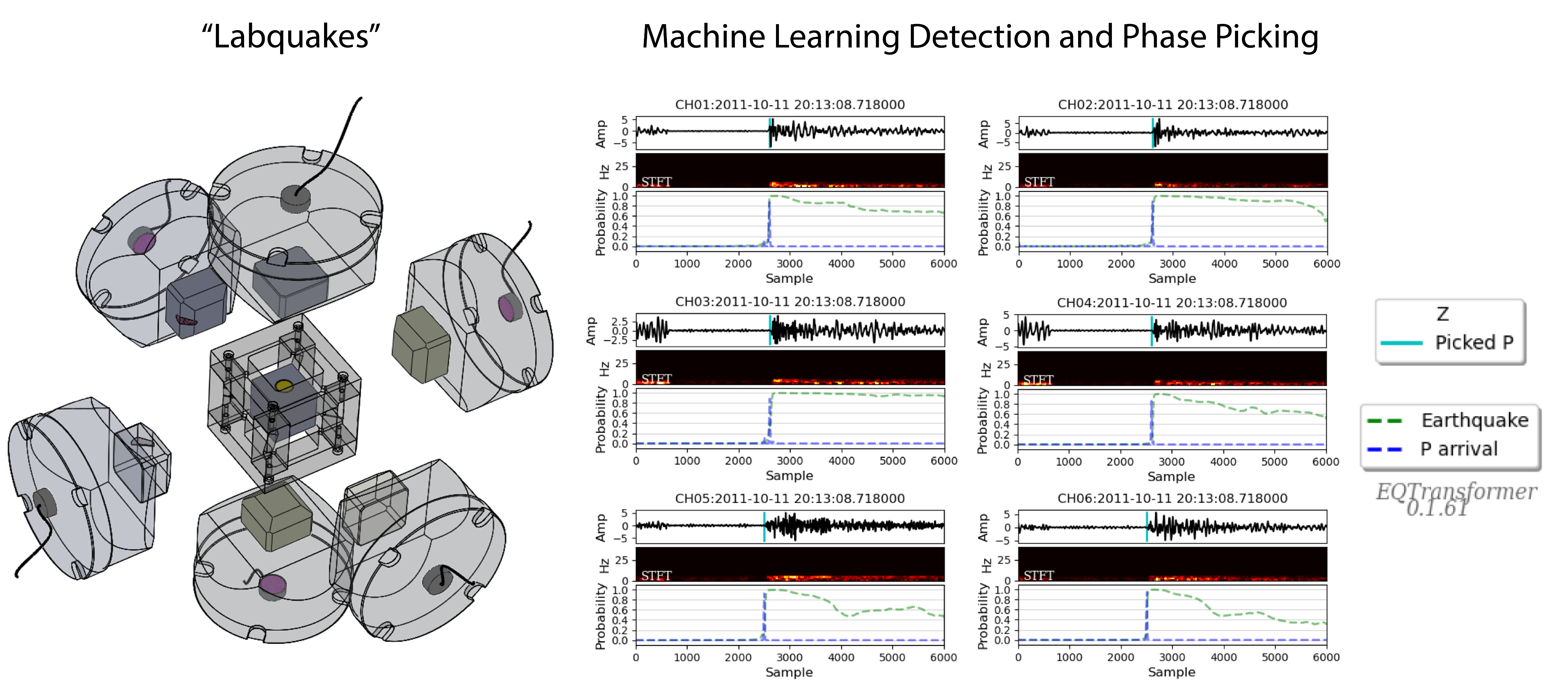
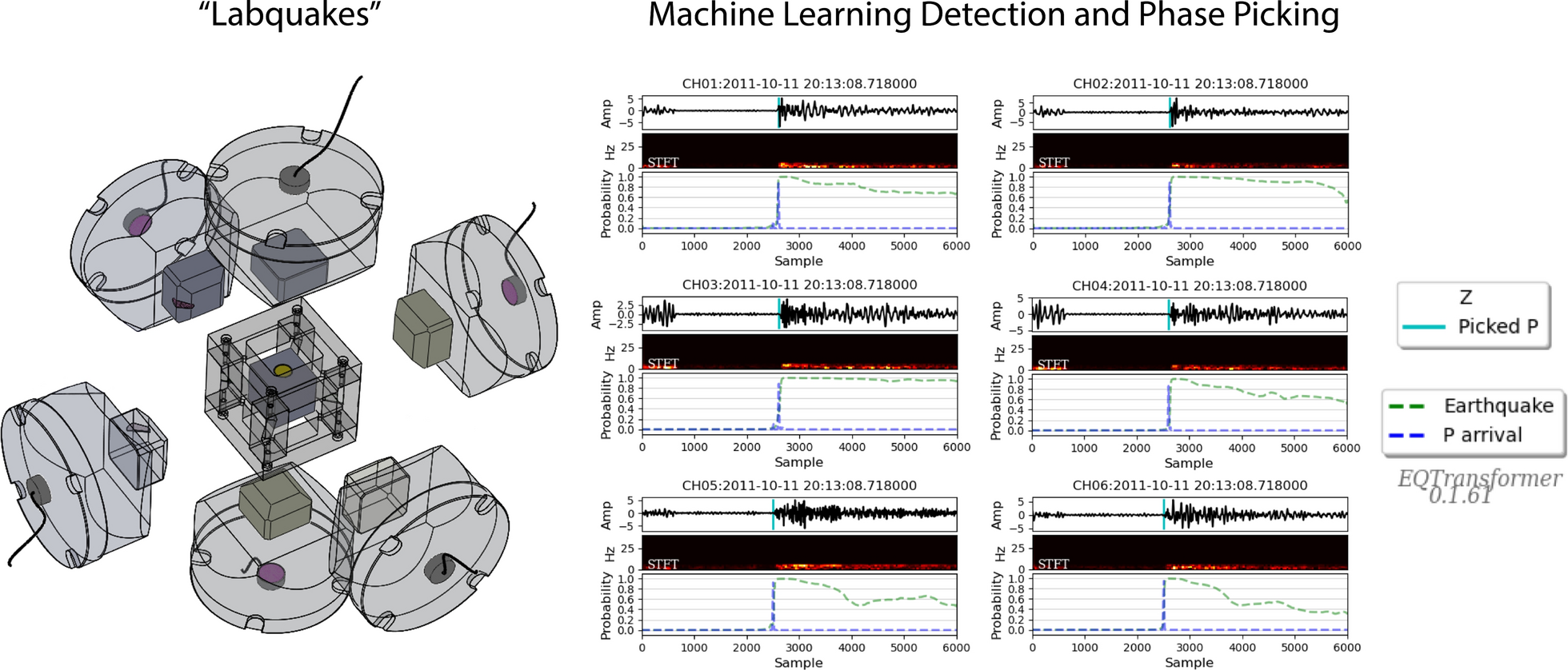
Every time a rock cracks, it lets out a tiny, high-frequency pop known as an acoustic emission (AE). These sounds of rock deformation are small-scale versions of the seismic waves produced during earthquakes, making them incredibly useful for studying how and why rocks break and earthquakes occur.
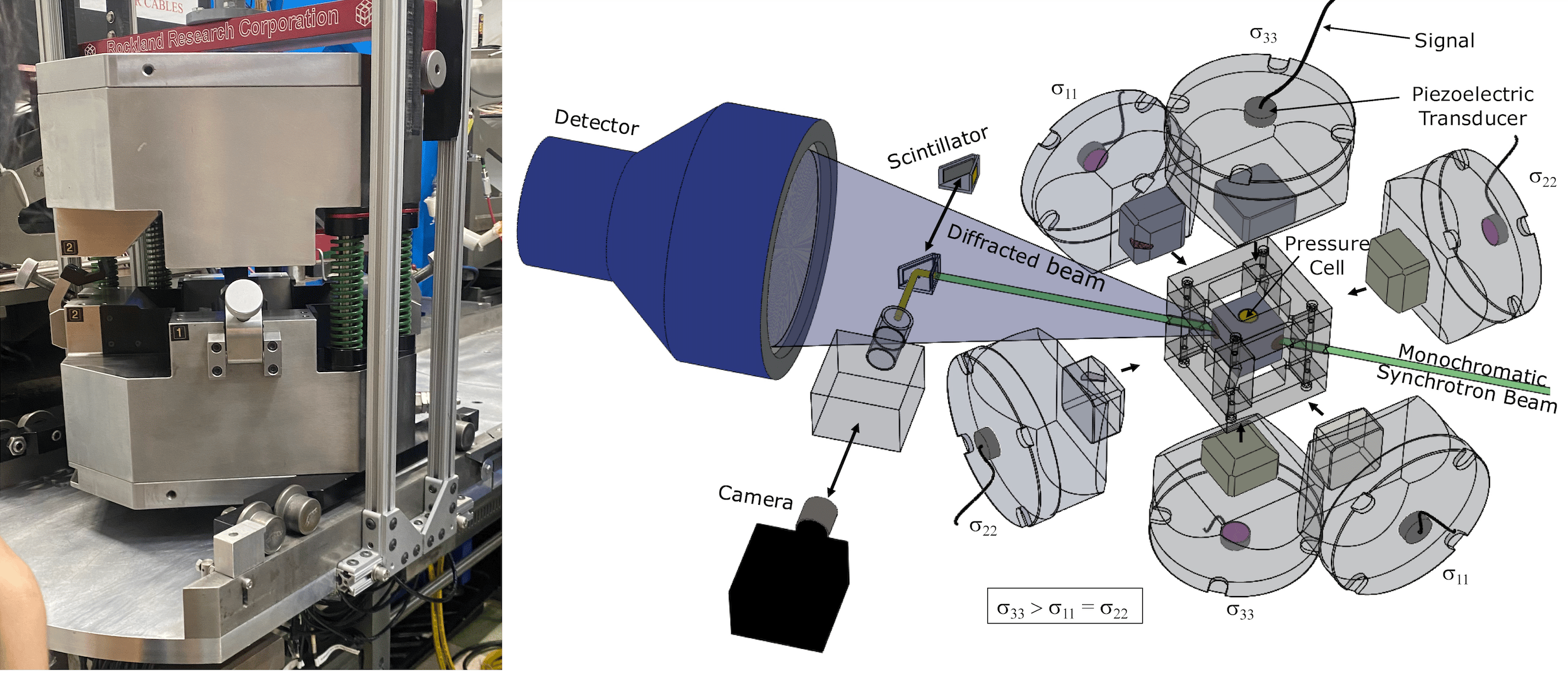
But here's the catch: laboratory rock deformation experiments can generate thousands of AE signals, and scientists have traditionally had to sort through the data manually. That means combing through days worth of waveforms to identify when and where each mini “earthquake” occurred. That's where machine learning and this study come in.
Machine Learning and EQTransformer
In recent years, machine learning has transformed seismology. One popular deep learning model called EQTransformer has proven particularly effective. It automatically detects earthquakes and identifies the exact moment a seismic event originates. Models like this work by training on already identified earthquakes, called labeled data. But could a model trained on labeled earthquakes be used to study labquakes?
Without any retraining, we applied EQTransformer to two laboratory datasets created during high-pressure experiments that mimic the extreme conditions where earthquakes occur. Our goal was to see if this off-the-shelf AI could detect AEs just as well as it detects typical earthquakes.
Man vs Machine vs Machine
We worked with two datasets, containing in total ~4,500 identified AE events. Because AE signals and traditional earthquakes happen on very different scales, their data can look a little different. We converted the AE data into a format that EQTransformer could understand, adjusting the timing, units, and metadata to make them look like regular earthquake data. Then we ran EQTransformer on both datasets and waited.

The results were impressive, and almost immediate. On both datasets, EQTransformer detected all of the previously identified events. In addition, it discovered many more that had gone undetected—65% more! In just a fraction of the time, the model detected all of the events that the analysts had, and revealed that the analysts had barely found half the total signals. Even more impressive was the accuracy. EQTransformer's precise picks of when each event originated were almost always within a microsecond of the carefully selected analyst's.
When compared to EQTransformer's performance on typical earthquake signals, the results were indistinguishable. We also compared the results to an AI model built specifically for analyzing AEs, called MultiNet. Once again, the results were remarkably similar. While MultiNet did perform slightly better—finding more new events and being less prone to random variation—both AI models were considerably more alike than the analysts' selections.
Why It Matters
This work isn’t just about detecting AEs in labquakes. Our goal is to make earthquake science more scalable, efficient, and accessible. The fact that EQTransformer performed so well without ever being trained on lab data suggests that it could be a powerful tool for scientists who don't have the time or resources to develop custom models, or are just looking for a quick initial analysis. It also highlights the connection between AEs and full-scale earthquakes. As experiments continue to improve and high-resolution laboratory data become more common, AI tools like EQTransformer may be the tool that bridges the gap between experimental and field seismology.
To learn more about how and why we did what we did, please check out our paper linked at the top of this article!
Follow the Topic
-
Earth, Planets and Space
An international, peer-reviewed and open access e-journal publishing high-quality scientific articles in the Earth and Planetary Sciences, particularly geomagnetism, aeronomy, space science, seismology, volcanology, geodesy, and planetary science.