March Highlights from Mathematics, Physical and Applied Sciences Communities
Published in Chemistry, Earth & Environment, and Statistics






From water safety and climate resilience to biodiversity and sustainable technologies, March has brought together a diverse range of research across the Mathematics, Physical and Applied Sciences Communities. This month’s highlights explore how science is responding to some of today’s most pressing global challenges, from understanding the hidden impacts of environmental change to developing smarter, data-driven solutions for the future.
World Water Day
On World Water Day 2026, attention turns to the unequal burden of the global water crisis. While access to safe water and sanitation remains a universal challenge, women and girls are disproportionately affected - often responsible for collecting water, managing household needs, and caring for those impacted by unsafe supplies. These responsibilities come at the cost of time, health, education, and economic opportunity.
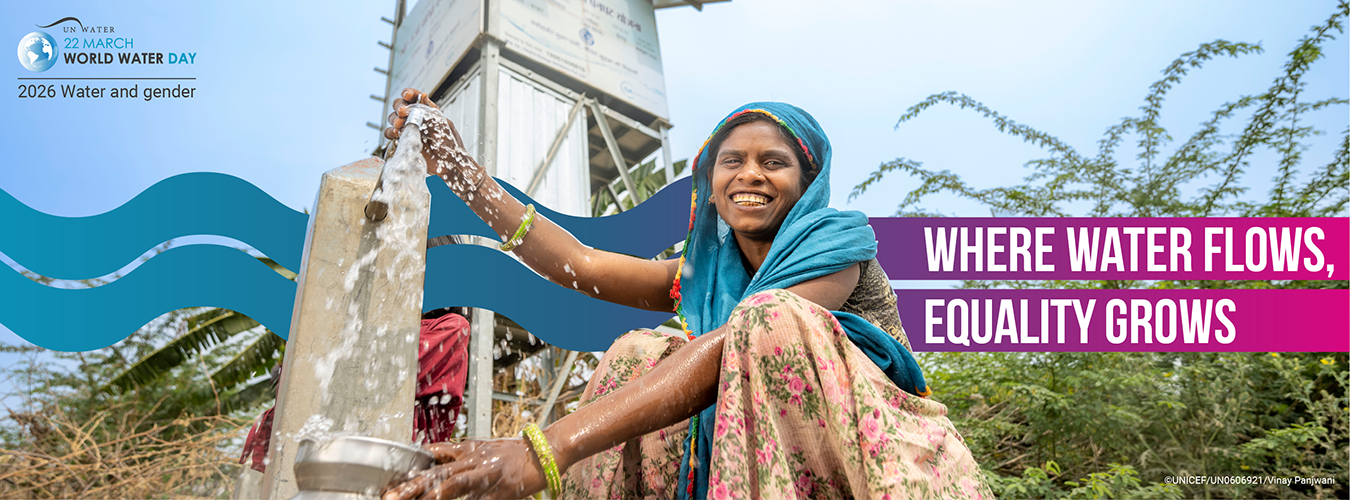
Photo:UNICEF/Vinay Panjwani
Experts are calling for a more inclusive, rights-based approach to water governance, one that places women at the centre of decision-making and leadership. As climate change and resource pressures intensify, ensuring equitable access to water is increasingly seen not only as a development priority, but as a critical step towards advancing gender equality worldwide.
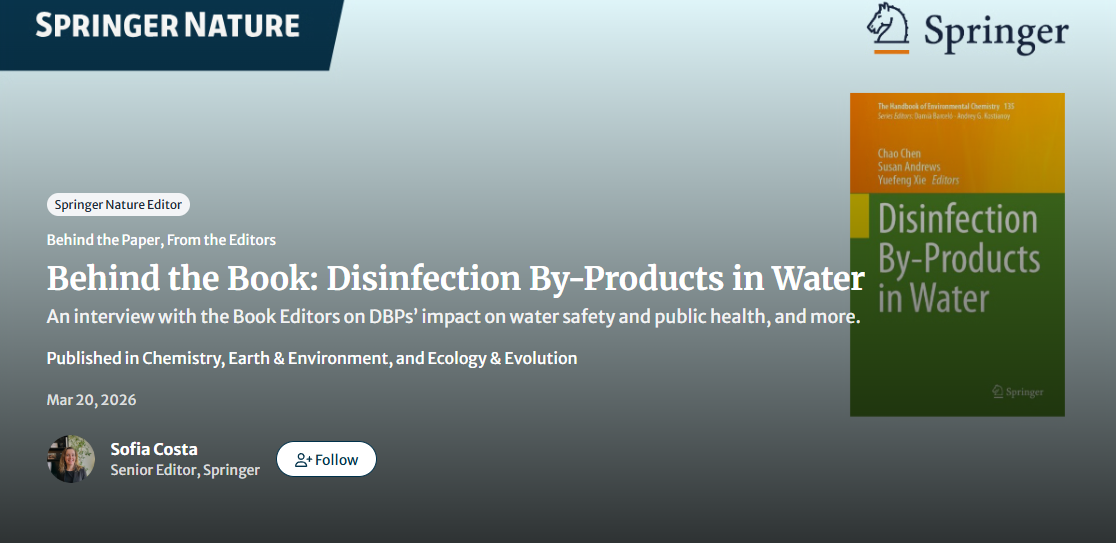
What do disinfection by-products mean for the safety of our everyday water?
For the occasion of World Water Day, @Sofia Costa revisits Disinfection By-Products in Water, a book published by Springer Nature at the end of 2024, marking 50 years since Dr. Rook’s discovery of trihalomethanes in chlorinated tap water. Edited by Chao Chen, Susan Andrews, and Yuefeng Xie, the book brings together global expertise to explore how disinfection by-products (DBPs) form, their implications for water safety and public health, and the latest scientific and regulatory developments in the field.
In this Behind the Book interview, the editors reflect on the evolution of DBP research, the balance between microbial safety and chemical risks, and the challenges that lie ahead - from climate change impacts to emerging analytical techniques and AI-driven insights. Their perspectives highlight why understanding DBPs is essential for researchers, policymakers, and communities alike, as we continue working towards safer and more sustainable water systems. Read the full Behind the Book post to explore the interview in detail!
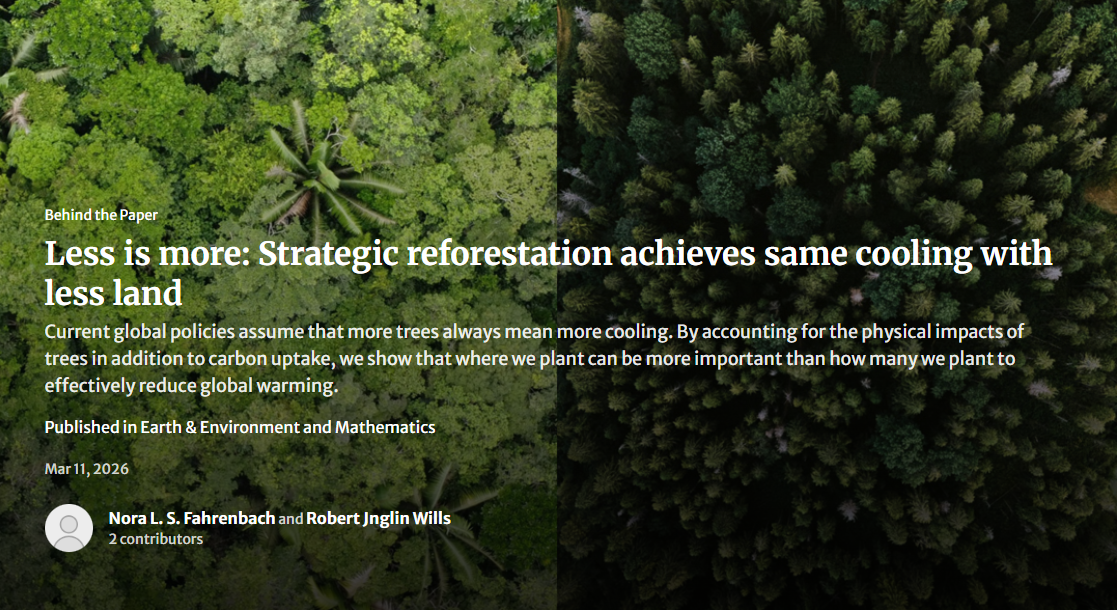
Planting smarter, not wider
Can planting fewer trees sometimes cool the planet just as effectively? @Nora L. S. Fahrenbach and @Robert Jnglin Wills take a closer look at one of climate policy’s most popular solutions: reforestation. While trees are widely seen as a natural way to absorb carbon, their study shows the story is more complex. Where forests are planted can shape how much they actually cool the Earth and, in some regions, planting trees can even offset expected benefits.
Using large-scale climate simulations, the researchers found that a more targeted reforestation strategy could achieve similar cooling with significantly less land. The key lies in understanding how forests influence not just carbon storage, but also sunlight reflection, water cycles, and atmospheric patterns. Their findings, published in Communications Earth & Environment, point towards a more thoughtful, “climate-smart” approach to reforestation - one that balances environmental impact with real-world effectiveness. Read the full Behind the Paper post here!
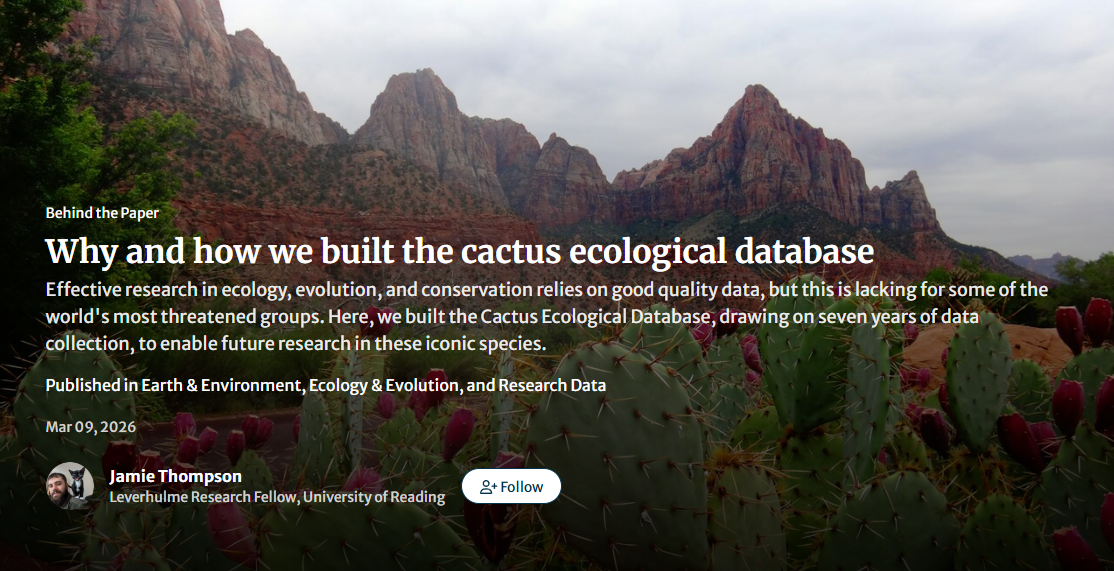
Bringing cactus data together
Why do we know so little about some of the world’s most iconic and most threatened plants? @Jamie Thompson shares the story behind building the Cactus Ecological Database. Despite global fascination with cacti, essential data about their traits, distribution, and evolution has long been scattered and difficult to use. After years of collecting, cleaning, and connecting information from hundreds of sources, this project brings it all into one open, accessible resource.
More than just a dataset, the database opens new possibilities for understanding how cacti evolve, adapt, and respond to climate change at a time when many species face increasing risk. The research, published in Scientific Data, also highlights the power of collaboration, combining expertise from across the world to create something the research community can continue to build on. Read the full Behind the Paper post to explore the story behind the database.
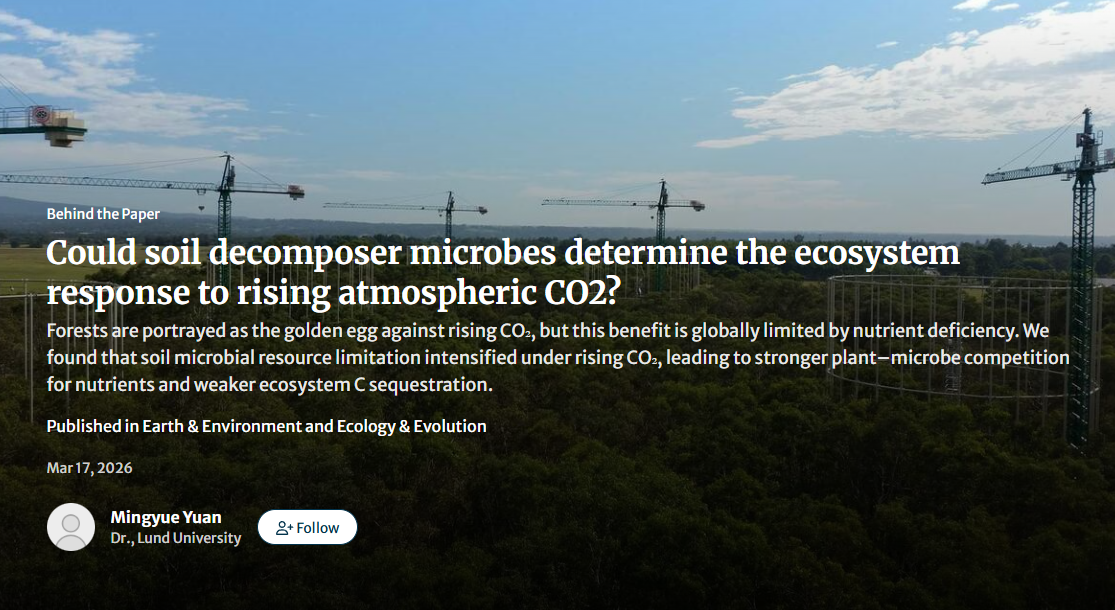
Are soil microbes quietly limiting how much carbon forests can store?
It’s tempting to see forests as a simple solution to combating rising CO₂ levels. But in this Behind the Paper post, @Mingyue Yuan unpacks a more nuanced reality beneath our feet. By studying soils from the EucFACE experiment in Australia, the research reveals that as CO₂ rises, microbes don’t just passively process extra carbon. They compete more intensely with plants for nutrients, reshaping how ecosystems function.
What’s particularly striking is the unexpected twist: even with more carbon entering the soil, microbes become more carbon-limited, alongside growing phosphorus constraints. This shift in microbial behaviour could weaken the ability of forests to act as long-term carbon sinks. The study published in Communications Earth & Environment brings a fresh perspective to climate science, reminding us that the smallest players in the ecosystem may have some of the biggest impacts. Read the full Behind the Paper post to explore the story behind the research.
Faster ways to design better catalysts
In this Behind the Paper post, @Santiago Morandi and @Oliver Loveday introduced a simpler way to understand a complex problem. Designing catalysts has traditionally taken years of trial and error, with scientists carefully testing and simulating one reaction at a time. Their new tool, CARE, uses machine learning to speed this up - automatically mapping how reactions happen and helping researchers see the bigger picture much faster. The research was published in Nature Chemical Engineering.
Instead of spending most of the time setting up simulations, scientists can now focus on what the results actually mean. This makes it easier to predict how a catalyst will perform before running experiments, saving time and resources. In the long run, tools like CARE could help develop cleaner and more efficient industrial processes much more quickly. Read the full Behind the Paper post to learn more.
These stories showcase the breadth of research and perspectives across our Communities and the important conversations happening beyond the published papers. If any of these topics resonate with you, we encourage you to explore the posts further and start a discussion in the comments.
Have a story to share? We’d love to hear from you whether through a Behind the Paper, Behind the Book, or your own research insights.
Further readings:
Passionate about connecting researchers and amplifying their voices through digital engagement. As Manager for the Research Communities by Springer Nature, I work with researchers to showcase their discoveries and experiences.
With a strong interest in public engagement and creative science communication, I’m dedicated to making research more accessible and inspiring wider conversations around scientific discovery and innovation.
Follow the Topic
-
Scientific Data
A peer-reviewed, open-access journal for descriptions of datasets, and research that advances the sharing and reuse of scientific data.
-
Nature Chemical Engineering
This is a new monthly online journal dedicated to publishing the most significant original research, commentary and analysis of direct relevance to the diverse community of chemical engineers.
-
Communications Earth & Environment
An open access journal from Nature Portfolio that publishes high-quality research, reviews and commentary in the Earth, environmental and planetary sciences.



Related Collections
With Collections, you can get published faster and increase your visibility.
10 years of the FAIR principles
Publishing Model: Open Access
Deadline: Nov 14, 2026
Data to support cancer treatment, diagnosis, and disease understanding
Publishing Model: Open Access
Deadline: Jan 02, 2027