Nanoemulsion-directed growth of MOFs with versatile architectures for the heterogeneous regeneration of coenzymes
Published in Materials

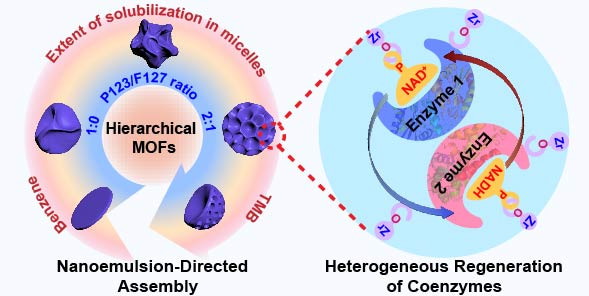




Metal-organic frameworks (MOFs) with hierarchical architectures have attracted great attention due to their alluring features that distinguish them from microporous counterparts. However, the rational morphological control of hierarchical MOFs (HMOFs) has remained a major challenge, because their traditional solvothermal synthesis conditions are usually incompatible with the conditions used for fabricating classical hierarchical materials such as soft template strategy.
Among the soft template strategy, nanoemulsion-guided growth is one of the most appealing methods for the synthesis of nanomaterials with versatile architectures. Generally, emulsions are dispersions made up of two immiscible liquids (such as water and oil) combined with surfactants which are responsible to reduce the surface tension. An oil in water (O/W) nanoemulsion system could not only provide the interface as the reaction space but also template the multiple architectures of the materials. Therefore, two critical issues need to be addressed when trying to use the nanoemulsion-directed method to tailor the structure of MOFs. First, the assembly process needs to be adapted to the change of synthetic solvent from pure organic phase such as dimethylformamide (DMF) to O/W system, and the other is to ensure the effective interaction between the MOFs precursor and emulsion interface.
Herein, in the presence of salting-in ion of ClO4-, the problems of aqueous-phase synthesis and MOF-emulsion interaction could be well resolved, and the continuous architecture transition of Zr-based HMOFs in an O/W nanoemulsion system was achieved.
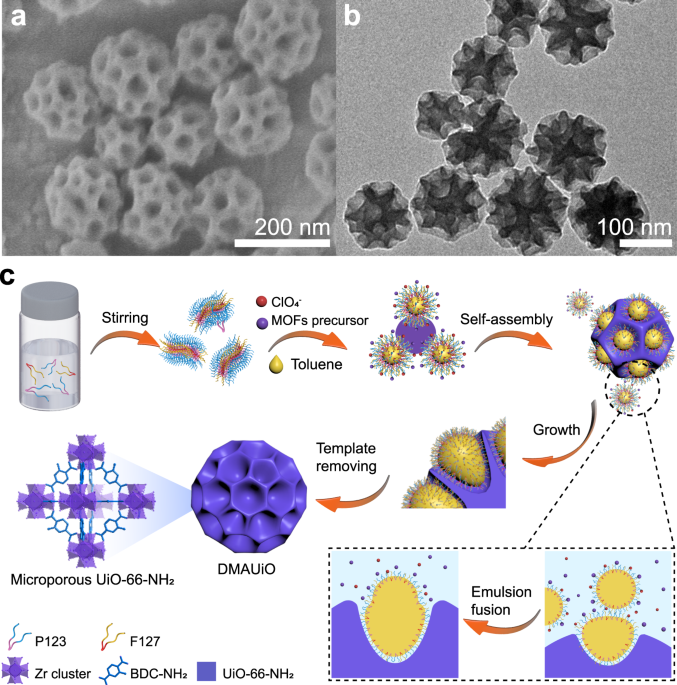
The nanoemulsion system consisted of two kinds of PEO-PPO-PEO copolymers (P123 and F127) and a family of hydrophobic aromatic compounds (Figure 1). Firstly, we chose toluene as the oil phase during the self-assembly process. The interaction between the MOFs precursor and PEO layer of emulsions would be strengthened with the assistance of ClO4-, ensuring the directed crystallization of MOFs along with the nanoemulsion interface. Therefore, the dendritic mesoporous Zr-based UiO-66 MOF (DMAUiO) was obtained.
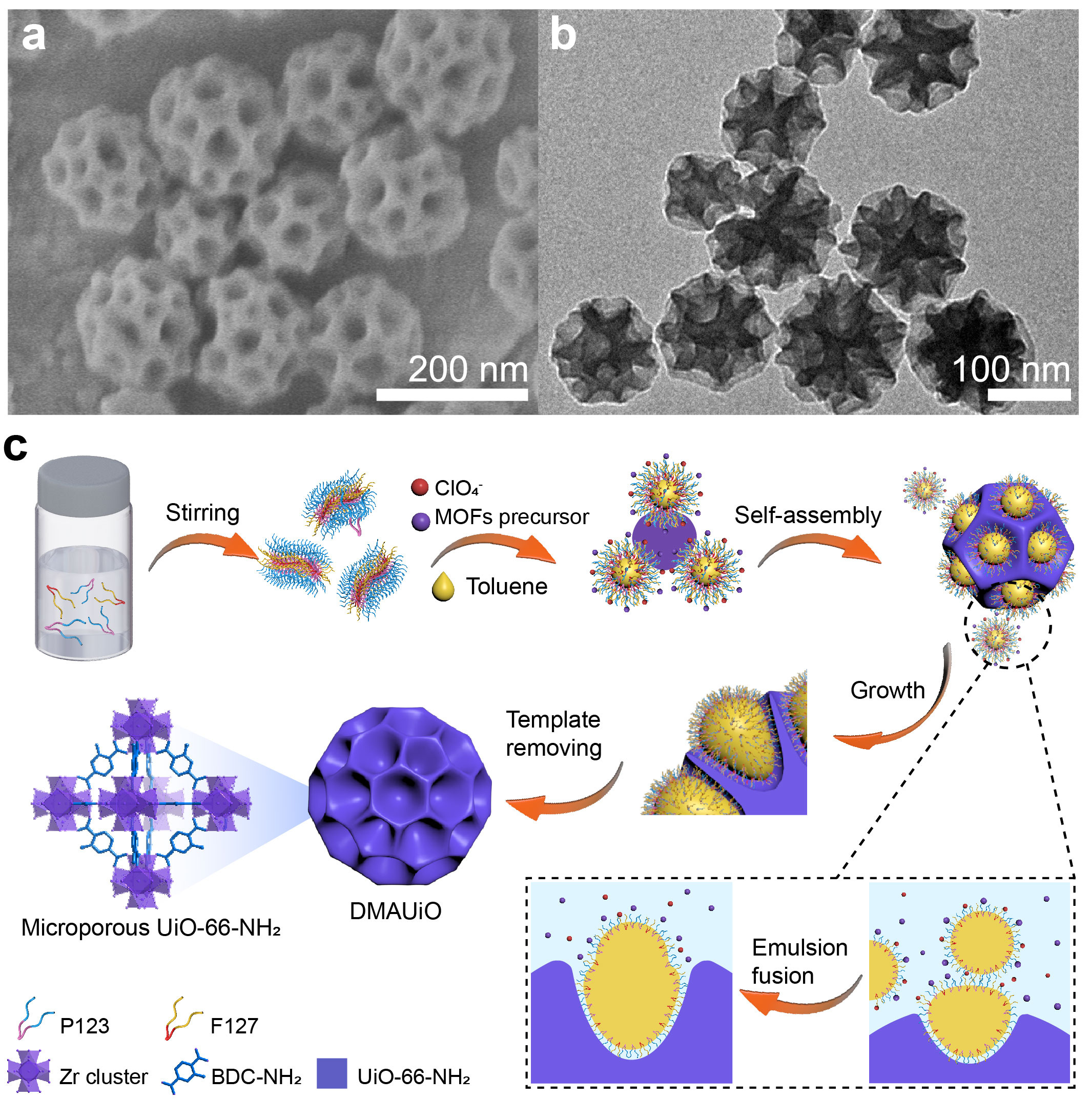
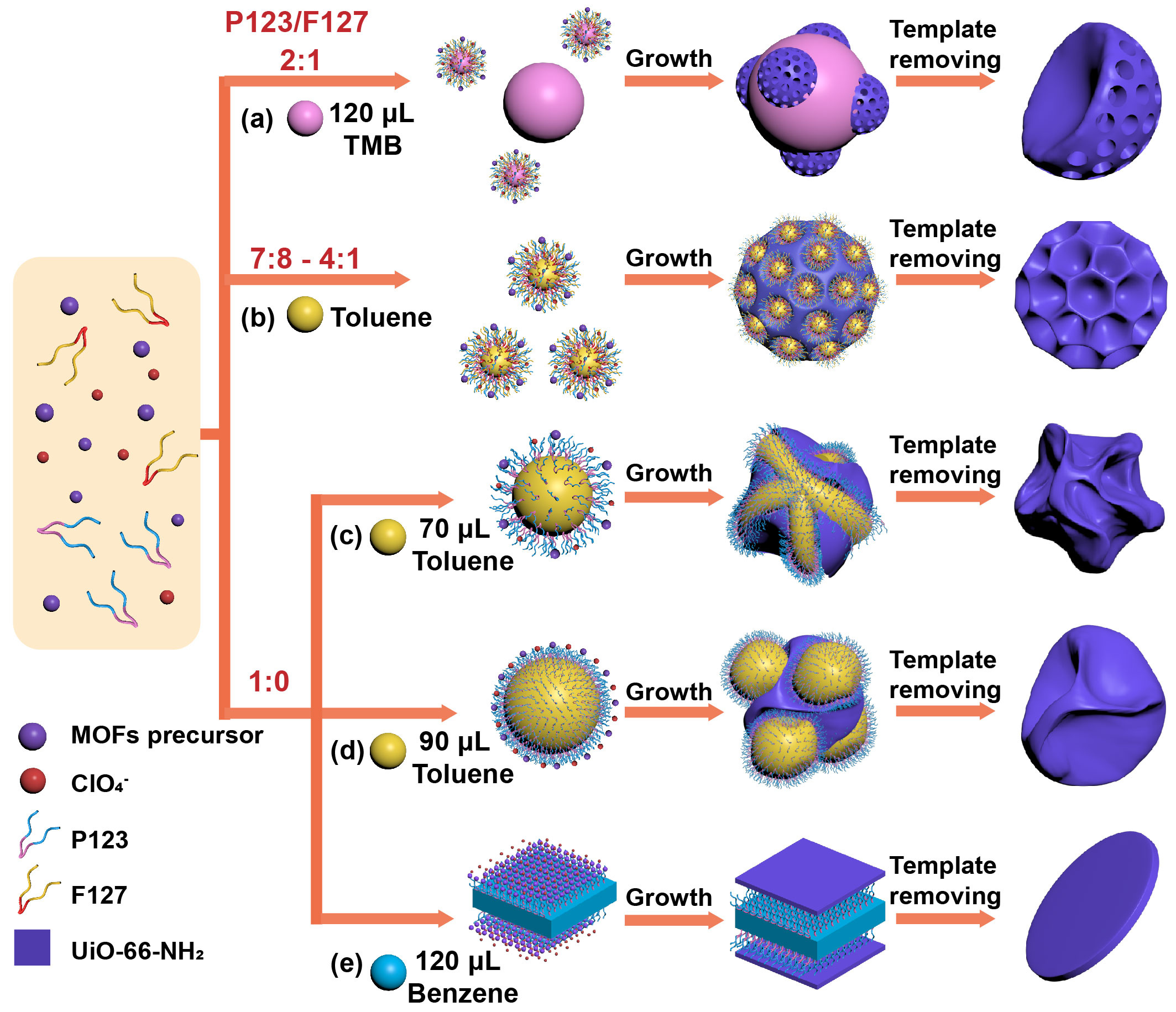
Then, since the extent of solubilization of aromatics such as benzene, toluene and 1,3,5-trimethylbenzene can be systematically varied in PEO-PPO-PEO copolymers micelles according to the different proportion of hydrophobic domains, we adjusted the ratio of P123/F127 and changed the introduced hydrophobic aromatic compounds to control the architectures of the resultant of MOFs. Therefore, monodispersed and nanoscale MOFs with various architectures were realized, such as bowl-like mesoporous particles, dendritic nanospheres, walnut-shaped particles, crumpled nanosheets and nanodisks (Figure 2).
Then, since the extent of solubilization of aromatics such as benzene, toluene and 1,3,5-trimethylbenzene can be systematically varied in PEO-PPO-PEO copolymers micelles according to the different proportion of hydrophobic domains, we adjusted the ratio of P123/F127 and changed the introduced hydrophobic aromatic compounds to control the architectures of the resultant of MOFs. Therefore, monodispersed and nanoscale MOFs with various architectures were realized, such as bowl-like mesoporous particles, dendritic nanospheres, walnut-shaped particles, crumpled nanosheets and nanodisks (Figure 2).
Among these Zr-based HMOFs, the dendritic mesoporous nanospheres with fully exposed active sites and ultra-large mesochannels take their unique advantages for the efficient in situ heterogeneous regeneration and recycling of expensive and consumable coenzymes such as NAD+/NADH. By forming Zr-O-P bonds, NAD+ could be stably suspended on the pore walls of dendritic mesoporous MOFs, and it could still be mobile locally thanks to the sufficient surrounding free space, ensuring its binding affinity to the active pocket sites of co-immobilized oxidoreductases and minimizing the mass transfer resistance, thereby realizing more efficient heterogeneous regeneration and recycle of NAD+ than that in a homogeneous system.
This strategy is expected to pave a new way for the controllable design and synthesis of HMOFs with novel architectures which can be competent for various practical applications with bulky molecules involved.
Follow the Topic
-
Nature Communications
An open access, multidisciplinary journal dedicated to publishing high-quality research in all areas of the biological, health, physical, chemical and Earth sciences.

Related Collections
With Collections, you can get published faster and increase your visibility.
Women's Health
Publishing Model: Hybrid
Deadline: Ongoing
Tumor Microenvironment Crosstalk and Therapeutic Implications
Publishing Model: Hybrid
Deadline: Nov 02, 2026