NephroQuiz: a fishy rash.
Published in General & Internal Medicine





A 51-year-old man presented for evaluation of a newly developed rash (xerosis with hyperpigmented scaly lesions on his arms, legs, abdomen, and back). Skin biopsy showed hyperkeratosis with non-necrotising granulomas. He had no medical history, did not report any nausea, vomiting, chest pain, dyspnea, or urinary symptoms. On examination his blood pressure was 125/75 mmHg, pulse rate was 85 beats per minute, and his oxygen saturation was 96%.
Laboratory investigations showed creatinine 6.27 mg/dL (normal range 0.67–1.17; a baseline measurement 2 months before he presented was 0.9), sodium 137 mmol/L (normal range 136–145), potassium 3.8 mmol/L (normal range 3.5–5.1), bicarbonate 22 mmol/L (normal range 22–29), calcium 15.1 mg/dL (normal range 8.6–10.2), albumin 4.3 g/dL (normal range 3.5–5.2), ionized calcium 1.91 mmol/L (normal range 1.17–1.38), parathyroid hormone (PTH) 9.1 pg/mL (normal range 18.4–80.1), PTH-related protein 3.4 pmol/L (normal range 0.0–2.3), 1,25-dihydroxyvitamin D 97.3 pg/mL (normal range 19.9–79.3), and angiotensin-converting enzyme 120 U/L (normal range 16–85).
Urinalysis was positive for proteinuria with a urine protein-to-creatinine ratio of 0.92. Further serology workup showed the following: negative hepatitis B virus, hepatitis C virus, and HIV serologies, normal C3 and C4, undetectable antinuclear antibodies (ANAs), anti-double stranded DNA antibodies titer of <1:10 (normal <1:10), negative antineutrophil cytoplasmic antibodies (ANCAs), serine protease 3 antibodies (PR3-ANCAs) titer of 0 AU/mL (normal 0–19), myeloperoxidase antibodies (MPO) titer of 0 AU/mL (normal 0–19), and phospholipase A2 receptor (PLA2R) antibody titer of <1:10 (normal <1:10).
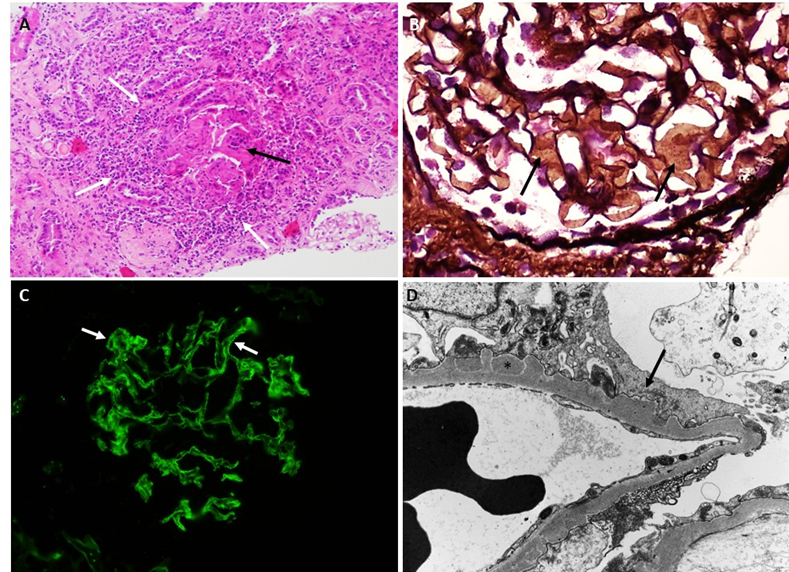
Kidney biopsy (shown above) was performed with: light microscopy hematoxylin and eosin stain (A), light microscopy periodic acid methenamine silver stain (B), IgG Immunofluorescence microscopy (C), electron microscopy (D).
The correct answer and explanation will be revealed once you select an answer in the multiple choice question above.
Click here to read the original case report. We encourage discussion of the case and questions in the comments.
Follow the Topic
-
BMC Nephrology
This is an open access journal publishing original peer-reviewed research articles in all aspects of the prevention, diagnosis and management of kidney and associated disorders, as well as related molecular genetics, pathophysiology, and epidemiology.

Related Collections
With Collections, you can get published faster and increase your visibility.
Artificial intelligence in renal diagnostics
BMC Nephrology invites submissions to our Collection on Artificial intelligence in renal diagnostics.
The integration of artificial intelligence (AI) into renal diagnostics is transforming the landscape of nephrology. With the increasing complexity of kidney diseases and the vast amount of data generated from various diagnostic modalities, AI technologies such as machine learning and deep learning offer promising avenues for enhancing diagnostic accuracy and efficiency. This Collection seeks to highlight research that explores the application of AI in renal imaging, predictive algorithms, and automated interpretation of renal biopsies, paving the way for innovative solutions in kidney disease management.
Recent advancements have demonstrated the capability of AI systems to analyze imaging data with remarkable precision, assist in early detection of kidney diseases, and even predict disease progression. These technological developments not only enhance the diagnostic process but also facilitate personalized treatment strategies, ultimately contributing to better management of kidney health and patient care.
Topics of interest for this Collection include, but are not limited to:
- AI applications in renal imaging
- Machine learning for kidney disease diagnosis
- Predictive algorithms in nephrology
- Deep learning for glomerular pathology
- Automated renal biopsy interpretation
All manuscripts submitted to this journal, including those submitted to collections and special issues, are assessed in line with our editorial policies and the journal’s peer review process. Reviewers and editors are required to declare competing interests and can be excluded from the peer review process if a competing interest exists.
Publishing Model: Open Access
Deadline: Dec 24, 2026
Equity in kidney care access
In recent years, the field of nephrology has increasingly recognized the critical need for equitable access to kidney care. Healthcare disparities in nephrology represent significant unmet needs for diverse populations. Many patients face socioeconomic barriers that severely limit their access to essential services such as dialysis and transplant resources. Studies have demonstrated that individuals from lower socioeconomic backgrounds are less likely to receive timely referrals for nephrology services and experience poorer health outcomes. These disparities not only complicate clinical management but also exacerbate the overall public health burden associated with chronic kidney disease (CKD).
Researchers have begun exploring the impact of community-based approaches to kidney care, highlighting the importance of tailored patient education and culturally sensitive healthcare practices. Additionally, policy frameworks that promote inclusivity in kidney care have emerged, demonstrating a commitment to reducing barriers and ensuring that all individuals have access to necessary resources.
Advancements in telemedicine and mobile health technologies present new avenues for expanding access to nephrology services, particularly in underserved areas. Furthermore, investigating the role of social determinants of health will provide critical insights that can inform holistic strategies to improve kidney care equity.
Important topics of interest include but are not limited to:
- Socioeconomic barriers to dialysis
- Equitable distribution of transplant resources
- Policy frameworks for kidney care inclusivity
- Global access gaps in renal treatment
- Innovative community-based interventions
- Telemedicine in nephrology
- Social determinants of kidney health
This Collection supports and amplifies research related to SDG 3: Good Health and Well-being.
All manuscripts submitted to this journal, including those submitted to collections and special issues, are assessed in line with our editorial policies and the journal’s peer review process. Reviewers and editors are required to declare competing interests and can be excluded from the peer review process if a competing interest exists.
Publishing Model: Open Access
Deadline: Mar 26, 2027