One plus one equals more than two
Published in Electrical & Electronic Engineering
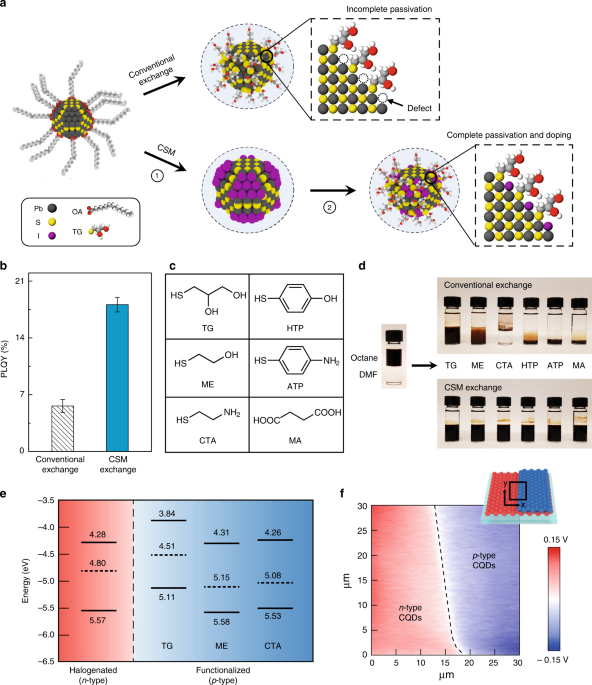

Control over charge carrier type and doping levels in semiconductor materials is key for optoelectronic applications. In the case of colloidal quantum dots (CQDs), these properties can be tuned via the modification of surface chemistry.
In CQD inks – dispersions of quantum dots that can be directly applied to make a device, without requiring further processing (e.g. ligand exchanges) – a number of approaches have been pursued to tailor doping character; however, to date, none has enabled high-optoelectronic-quality films of tunable n- and p-type character. Promising n-type inks have been developed; but p-type inks directly processed to generate a high-quality p-type solid have remained elusive.
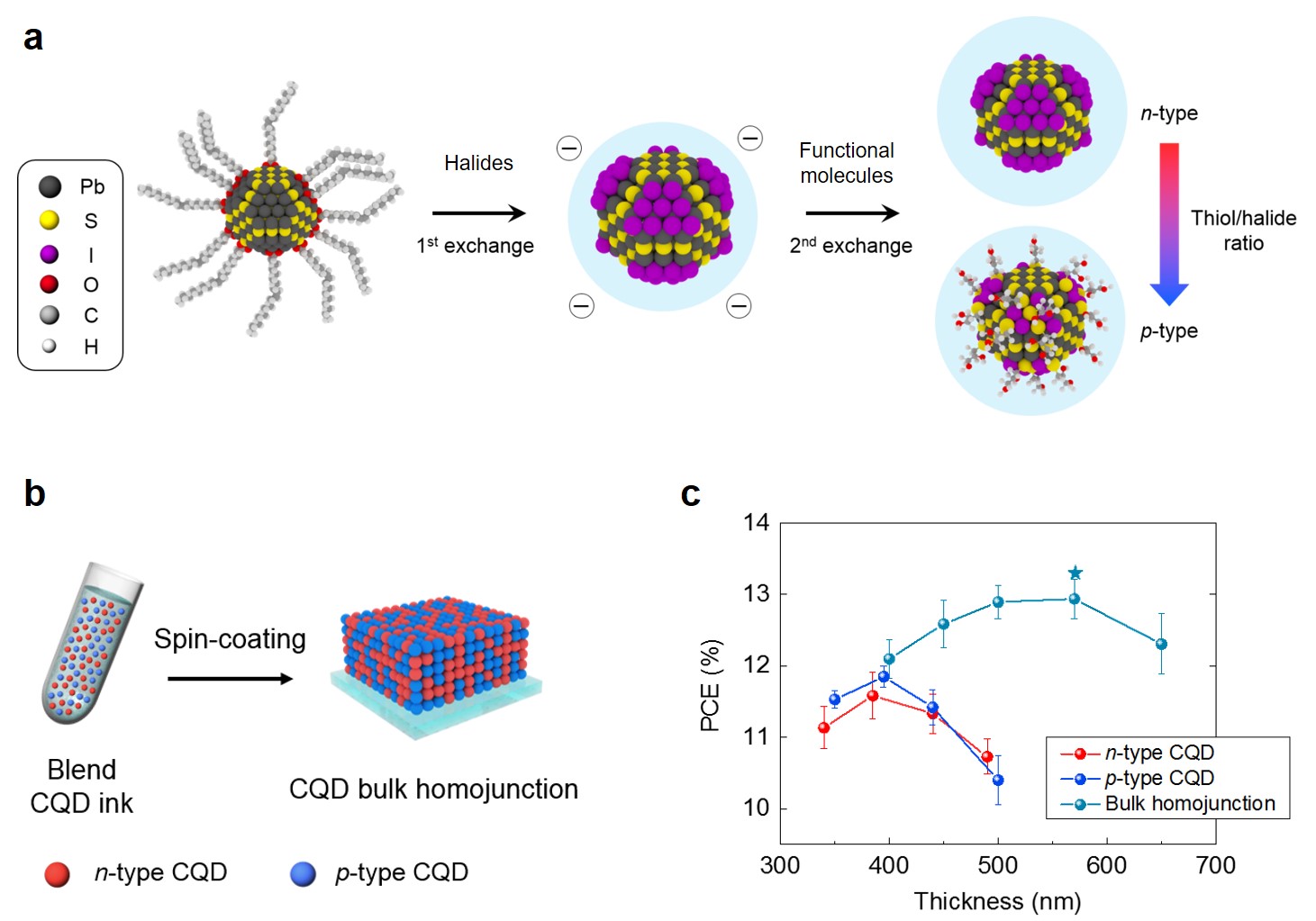
In this work, we report a new materials processing chemistry, a strategy we term cascade surface modification (CSM), that enables control over doping character, colloidal solubility of CQD inks and conformal surface passivation.
One consequence is that CSM allows fabrication of bulk heterojunction and bulk homojunction solar cells: photovoltaics that demand the coprocessing of n- and p-type materials together. These architectures have the potential to enable superior performance compared to their single-component analogues; a feature that had yet to be realized in CQD photovoltaic devices.
The CQD bulk homojunction photovoltaic devices implemented by CSM led to the highest certified AM1.5 power conversion efficiency (12.5%) reported in CQD solar cells, and the first demonstration of a bulk homojunction CQD solar cell that surpasses the performance of its constituents.
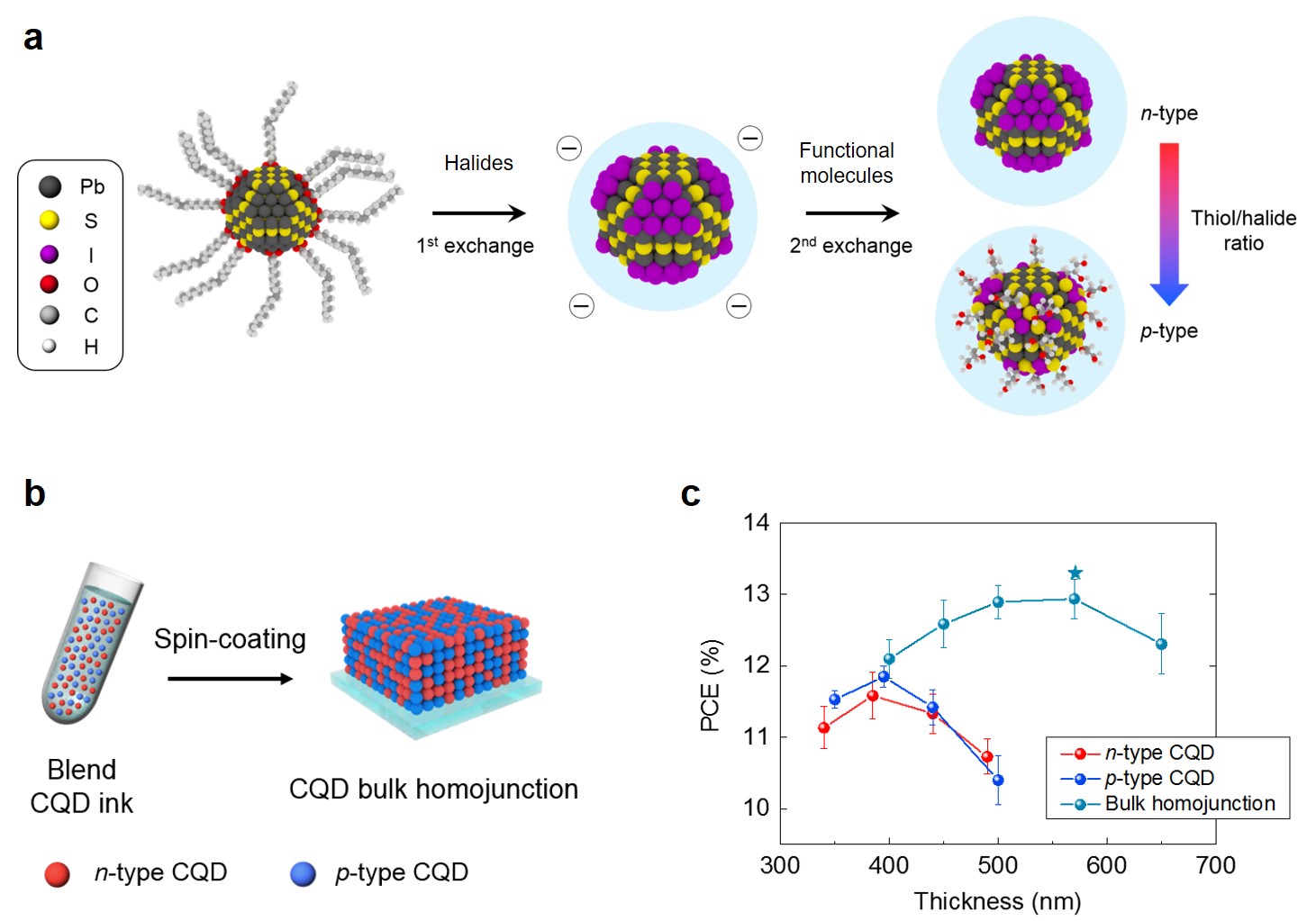
Figure 1. Summary of this work. (a) Schematic illustration of CSM method to synthesize n- and p-type CQD inks, which (b) enables to fabricate CQD bulk homojunction solids. (c) Power conversion efficiency (PCE) of CQD photovoltaic device using n-type CQD, p-type CQD, and CQD bulk homojunction as a function of thickness of CQD film.
The full paper can be found here: doi:10.1038/s41467-019-13437-2

Follow the Topic
-
Nature Communications
An open access, multidisciplinary journal dedicated to publishing high-quality research in all areas of the biological, health, physical, chemical and Earth sciences.

Related Collections
With Collections, you can get published faster and increase your visibility.
Women's Health
Publishing Model: Hybrid
Deadline: Ongoing
Tumor Microenvironment Crosstalk and Therapeutic Implications
Publishing Model: Hybrid
Deadline: Nov 02, 2026