Pixel-level Bayer-type colour router based on metasurfaces used in miniaturized image sensor
Published in Physics

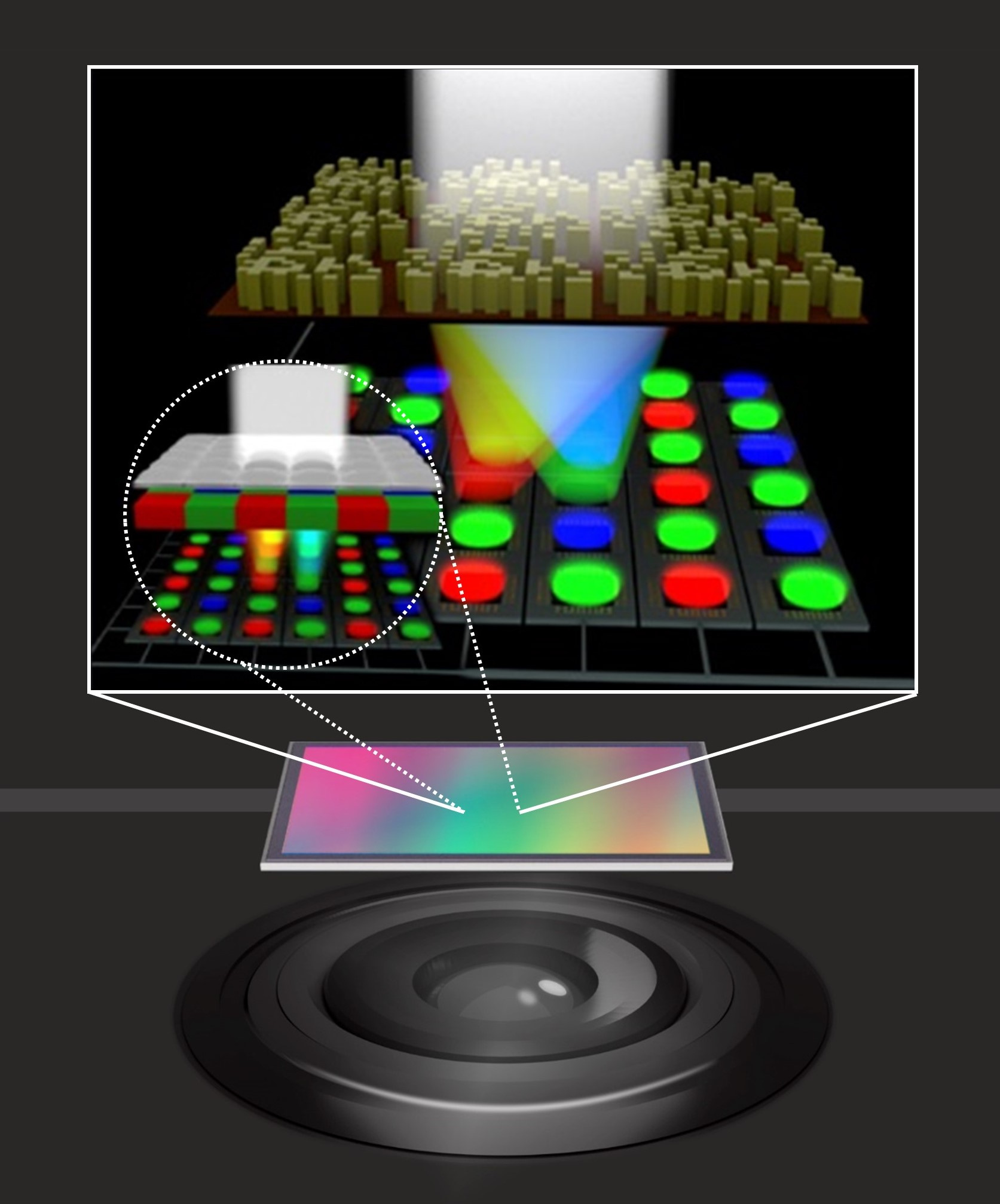

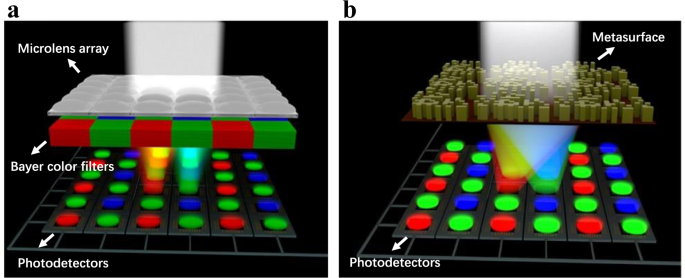

Image sensors based on integrated circuit technology have become widely used in many fields due to their advantages, such as digital electronic products, video electronic mail, medical equipment, security monitoring, visual communication, industrial video monitoring, visual toys, and other aspects of social life and industrial production, as a result of the development of integrated circuit manufacturing technology and the continuous improvement of integrated circuit design level. Because the application of digital image sensors in digital products such as digital cameras and camera phones has a large market potential, the research and development of digital image sensors has a very high market value. Digital image sensors usually include complementary metal-oxide semiconductors (CMOS) and charge-coupled devices (CCD). Both of them convert the changing light intensity in the scene into electrical signals and record them in the form of images. Because the photodiode in the image sensor can only detect light intensity but not color (spectrum), the color image sensor usually adds an optical device to gather the spectrum/color (i.e., the color filter array) to obtain the color image. Furthermore, a microlens array (as shown in Fig. 1) is typically placed on the color filter to improve light collection efficiency. Color gating on a specific pixel allows pixels in different spatial positions to perceive different colors. The three color information at each pixel position and the complete color image can be produced once the original image data collected from the sensor is interpolated.
The traditional color filter for color imaging uses a polymer filter with dye doping on each pixel. At each pixel position, the dye-type color filter permits one color of light to flow through, while the other color light is absorbed or reflected. As a result, each pixel position loses at least 2/3 of the light energy, and the image quality has always been influenced by the dark imaging environment. People are progressively pursuing greater resolution images, resulting in smaller and smaller pixels on the sensor, with the development of science and technology and the exploration of unknown fields. Because organic dyes have a low absorption coefficient, optical crosstalk between pixels becomes more noticeable as pixel sizes shrink. The current commercial CMOS sensors use about 1 µm × 1 µm pixels. This method improves the spatial sampling frequency by reducing the size of pixels, which further reduces the utilization of light energy, resulting in blurred imaging, especially in low-light environments. Furthermore, the dye-doped polymer is essentially a type of photoresist that degrades easily in UV or high-temperature environments, reducing the performance of the color filter.
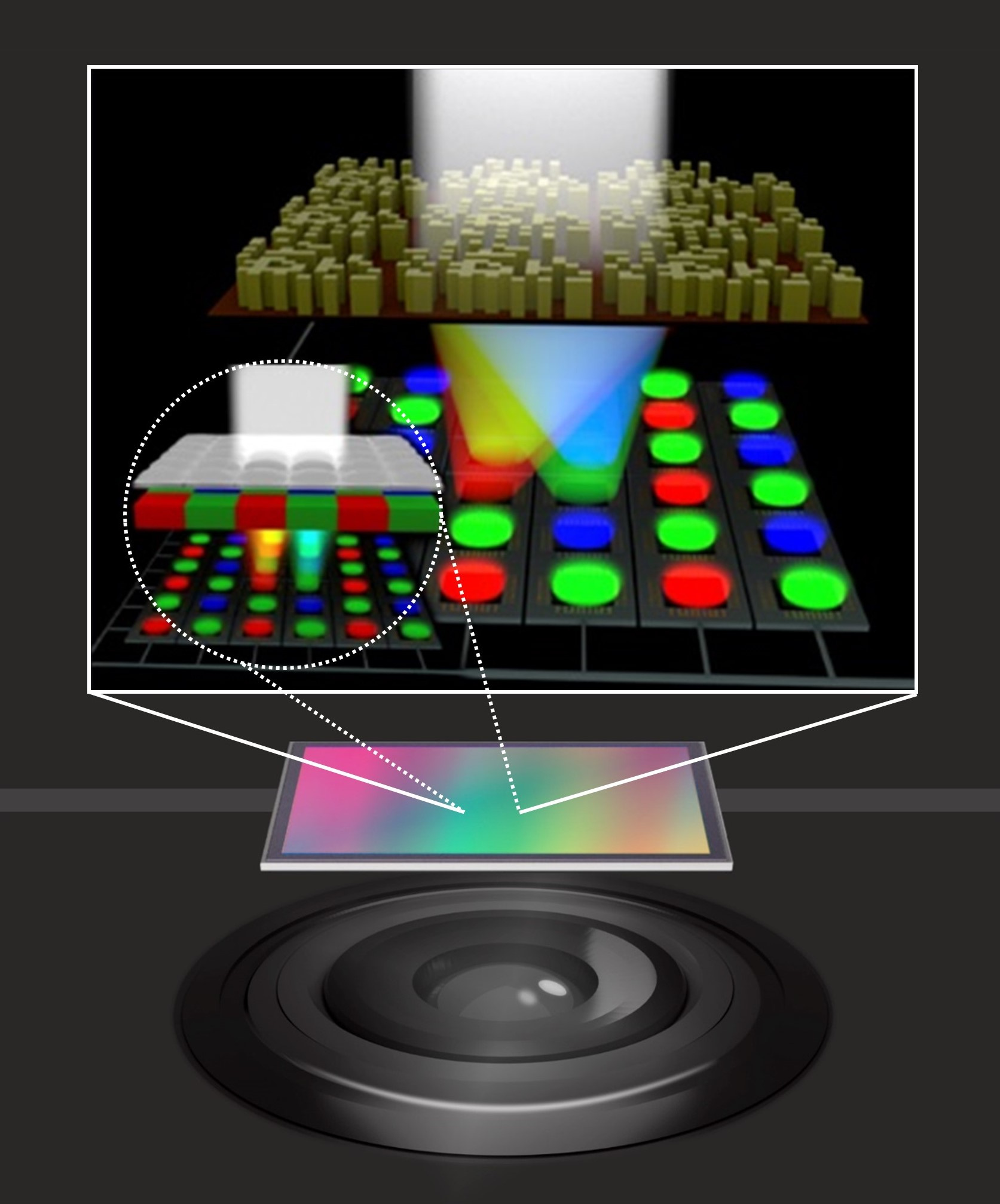
In our recent published paper in Nature Communications, we demonstrated a pixel-level Bayer-type color router based on a single-layer metasurface to compensate for some of the shortcomings of current color filters, as shown in Fig. 1. Given the limitations of the current nanostructure preparation process, we used the reverse design method to create a metasurface-based color router with a pixel size of 1um based on the standard nano-fabrication process. Our color router can provide significant improvement (84%) in the energy utilization efficiency and maximal color collection efficiencies (~50%) of RGB light, which is much higher than the ideal efficiency of 33% and the actual efficiency of 20% of the traditional filter. Due to the benefits of mosaic arrangement of traditional Bayer color filters in making color images obtained more suitable for human observation, we followed this law and designed the unit cell of the metasurface to seperate 4 color lights focused on 2*2 color pixels, respectively. As a result, it can be directly inserted into existing image sensors without the need for color conversion algorithms to convert the three primary colors, avoiding the imaging color deviation. Furthermore, full-color imaging is realized using the fabricated color router sample, and the obtained image is demonstrated to show a higher intensity than that obtained by a commercial imaging sensor, as shown in Fig. 2.
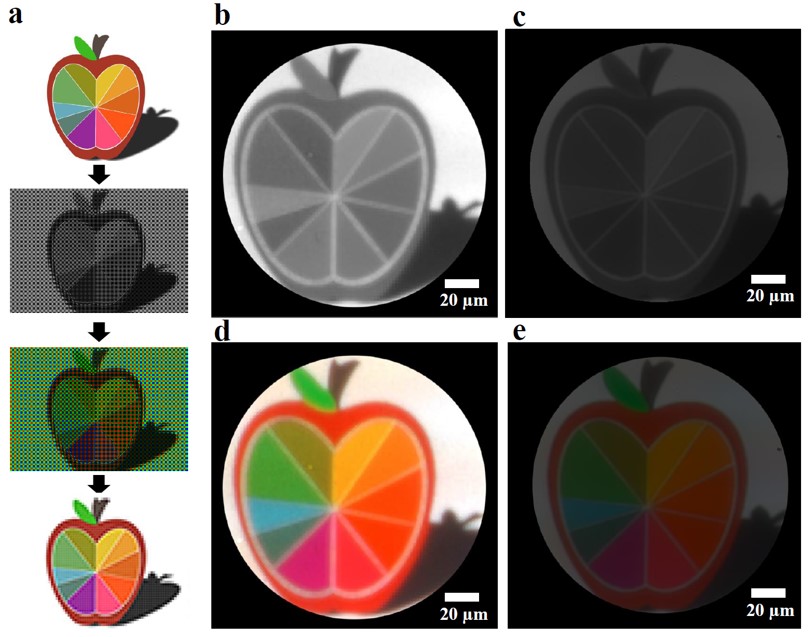
Fig. 2. Comparison of imaging response between MBCR and BCFs. (a) The post-processing procedure of color imaging. (b) and (c) Greyscale images obtained directly by reconstructing the monochromatic images obtained using MBCR and BCFs respectively, for comparison of the intensity. (d) and (e) The reconstructed color images of MBCR and BCFs combined with the spectral response, respectively.
The most important innovations of this work are as follows: 1) Miniaturization and periodization of single-layer metasurface pixels to create a micro color filter for use in color image sensors. The previous related works reported at home and abroad focused on the theoretical design of a large-size pixel structures or irregular structures. 2) In terms of the design method, we adopt the reverse design of the optimization algorithm instead of the common metasurface design method based on wavefront phase compensation. The advantage is that we can realize the multiplexing and superposition of multiple functions on a very small area of the metasurface, and there is no need to design the shape of nanostructures in advance and scan the phase library of the nanostructures. 3) In terms of design principle, we adopt the scheme of light splitting rather than filtering, which fundamentally solves the problem of the low efficiency of traditional color filters and increases the light utilization in actual color imaging.
For more information, please refer to our paper published in Nature Communications, “Pixel-level Bayer-type color router based on metasurfaces. https://doi.org/10.1038/s41467-022-31019-7”.
Follow the Topic
-
Nature Communications
An open access, multidisciplinary journal dedicated to publishing high-quality research in all areas of the biological, health, physical, chemical and Earth sciences.

Related Collections
With Collections, you can get published faster and increase your visibility.
Women's Health
Publishing Model: Hybrid
Deadline: Ongoing
Tumor Microenvironment Crosstalk and Therapeutic Implications
Publishing Model: Hybrid
Deadline: Nov 02, 2026