Quarterly Highlights from the Humanities and Social Sciences Communities
Published in Healthcare & Nursing, Astronomy, and Social Sciences



From July to September 2025, a series of blog posts from the Humanities and Social Sciences Communities drew in high readership levels. These posts explore how emotions shape learning, how language influences inclusion, how social science genetics connect DNA with society, and how AI is used in research. What unites them is a focus on how research, communication, and technology intersect with real-world human experiences.
Tracking Emotions to Understand Learning from Misinformation 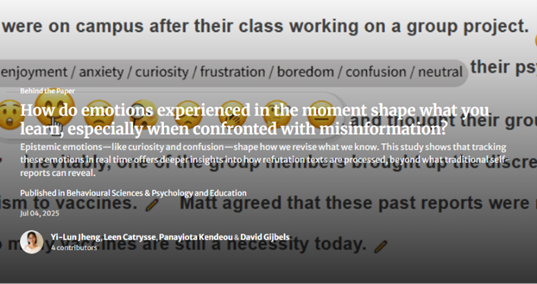
How do our emotions shape what we learn, especially when facing misinformation? In this Behind the Paper blog post, @Yi-Lun Jheng @Leen Catrysse @David Gijbels and Panayiota Kendeou introduce DynamicEmo, a real-time emotion-tracking tool, which tracks readers’ feelings, such as curiosity or confusion, sentence by sentence while they read refutation texts that correct false beliefs. The study shows that moments of correction often spark curiosity and engagement, while negative emotions can hinder belief revision. Developed during the COVID-19 pandemic, this tool opens new possibilities for understanding how emotion and cognition interact during learning. It also points to a future where emotion-tracking tools could make science communication and digital learning more adaptive and human-centered.
Read the full blog to see how emotion tracking reveals the hidden dynamics of learning from misinformation.
🔎Explore these topics further: Emotion; Digital Education and Educational Technology
A Love Letter to Social Science Genetics 
In this Behind the Paper post, @Abdel Abdellaoui shares deep admiration for social science genetics, a field often seen as controversial but full of potential. He explains how social structures and genetic differences interact, showing that migration, mate choice, and education can leave subtle genetic imprints over generations.
Abdellaoui reflects on the field’s complex past, from its historical ties to eugenics to today’s ethical debates around embryo screening. He argues that confronting, rather than avoiding these issues, is key to moving forward responsibly. What excites the author most is the field’s ambition: connecting DNA, the smallest unit of biology, to human culture, one of the most complex forces on Earth. It’s a discipline that demands collaboration across genetics, psychology, economics, history, and ethics.
Curious why a geneticist calls this 'the most promising field in life sciences’? Read the full blog to see how he defends and celebrates a science that bridges our biology and our society.
🔎 Explore these topics further: Genetics and Genomics; Behavioral Genetics; Philosophy of the Social Sciences
Silenced Words, Hidden Inequities 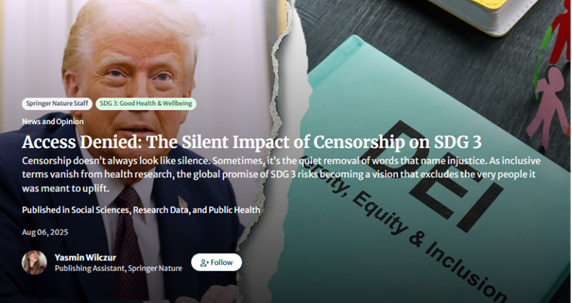
In this News and Opinion blog post, @Yasmin Wilczur examines how language restrictions in health research are quietly undermining the Sustainable Development Goal 3 (SDG 3) which strives towards a healthy life for all. Terms like ‘women’, ‘disability’, ‘gender’, and ‘DEI (Diversity, Equity, and Inclusion)’ are more than words; they acknowledge the existence and needs of diverse communities. However, recent U.S. policies and institutional pressures have led to restrictions of these terms in academic publications. These restrictions have real consequences: funding for critical studies has been cut, public health datasets removed, and researchers face pressure to self-censor.
Wilczur argues that publishers and researchers play a crucial role in defending inclusive language. By maintaining editorial integrity, supporting open access, and promoting diverse authorship, the scientific community can ensure that health research continues to serve all populations.
Read the full blog to understand how erasure of certain words can silently erode health equity. For more on advancing SDG 3 through inclusive research, check out @Alice Coe’s SDG 3 Newsletter: Access for All.
🔎 Explore these topics further: Applied Linguistics; Research Data; Political Science; Public Health
Researcher Riddle: Using AI as A Researcher 
AI tools are used everywhere, from helping analyse data to polishing writing. But where’s the line between smart use and misuse? In this Empower Your Research blog post, @Jo Appleford-Cook and @Zina Bibanovic walk researchers through which AI uses in research are acceptable (like using AI for image classification or data analysis) and which aren’t (like letting ChatGPT write your manuscript or create figures).
They remind researchers to think not just about what AI can do, but what it should do, balancing innovation, ethics, and integrity.
Ready to take on the researcher riddle? Read the blog post to see how your AI instincts measure. And if you’re wondering how to make the right call in your own work, don’t miss the UKRIO course “Embracing AI with Integrity: A Practical Guide for Researchers”.
🔎 Explore these topics further: Research Integrity
Further readings:
When AI Speaks with Empathy
@Prof. Abdullah Al Fraidan takes us behind the scenes of a personal experiment where ChatGPT became more than a research tool. Over 90 days, Prof. Al Faridan tracked his blood pressure, moods, and daily reflections with ChatGPT, exploring how emotionally aware AI can influence our behavior, motivation, and well-being. His study highlights that AI doesn’t just provide answers; it can encourage, comfort, and even subtly guide positive health habits.
Dive into the Behind the Paper blog post to discover how AI and human care can intersect in surprising and meaningful ways.
🔎 Explore these topics further: Applied Linguistics; Artificial Intelligence; Health Care; Health Communication
Why AI Fails at Lawmaking 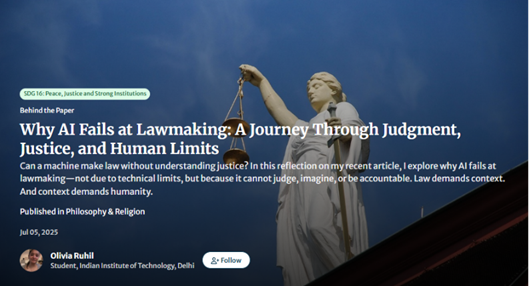
Governance is not about procedural mimicry. It is about ethical reckoning. It is the patient, painful act of deciding what kind of world we wish to live in — and who we are willing to be responsible to.
In this Behind the Paper blog post, @Olivia Ruhil explores why artificial intelligence, despite its speed and scale, cannot replace human judgement in law. AI can process data and spot patterns, but it cannot grasp moral context, interpret justice, or take responsibility. Drawing on historical examples, legal philosophy, and even a BBC courtroom drama like Garrow’s Law, Ruhil shows that law is more than rules. It’s a reflection of ethical struggle, societal values, and human deliberation.
Read the full blog post to learn insights on justice in the age of AI.
🔎 Explore these topics further: Philosophy of Artificial Intelligence
These blog posts show how Humanities and Social Sciences researchers are exploring the intersection of emotions, genetics, language, healthcare, AI, and human experience. They highlight the importance of ethics, equity, and thoughtful communication in research that connects with our lives. Read the full blog posts, like, and leave a comment on the ones you enjoy!
Further readings:
Quarterly Highlights from Health & Clinical Research and Life Sciences Communities
Quarterly Highlights from Humanities and Social Sciences Communities
Quarterly Highlights from Mathematics, Physical & Applied Sciences Communities

Supporting Humanities and Social Sciences research area on the Research Communities platform. I’d love to hear from you and connect!
Follow the Topic
-
Humanities and Social Sciences Communications

A fully open-access, online journal publishing peer-reviewed research from across—and between—all areas of the humanities, behavioral and social sciences.
-
Nature Human Behaviour

Drawing from a broad spectrum of social, biological, health, and physical science disciplines, this journal publishes research of outstanding significance into any aspect of individual or collective human behaviour.
-
npj Science of Learning

An online open access peer-reviewed journal dedicated to research on all aspects of learning and memory – from the genetic, cellular and molecular basis, to understanding how children and adults learn through experience and formal educational practices.
-
AI & SOCIETY

This journal focuses on societal issues including the design, use, management, and policy of information, communications and new media technologies, with a particular emphasis on cultural, social, cognitive, economic, ethical, and philosophical implications.
Related Collections
With Collections, you can get published faster and increase your visibility.
AI in Asia: Social and Ethical Concerns
This collection is opened to Asian Social and Ethical concerns related to AI. Asia is a large continent, with highly diverse religious and cultural systems, variations in industrial development, differing approaches to both government and governance, and unique historical and contemporary geopolitical dynamics that deserve to be treated independent of European or North American (or comparatively with African or Latin American) issues. It is also an important question because Asia is the most populated continent.
Existing studies on intercultural ethics of AI (Hongladarom and Bandasak 2024), comparative governance systems (Hine and Floridi 2024; Okuno and Okuno 2025), and postcolonial studies of AI (Ofosu-Asare 2025; Rodríguez 2025; Hassan 2023) highlight the importance of this work and the need for further studies. While comparative approaches are welcome, this topical collection seeks original research that attends specifically to the Asian context, understood both broadly across the region and within specific Asian societies. To this end, we encourage inter-cultural comparison within the Asian continent, with the special issue serving as a meta-comparative collection on Asian AI concerns. We encourage interdisciplinary approaches to studies along three broad branches: 1) philosophical and cultural considerations rooted in Asian perspectives; 2) political and social AI issues unique to specific Asian societies; 3) region-specific, trans-national challenges raised by AI.
Please consult the detailed call for papers at https://link.springer.com/journal/146/updates/27806474before submitting
Publishing Model: Hybrid
Deadline: Feb 28, 2026
Effects of lifestyle behaviours on learning and neuroplasticity
Publishing Model: Open Access
Deadline: Mar 09, 2026



Please sign in or register for FREE
If you are a registered user on Research Communities by Springer Nature, please sign in