Rocket Science for Spaceship Earth
Published in Earth & Environment and Electrical & Electronic Engineering





In 1966, Kenneth Boulding used the term "Spaceship Earth" to refer to a planet where human actions shape earth system processes at the global scale. This sentiment has recently been recaptured by the proposition of a new geological epoch: The Anthropocene. In the past, Spaceship Earth was on autopilot. Humans were passengers who went about their business of building infrastructure and societies, sometimes enduring some turbulence, but largely unbothered by the business of piloting Spaceship Earth. Now the extent and scale of human-made infrastructure systems are interfering with the autopilot systems of Spaceship Earth and humans now must move from being passengers with the luxury of autopilot to being active crew members. Are we up to the task?
It seems that the first step in this process would be to restore the autopilot function of Spaceship Earth to keep us within a safe operating space (SOS) as defined, for example by the Planetary Boundaries framework. But given that this will take time and there is much uncertainty about how to do so, we need the same sort of steering tools used to pilot spacecraft to safely navigate the turbulence toward a restored autopilot system with some new upgraded support systems to ensure its continued smooth function. The challenge is that there is no definitive operating manual for Spaceship Earth. We are driving in the dark - but maybe we can at least turn the headlights on for a partial view of the road ahead.
In fact, very basic tools from rocket science in the form of "PID" control systems can help do just that. PID is the acronym for (p)roportional-(i)ntegral-(d)erivative controllers. Such control systems take measurements of something about the present state of the system, the "P", past states of the system, the "I", and estimates of future states of the system (which are, of course, based on present information and knowledge), the "D". These measurements are then compared to a goal state and actions are taken based on deviations between the actual state and the goal state. The design element of the PID paradigm is to select the weights given to present, past, and future estimated information. And unlike more advanced control design paradigms that require accurate models or very advanced mathematics, e.g. model-based and H∞ (robust) control, the PID paradigm maps very nicely onto how policy makers actually make decisions. Given that they have neither accurate models nor unlimited computational power to tackle the extremely complex, poorly understood policy problems with limited measurement capacity, policy actors make decisions based on a partial characterization of the present state of a system, its history, and guesses about future states. Finally, and perhaps most importantly, these decisions feedback to the system being managed and, as a result, the system will be subject to general principles of feedback systems such as stability, controllability, and observability.
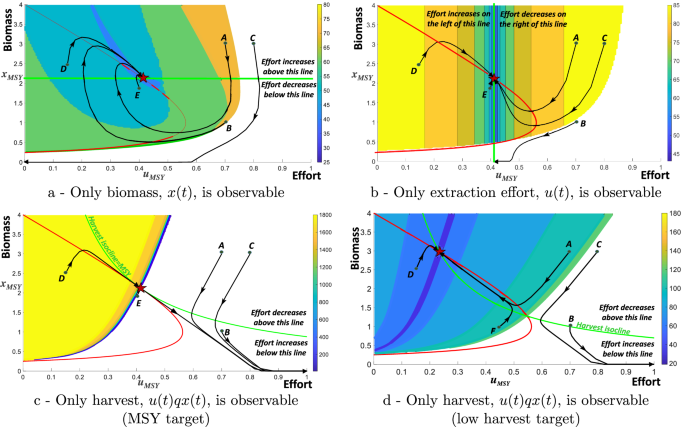
While control theory has been applied to many specific environmental systems (after all, it is a general and powerful tool for studying such problems), there are few efforts to bring these general principles into policy-making processes for real-time decision making. The article explores the implications of the general principles from control theory by illustrating how what you can observe impacts how controllable a social-ecological-technical system is, i.e. can a SOS be reached? We also explore the impact of how much weight is given to present, past, and estimated future information. We illustrate this with the French response to COVID-19. As the pandemic progressed, the government shifted from relying on present information (a P-controller) early on to a combination of past and present information (a PI controller) as data was gathered to including estimates of new cases using models and the basic reproduction number (a PID controller) which enabled a more effective management of lockdowns to minimize economic impacts. We also apply these tools to general problems involving natural resource management, climate change, and epidemiology to illustrate how choices about what to observe and how to control the system, e.g. through the state (resource population size, atmospheric carbon concentration, or number of infections) or through processes (harvest, climate damages, or contagiousness), impact whether a SOS can be reached and implications for real-time decision-making.
The paper argues that rather than focusing on developing better models and developing theory-based policies and new governance models, it may be more effective to focus on understanding what information can be observed and how it can be used in existing governance structures in real time to more effectively steer Spacesp Earth.
Follow the Topic
-
Communications Earth & Environment
An open access journal from Nature Portfolio that publishes high-quality research, reviews and commentary in the Earth, environmental and planetary sciences.

Related Collections
With Collections, you can get published faster and increase your visibility.
Ecological resistance and resilience under global change
Publishing Model: Open Access
Deadline: Apr 07, 2027
Hazards in Mountain Regions
Publishing Model: Open Access
Deadline: Nov 02, 2026