Low Earth orbit space telescopes are getting blocked by internet satellites
Published in Astronomy, Earth & Environment, and Law, Politics & International Studies
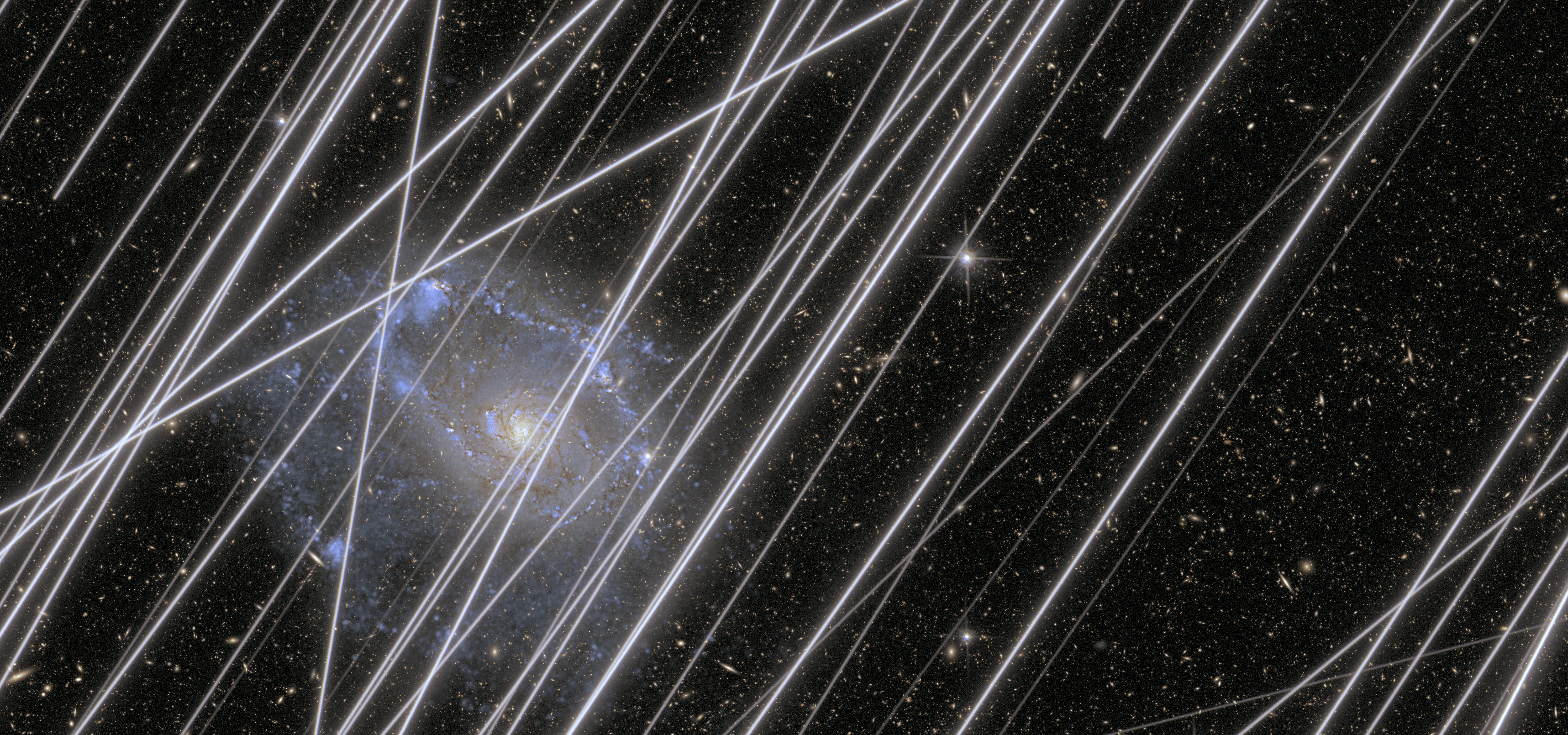




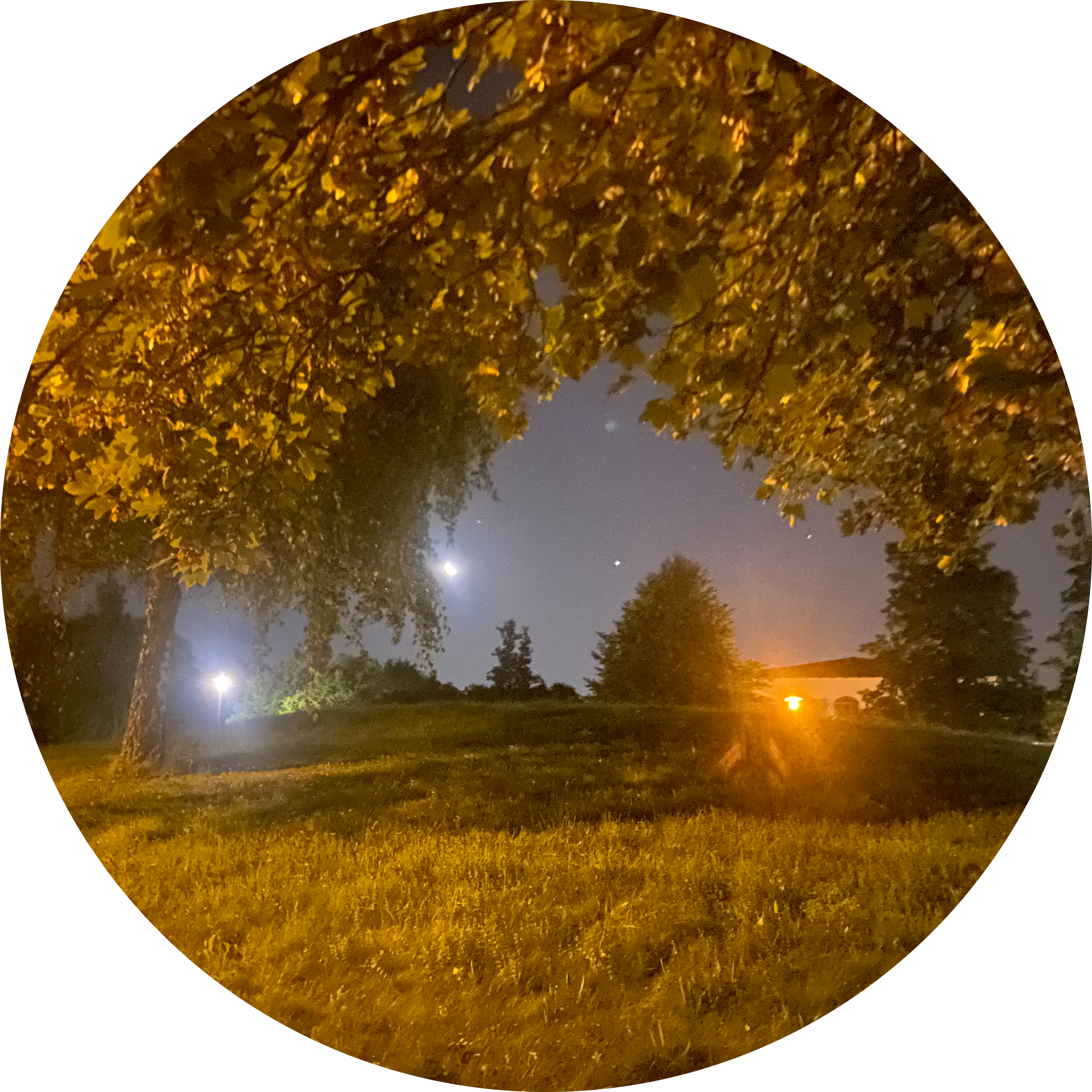

In 2019, the first launches of Starlink constellation shocked the world. The concept of internet-by-satellite was not new (e.g., Iridium), but their recently launched artificial satellites were extremely bright in the night sky, clearly visible to the unaided human eye. Six years later, the space telecommunications industry exploded, increasing exponentially the number of satellites in Low Earth Orbit from 2000 to 13,000. While 75% of the active satellites in the world (as of December 2025) belong to the same satellite operator (SpaceX) new companies like Amazon Kuiper/Leo, OneWeb, and Guowang are rapidly joining the market, competing to launch their own constellations with thousands of new satellites. Currently, the proposed number of spacecraft to be launched is 560,000, and continues to grow day by day, with new multi-million projects including orbital cloud data-centers in space up to 3600 m2 in size, constellations of AI-servers each with solar panels as large as the International Space Station, and even reflectors to provide sunlight-by-demand. This rapidly changing scenario raises the question: What are the environmental and scientific implications? Is space truly infinite?
The answer is no, and for space scientists the consequences of such an intense orbital crowding were immediate. Professional and amateur astronomers worldwide started reporting that the reflected and self-emitted light from the new satellites were interfering with their telescopes. As the satellites travel through the night sky, they leave traces of bright light that vastly outshine the faint emission from astronomical sources (planets, asteroids, galaxies). Those satellite trails erase the few photons that astronomers can gather from the Cosmos, far beyond any possible restoration. Last generation observatories like Vera C. Rubin predicted that 20% to 80% of the astronomical images will be affected by light pollution from satellites. Even radio-telescopes are starting to receive the inference emissions from their antennas, tens of thousands of times more powerful than the signals received from distant black holes. A new existential crisis started for astronomy.
Historic increase of the number of active satellites in orbit since 1958 to 2040 (predicted). Credit: NASA / Borlaff, Marcum, Howell (Nature, 2025)
Contrary to the popular belief, light pollution is not a problem unique of ground-based astronomy. While forcing scientists to use space telescopes only (like Hubble) instead of ground ones (Vera C. Rubin) seems as a tempting solution, there are two problems: 1) space telescopes cannot possibly replace the thousands of different observatories on the ground and - as we demonstrate in this article - 2) satellites can contaminate space telescopes as well. Space observatories like Hubble orbit at the very same altitudes as the telecommunication satellites and close-encounters are becoming more and more common. Taking into account the exponential increase of the number of satellites in this new era of widespread industrial exploitation of Low Earth Orbit, the survival of astronomy from Earth depends on the answer to one main question: how much contamination will space-telescopes receive from upcoming satellite mega-constellations?
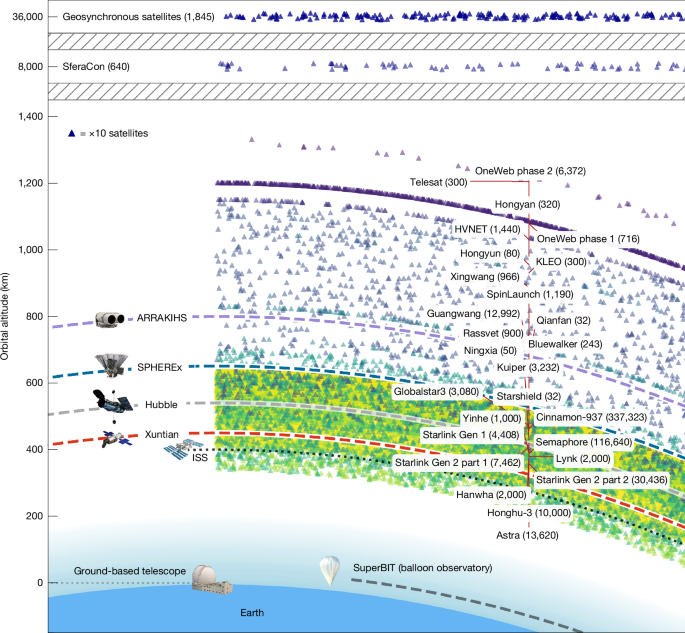
Structure of proposed satellite telecommunication constellations in Low Earth Orbit from 1958 to 2037 (predicted). The altitude of satellites is compared to the orbits of Hubble Space Telescope, Xuntian Space Telescope (CSST), SPHEREx, and proposed ARRAKIHS mission. Credit: NASA / Borlaff, Marcum, Howell (Nature, 2025)
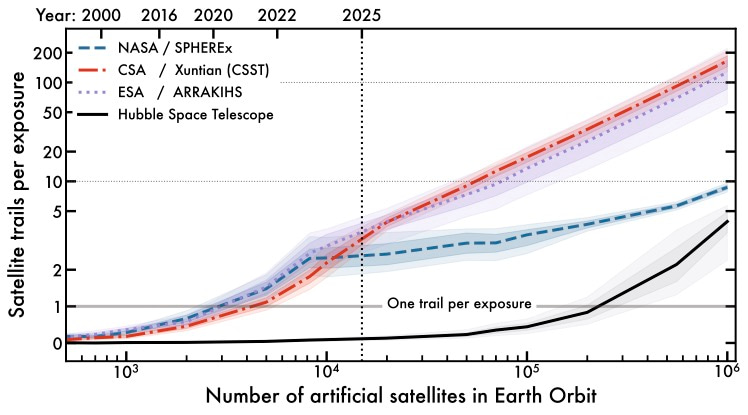
In our featured Nature paper, we decided to generate a computer simulation of the Earth orbited by four different flagship space telescopes: Hubble (NASA/ESA), SPHEREx (NASA), Xuntian (CSA, planned for 2026), and ARRAKIHS (ESA, 2030s). In this simulation, telecommunication satellites were included as well, reflecting the light that they received from the Sun, the Earth, and the Moon. We also simulated the thermal emission from the temperature of the satellites themselves, an important factor for infrared telescopes like SPHEREx. Based on that experimental setup, we performed thousands of simulated observations increasing the number of artificial satellites up to one million, measuring the number of times a satellite "photo-bombed" our space-telescopes.
The results are clear. If the satellite constellations proposed by the industry become operational, up to 96% of the images of new telescopes like SPHEREx, ARRAKIHS, and Xuntian will be contaminated by satellites, showing tens to hundreds of satellite trails per image. Almost 40% of the images of Hubble will be contaminated as well. Their exact position and level of contamination over the images is extremely hard to predict, given the lack of information about the new satellites (orbits, reflectivity), but the efforts to identify, analyze, and attempt to remove this new source of contamination will dramatically increase the operational costs of the observatories and the quality of the astronomical images, maiming our capabilities to - for example - discover distant galaxies or new hazardous asteroids.
Nonetheless, the environmental crisis highlighted in our work extends far beyond astronomy. Like the canary in the coal mine, telescopes are just the first casualty. The unregulated use of space has prompted a rapid increase in the number of orbital debris and the need for orbital collision avoidance maneuvers. Even more catastrophic, new studies reported that the continuous reentries of satellites increase the amount of aluminum oxide nanoparticles in Earth’s stratosphere, depleting the delicate ozone layer that protects life against solar radiation.
For these reasons, the International Astronomical Union launched the Centre for the Protection of the Dark and Quiet Sky from Satellite Constellation Interference (CPS). Its mission is to coordinate the multidisciplinary effort by performed by international scientists to protect the night sky. The IAU CPS focuses not only on the adverse impact of satellite mega-constellations on astronomy. Some of the new satellites are already replacing the brightest stars in the night sky, with a yet-to-be-measured impact on nocturnal wildlife and migrating fauna. Such a wide-field problem must be tackled from a multidisciplinary perspective, to provide facts and strategies that will turn into policies. But we need your help and support.
In 1994, the UNESCO’s Human rights for future generations declaration was signed by at the University of La Laguna (Tenerife, Spain). Its Article 1 states that persons belonging to future generations have the right to an uncontaminated and undamaged Earth, including pure skies. Like the CFC crisis that brought Earth's atmosphere to the brink of destruction at the end of the 20th century, we can find new way to progress together without destroying our environment. We can avoid the next ozone layer crisis, but the time to act is now.

Follow the Topic
-
Nature
A weekly international journal publishing the finest peer-reviewed research in all fields of science and technology on the basis of its originality, importance, interdisciplinary interest, timeliness, accessibility, elegance and surprising conclusions.

Related Collections
With Collections, you can get published faster and increase your visibility.
Carbon Dioxide Removal
Publishing Model: Hybrid
Deadline: Jan 16, 2027
Cancer Neuroscience: from mechanisms to therapy
Publishing Model: Hybrid
Deadline: Jan 30, 2027