Spontaneous Dewetting Transitions of Droplets during Icing & Melting Cycle
Published in Materials
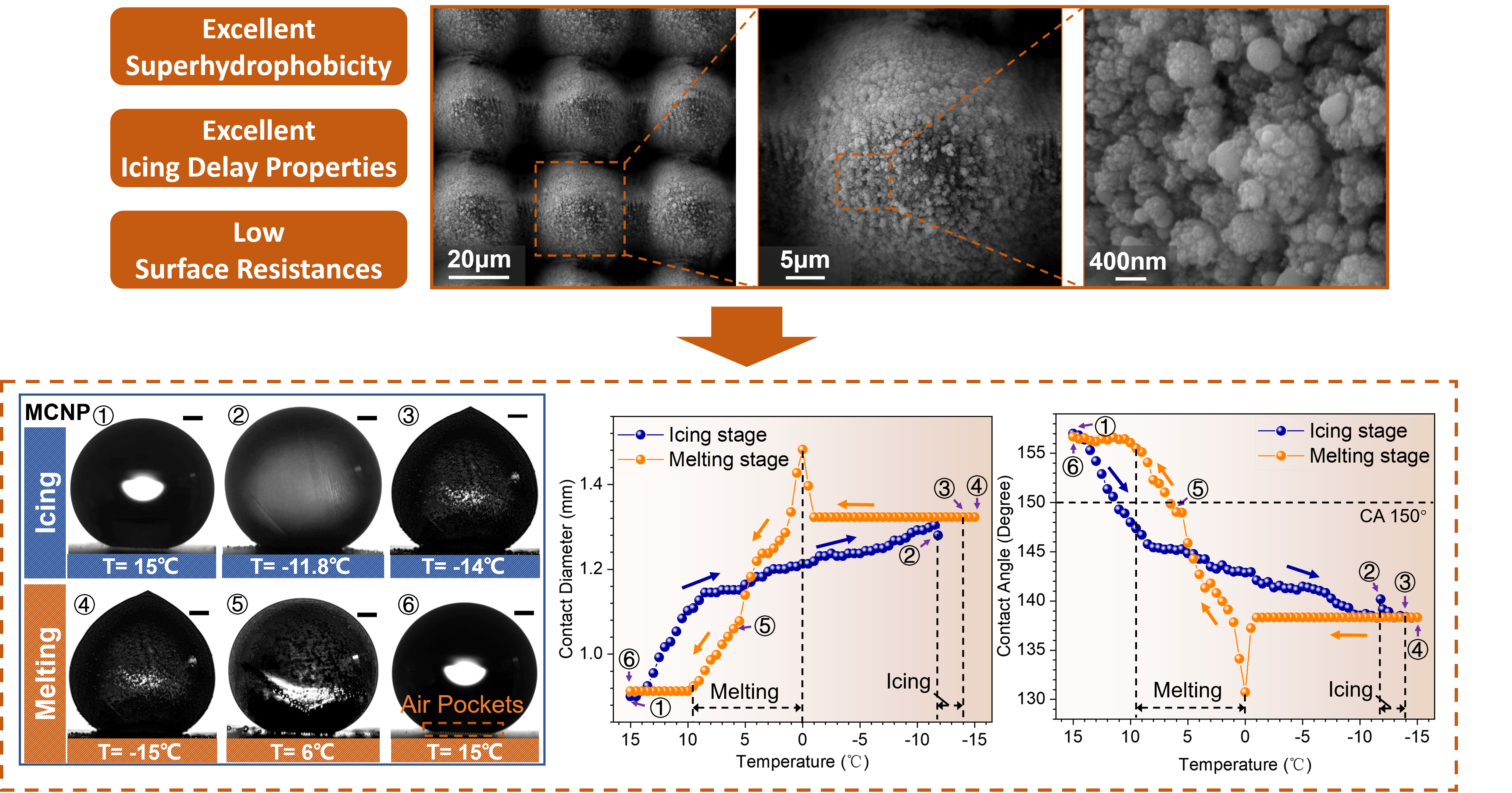


On January 19, 2022, the team of Professor Zhong Minlin from Tsinghua University first reported a spontaneous dewetting transition from the high-adhesion Wenzel state to the low-adhesion Cassie-Baxter state on the special micro-nanostructured superhydrophobic surfaces fabricated by ultrafast laser. Under external slight disturbances, the spontaneous transition from Cassie-Baxter state to Wenzel state occurs inevitably, which has been a vital challenge for practical applications of superhydrophobic surfaces. Our discovery realizes the spontaneous Wenzel-to-Cassie dewetting transitions during icing & melting cycle, which was regarded impossible before. This work not only deepens theoretical research on wettability but is greatly worthwhile for the anti-icing applications of superhydrophobic surfaces.
Icing issue, existing ubiquitously in nature, has brought great troubles to our daily life and industry. Especially when airplanes fly at high altitudes, the icing wings and propellers even cause some catastrophic crashes. Active deicing methods such as electric heating and pneumatic deicing, which have been widely applied nowadays, have typical problems such as low efficiency and high energy consumption. In some severe or extreme weather conditions, these methods cannot eliminate the hazards of icing.

Fig. 1 Plane crashes caused by icing problems.
Recently, inspired by the unique water-repellency property of lotus leaves, superhydrophobic surfaces have become one of the most promising approaches to achieving energy-saving passive deicing. However, superhydrophobicity is not the same as icephobicity. There are two states existing on superhydrophobic surfaces: Cassie-Baxter state and Wenzel state. Generally, a droplet on superhydrophobic surfaces tends to sit on thousands of air pockets surrounded by micro-nanostructures and remains a small solid-liquid contact area, forming a so-called Cassie-Baxter state where droplets have the excellent self-removal ability and can roll freely at a low tilted angle. However, the trapped air pockets in micro-nanostructures will be inevitably impaled under external disturbances such as cooling, vibration and dynamic pressure, leading to the transition from the water-repellent Cassie-Baxter state to the high-adhesion Wenzel state. Once in the Wenzel state, droplets will be stuck by the bottom micro-nanostructure, and superhydrophobic surfaces will lose icephobicity, resulting in more dangers of re-icing and ice accretion. Therefore, to guarantee the icephobicity of superhydrophobic surfaces, the transition to the Cassie-Baxter state is of vital importance. However, the spontaneous reversible transition from Wenzel to Cassie-Baxter is normally impossible due to a large energy barrier existing between the two states. Relevant references have also reported that the recovery of the Cassie-Baxter state cannot be spontaneously realized even if the temperature rises to room temperature. This problem has become the main obstacle for the anti-icing applications of superhydrophobic surfaces. If the Wenzel-state droplets can recover to the easy-removal Cassie-Baxter state spontaneously and well, the hazards of re-icing and severe ice accretion will be effectively avoided, which is especially meaningful for aviation applications involving multiple icing & melting cycles.
Focusing on this point, we demonstrated a spontaneous dewetting transition from the Wenzel state to the Cassie-Baxter state on a precisely micro-nanostructured superhydrophobic surface fabricated by ultrafast laser. Compared with other surfaces (including the single-scale surface, irregular double-scale surface and micro-nanostructured surfaces fabricated by other generally chemical etching), on the surfaces with regularly periodical microcones densely distributed with nanoparticles, droplets almost completely recovered to the water-repellency Cassie-Baxter state (97.8% of contact diameter and 98.5% of contact angle) and could be removed at a low tilted angle of 3.7°.
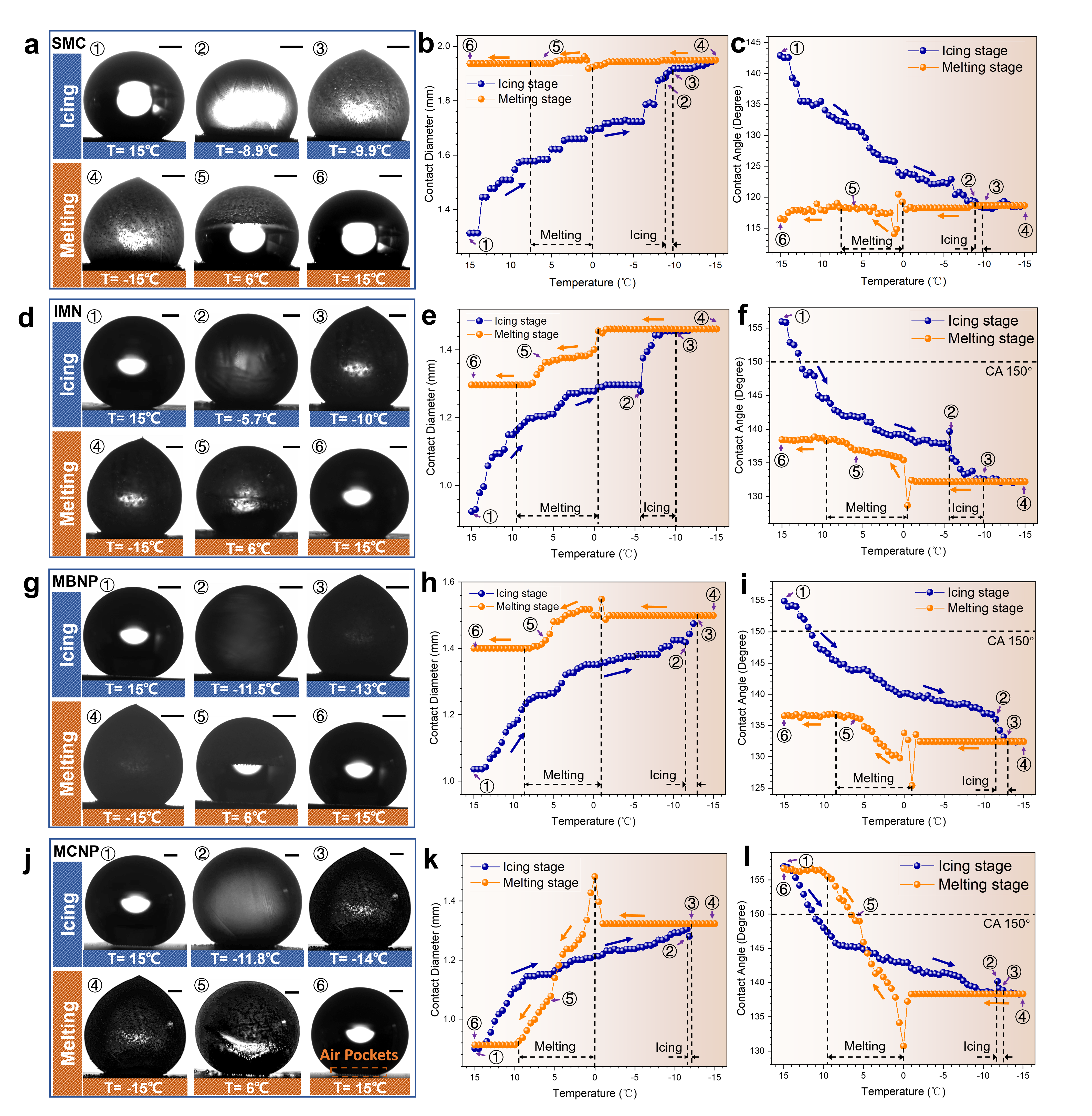
Fig. 2 States, contact diameters and contact angles of droplets on the four hydrophobic surfaces during icing and melting processes. a-c On the SMC (Single-scale periodical microcones) surface. d-f On the IMN (Irregular micro-nanostructure by chemical etching) surface. g-i On the MBNP (Double-scale random microbumps with dense nanoparticles) surface. j-l On the MCNP surface (Double-scale periodical microcones with dense nanoparticles).
Given this phenomenon, we have a question that what on earth propels the occurrence of the spontaneous dewetting transitions. To reveal the dewetting transition mechanism, we investigated the icing and melting processes further, and observed that massive bubbles were frozen in the ice droplets during the icing process due to the rapid decrease of air solubility in ice. While during the melting process, under the Marangoni force induced by surface tension gradient, the frozen bubbles could magically impact the bottom micro-nano valleys to prompt the recovery of air pockets, thus realizing the Wenzel-to-Cassie transition. By conducting a large number of experiments and theoretical analysis, we analyzed the changes of systematical energy and interfacial thermal resistances during wetting and dewetting processes, and further confirmed the prompting effects of bubbles impact on the dewetting transitions.
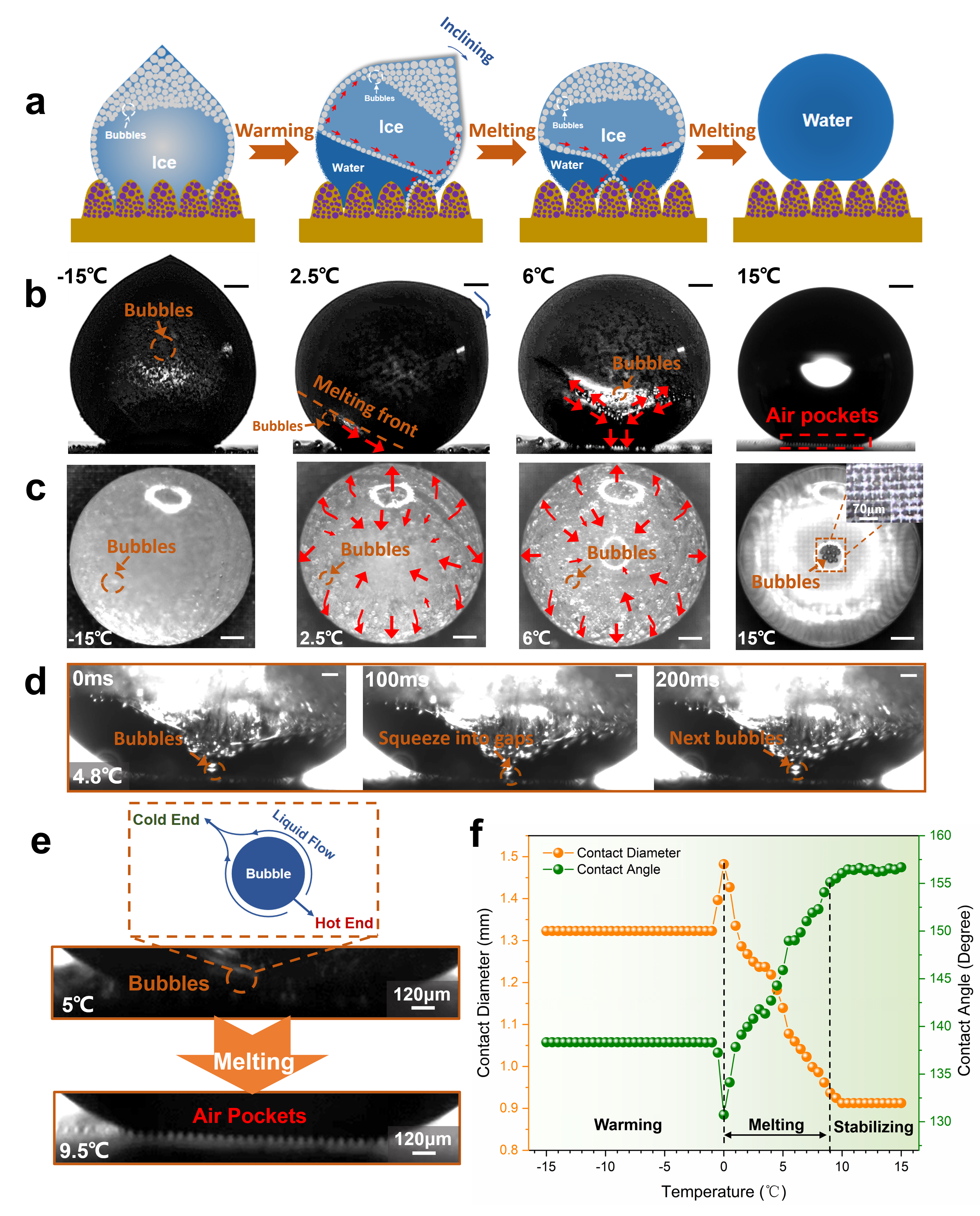
Fig. 3 Melting process of an ice droplet on the MCNP surface. a Schematic illustration of melting process. b Direct observation from the side view. c Direct observation from the top view. d Proof of bubbles downward movement and squeezing into the bottom micro-nano valleys sequentially.e Magnified observations for the appearance of the bottom air pockets with the increase of temperature. f The changes of contact diameters and contact angles of droplets on the MCNP surfaces with the temperature increase.
However, we found that not all superhydrophobic surfaces could realize the dewetting transitions well. To better guide the design of superhydrophobic icephobic surfaces, based on experimental and theoretical results, we concluded that the dewetting transition only occurred on the surfaces with superior superhydrophobicity, excellent icing delay property and appropriate micro-nanostructure with low surface resistance. Meanwhile, we confirmed that the special micro-nanostructured superhydrophobic surfaces fabricated by ultrafast laser well met the above three dewetting criteria, and could have the transition from Wenzel state to Cassie-Baxter state even if under multiple continuous icing & melting cycles, different environmental conditions, and icing conditions. These results further confirmed the universality and robustness of dewetting transitions on our designed surfaces. It can be observed in Figure 4 that the contact angles and sliding angles of droplets could still reach 155.6°±0.7° and 5.9°±0.4° even after five continuous cycles.
On the contrary, most superhydrophobic surfaces reported in currently published papers cannot realize the spontaneous Wenzel-to-Cassie transition during icing & melting cycle since their micro-nanostructures do not meet the above three criteria well. Therefore, the melted droplets on these surfaces cannot be removed easily, leading to the failure of superhydrophobic surfaces.
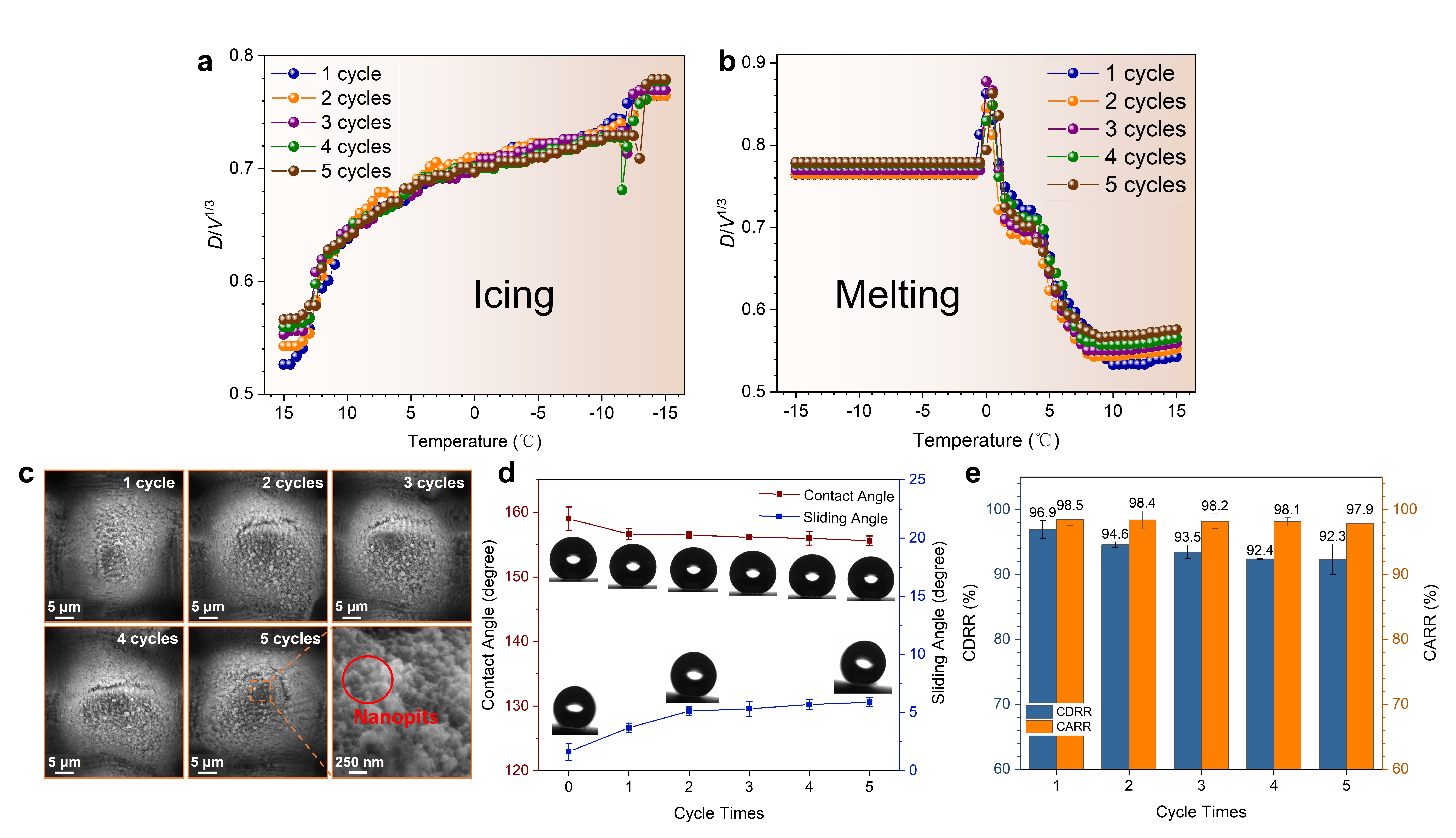
Fig. 4 Robustness tests of the W2C transition. a The D/V^(1/3) changes of the same droplet on the same location with the temperature decrease after 1–5 cycles. b The D/V^(1/3) change of the same droplet on the same location with increasing temperature after 1–5 cycles. c Evolutions of surface micro-nano structures after multiple cycles. d Evolutions of contact angles and sliding angles of the same droplet after multiple cycles. e The changes of the contact diameter recovery rates (CDRR) and the contact angle recovery rates (CARR) of droplets on the MCNP surface with the increase of cycle times.
In this work, we demonstrated the spontaneous dewetting transition from the Wenzel state to the Cassie-Baxter state during the icing & melting cycle and clarified the transition mechanisms and three design criteria for the transition. Our discoveries and investigations might enrich the acknowledgment of the general icing and melting phenomena in nature, and contribute to the development and applications of superhydrophobic anti-icing surfaces.
For more information, please read our paper.
https://www.nature.com/articles/s41467-022-28036-x#article-comments

Follow the Topic
-
Nature Communications
An open access, multidisciplinary journal dedicated to publishing high-quality research in all areas of the biological, health, physical, chemical and Earth sciences.

Related Collections
With Collections, you can get published faster and increase your visibility.
Women's Health
Publishing Model: Hybrid
Deadline: Ongoing
Tumor Microenvironment Crosstalk and Therapeutic Implications
Publishing Model: Hybrid
Deadline: Nov 02, 2026