Sugar transporter modulates nitrogen-determined tillering and yield formation in rice
Published in Sustainability and Plant Science

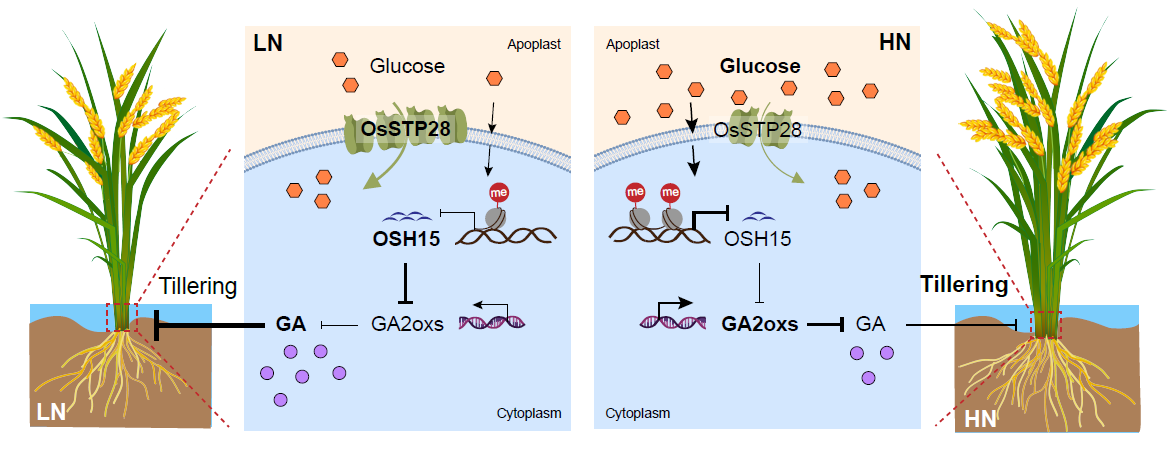

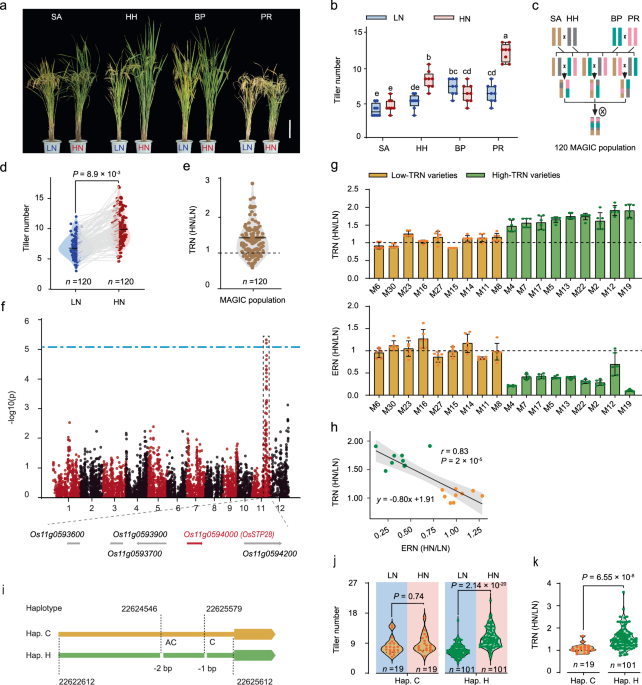

The synergistic metabolism and distribution of carbon (C) and nitrogen (N) in crops are the prerequisites for high yield and N use efficiency (NUE). In rice, N-determined shoot branching, also referred as tillering, makes a major contribution to improve yield and NUE. Uncovering the regulatory mechanism underlying tillering response to N becomes an important task for the genetic improvement of rice. Here, by dissecting the genetic basis underlying tillering response to N, Zhang et al. identify a plasma membrane localized glucose influx transporter OsSTP28 as a key regulator of N-responsive tillering and yield formation in rice.
- Increased N supply represses the expression of OsSTP28 to reduce glucose influx from apoplast to cytosol and results in glucose accumulation in tiller buds, which in turn inhibits the expression of a transcriptional inhibitor OSH15 via an epigenetic mechanism to activate gibberellin 2-oxidases-facilitated gibberellin catabolism in shoot base.
- OsSTP28-OSH15-GA2oxs module reduces the level of bioactive gibberellin in shoot base thus boosting tillering and grain yield upon elevated N supply.
- Knockout of OsSTP28 by genome editing substantially improves N-responsive tillering and grain yield, and such improvement has been verified in several elite Asian cultivated rice.
- An elite allele of OsSTP28 that is widely distributed in modern cultivated rice varieties and can more efficiently stimulate N-responsive tillering and yield formation, thus representing a valuable breeding target of NUE improvement for agricultural sustainability.
Previous studies have reported some important regulators of N- determined tillering in rice, such as OsTCP19 (Liu et al., 2021, Nature) and NGR5 (Wu et al., 2020, Science). However, the genetic basis and molecular mechanism of tillering response to N and yield formation are inherently complex and need deeper explorations. First, this study reveals that OsSTP28 facilities an OsTCP19-independent regulatory cascade to complement the declination of OsTCP19 in modern cultivated rice varieties, thus representing a novel mechanism of N-responsive tillering in modern elite rice varieties. Second, this study demonstrates that OsSTP28 functions genetically upstream of gibberellin metabolism and NGR5 to regulate tillering response to N. Third, OsSTP28 acts as a critical checkpoint to coordinate an appropriate balance between intercellular N status and carbohydrates distribution in sink organs that is essential for achieving N-responsive organ development and yield formation. Moreover, this study demonstrates that OsSTP28 can be taken as a valuable breeding target for improving yield and N use efficiency in rice.
References:
- Zhang, J. et al.Sugar transporter modulates nitrogen-determined tillering and yield formation in rice. Nat Commun 15, 9233 (2024).
- Liu, Y. Q. et al. Genomic basis of geographical adaptation to soil nitrogen in rice. Nature 590, 600–605 (2021).
- Wu, K. et al. Enhanced sustainable green revolution yield via nitrogen-responsive chromatin modulation in rice. Science367, 6478 (2020).
Follow the Topic
-
Nature Communications
An open access, multidisciplinary journal dedicated to publishing high-quality research in all areas of the biological, health, physical, chemical and Earth sciences.

Related Collections
With Collections, you can get published faster and increase your visibility.
Women's Health
Publishing Model: Hybrid
Deadline: Ongoing
Tumor Microenvironment Crosstalk and Therapeutic Implications
Publishing Model: Hybrid
Deadline: Nov 02, 2026