TCF1 as a Key Regulator of the Hybrid EMT State in Breast Cancer: Balancing Self-Renewal and Differentiation
Published in Biomedical Research






Background
Triple-negative breast cancer (TNBC) remains one of the most aggressive and treatment-resistant forms of breast cancer. Recent research has revealed that a unique hybrid epithelial/mesenchymal (E/M) subpopulation conveys tumor stemness and metastasis. In this study, we investigate how TCF1 (T cell factor 1) transcription factor, encoded by the TCF7 gene, known to drive T-cell stemness and immunity, regulates the hybrid EMT state, and how targeting this plastic state could open new therapeutic avenues for TNBC.
Cancer stem cells and the EMT spectrum
Cancer stem cells (CSCs) represent a small but potent subpopulation within solid tumors. They are capable of self-renewal and tumor regenerative ability leading to cancer recurrence and metastasis. Unlike the bulk of the tumor, CSCs exhibit chemo and therapy resistance and possess the ability to differentiate into various cell types within the tumor hierarchy. Elucidating their role in malignancy might provide key insights into therapeutic interventions. CSCs are fueled by the epithelial-to-mesenchymal transition (EMT), a process whereby epithelial tumor cells acquire a mesenchymal, metastasis-prone phenotype. EMT is being increasingly recognized not a binary process but as a continuum of epithelial and mesenchymal states, contributing to tumor heterogeneity, stemness and metastasis.
TCF1/Wnt signaling: a regulator of the hybrid EMT state
One question relevant to cancer stem cells is how hybrid EMT cells coordinate self-renewal with differentiation.
We isolated epithelial/mesenchymal (E/M) and mesenchymal (M) subpopulations from basal-like breast cancer cell lines that were CD104high/CD44high and CD104low/CD44high respectively. We found that TCF1 was upregulated in E/M cells. Overexpressing TCF1 in M-cells induced an E/M phenotype, with enhanced Wnt/b-catenin signaling, organoid and tumor-forming ability, highlighting the central role of Wnt signaling in E/M state regulation.
This led us to ask: how Wnt signaling regulates hybrid EMT and how it coordinates with EGFR signaling which is overexpressed in basal-like breast cancer cells?
Wnt versus EGF: a tug of war between self-renewal and differentiation.
By comparing ERK phosphorylation in response to canonical Wnt3a and EGF in E/M cells, we observed that Wnt3a induced transient while EGF triggered sustained ERK activation, thus mirroring their respective effects on self-renewal and differentiation.
Remarkably, Wnt3a/ERK activation transiently inactivates EGFR, thus preventing sustained ERK phosphorylation from causing mesenchymal (M) differentiation, while stimulating CDK4/6 that drives E/M cell self-renewal. Indeed, MEK/CDK4/6 drug perturbation suppressed organoid formation, tumor initiating potential, and induced E/M-to-E (epithelial) differentiation.
How ERK and CDK4/6 Shape the E/M Transcriptional Landscape?
ERK and CDK4/6 also exert profound effects on the transcriptional landscape of E/M cells involving a tight regulation by the transcription factors FOXC2 and FOXM1. While ERK or CDK4/6 drug perturbation suppressed FOXM1, combined ERK plus CDK4/6 inhibition was required to suppress FOXC2 expression. Remarkably, we showed that FOXC2 regulates TAp63 and DNp63 isoforms, which together support the E and M state respectively, partly via CD104 and Frizzled 7 upregulation.
Therapeutic implication for TNBC
Although CDK4/6 inhibitors are FDA-approved for ER-positive breast cancer, they are generally deemed ineffective for triple-negative breast cancer (TNBC) due to frequent deletions or mutations in the retinoblastoma (RB) gene. However, our study reveals that RB-deficient basal-like breast cancer (BC) cell lines express RBL proteins (p107 and p130), which may compensate for RB1 loss. This observation suggests that a subset of RBL-positive TNBC patients might still benefit from CDK4/6-targeted therapy. Notably, while CDK4/6 inhibition (using Abemaciclib) or MEK inhibition (using PD0325901) each effectively suppressed organoid formation by E/M mammary tumor cells ex vivo, dual therapy (Abemaciclib+ PD0325901) demonstrated superior efficacy, indicating a promising combinatorial treatment strategy for a subset of TNBC.
Synopsis
Wnt/ERK/CDK4/6 activation plays a pivotal role in fomenting the hybrid EMT state by promoting tumor stemness via FOXC2/p63 and self-renewal via FOXM1, while inactivating EGFR to suppress differentiation, resulting in tumor regenerative potential.
Proposed model: TCF1/ERK/CDK4/6 regulation of hybrid EMT state and its therapeutic potential in TNBC
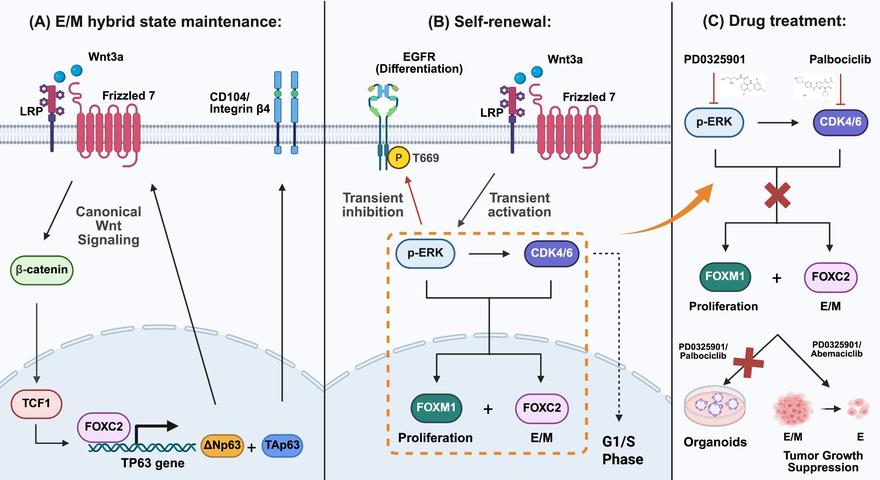
(A) Maintenance of E/M hybrid state: TCF1 upregulation in E/M cells potentiates Wnt/b-cat signaling which upregulates FOXC2, which in turn upregulates DNp63 and TAp63 isoforms. DNp63 activates Frizzled 7/Wnt signaling, while TAp63 regulates CD104; the two jointly stabilize the hybrid EMT state.
(B) Self-renewal of E/M CSCs: Wnt3a induces transient ERK phosphorylation (p-ERK), which promotes CDK4/6 activity and S-phase entry. In parallel, p-ERK inactivates EGFR via T669 phosphorylation, preventing sustained ERK signaling from EGFR that drives differentiation and thus CSC exhaustion. In parallel, ERK/CDK4/6 stabilizes FOXC2 and FOXM1 to support E/M maintenance and self-renewal.
(C) Therapeutic implications: Dual MEK (PD0325901), and CDK4/6 (Palbociclib or Abemaciclib) inhibitors suppress organoid formation and tumor growth by promoting E/M to E differentiation resulting in malignancy suppression.
British Journal of Cancer; https://doi.org/10.1038/s41416-025-03178-z
Follow the Topic
-
British Journal of Cancer
This journal is devoted to publishing cutting edge discovery, translational and clinical cancer research across the broad spectrum of oncology.