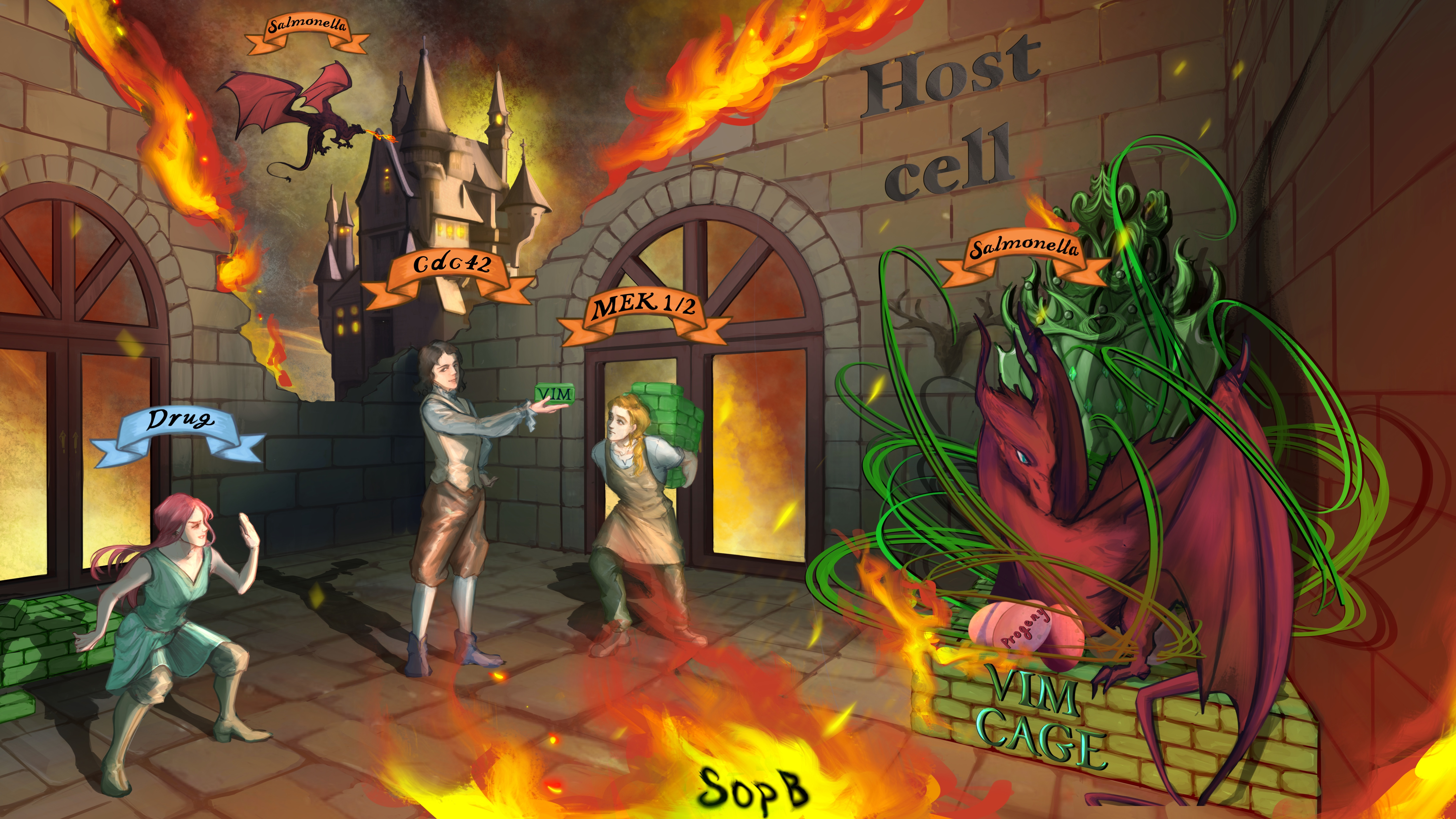
The infection event could have ended in tragedy
Published in Microbiology





This tragic story of bacterial invasion has existed since ancient times. Different from the previous tragedies, as the director of this drama, we established a plot reversal. After a series of efforts and trails, we found one solution to prevent the tragedy from happening --- we found a promising medicine to cure infection through imaging based high-throughput screening.
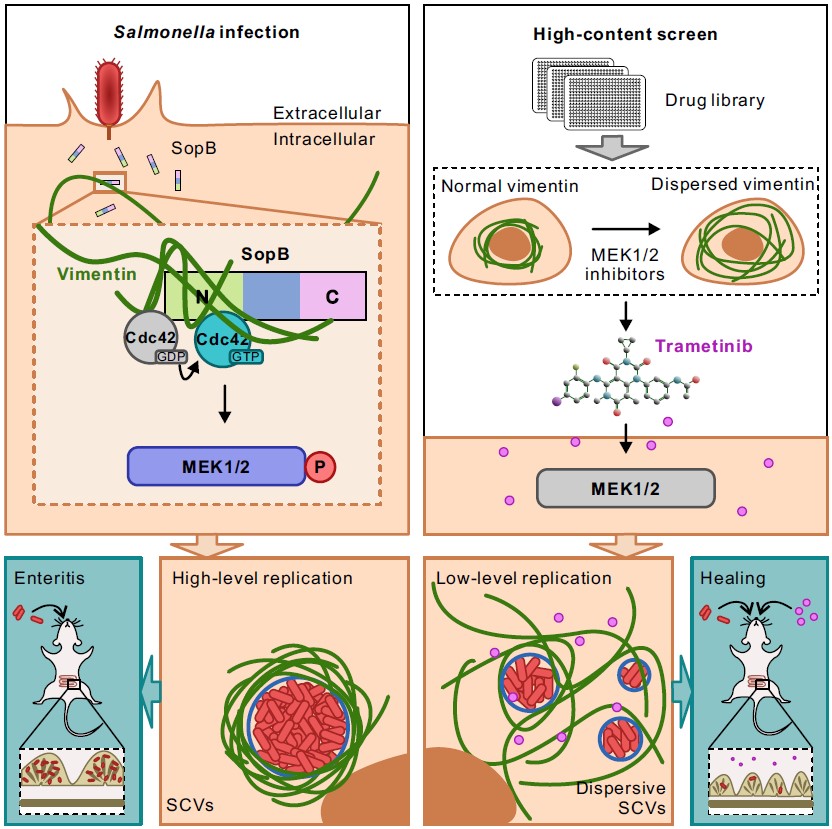
The drama begins with the international terrorist ‘Salmonella’ (Salmonella typhimurine infects more than 100 million people worldwide every year) releasing a highly lethal weapon ‘B’ (SopB, the virulence factor of the bacterial type 3 secretion system) into human homeland (host cells). Weapon ‘B’ purposely recognizes a homeland member ‘C’ (the small G-protein Cdc42 in the host cell) and triggers the activation of ‘C’ (the N-terminal of SopB binds and activates Cdc42). The homeland member ‘C’ and another homeland member ‘M’ (MEK kinase) team-up together to carry the bricks ‘V’ (Cdc42-MEK induces the reconstruction of cytoskeletal intermediate filament vimentin) on the faulty instruction. ‘V’ has built an illegal ‘iron throne’ named SCV (Salmonella Containing Vacuole). The terrorist ‘Salmonella’ invaded into our homeland, lived within ‘iron throne’ SCV, and further produce many copies of ‘Salmonella’ within the ‘iron throne’, which was protected by solid brick ‘V’. The entire homeland thus cannot function properly and eventually collapse (host cells malfunction or die, and countless patients are infected in this way, leading to disease and even death).
The sad part of this drama is that ‘V’, who belonged to a member of the homeland, was hijacked as hostage by terrorists. Our work aims to find ways to prevent the ‘betray’ of ‘V’. In order to wake up ‘V’, we set up a screen platform to prevent ‘V’ from being taken. A clinical drug ‘T’ was subsequently found, which was originally an anti-tumor drug. However, we found drug ‘T’ can lock up brick ‘V’ and kept it from being moved within the homeland, so that the homeland SCV is not able to build. The components in the host cell protect the human body just like the way we guard our homeland. Every individual makes ‘mistake’. Therefore, the constant searching for safeguards to monitor the system can be used to repair errors. In our story, fixing the ‘mistake’ not only fends off the invasion of the terrorist ‘Salmonella’, but also saves homeland member ‘V’. ‘V’ remains as intermediate filament protein with the most tolerance and resilience ability.
Reference:
Zhao S#,Xu Q#,Cui Y#,Yao S,Jin S, Zhang Q,Wen Z,Ruan H,Liang X, Chao Y, Sansonetti P,Wei K*,Tang H*,Jiu Y* “Salmonella effector SopB reorganizes cytoskeletal vimentin to maintain replication vacuoles for efficient infection”. Nature Communications. Jan30;14(1):478. doi:10.1038/s41467-023-36123-w. 2023.

Follow the Topic
-
Nature Communications
An open access, multidisciplinary journal dedicated to publishing high-quality research in all areas of the biological, health, physical, chemical and Earth sciences.

Related Collections
With Collections, you can get published faster and increase your visibility.
Women's Health
Publishing Model: Hybrid
Deadline: Ongoing
Tumor Microenvironment Crosstalk and Therapeutic Implications
Publishing Model: Hybrid
Deadline: Nov 02, 2026