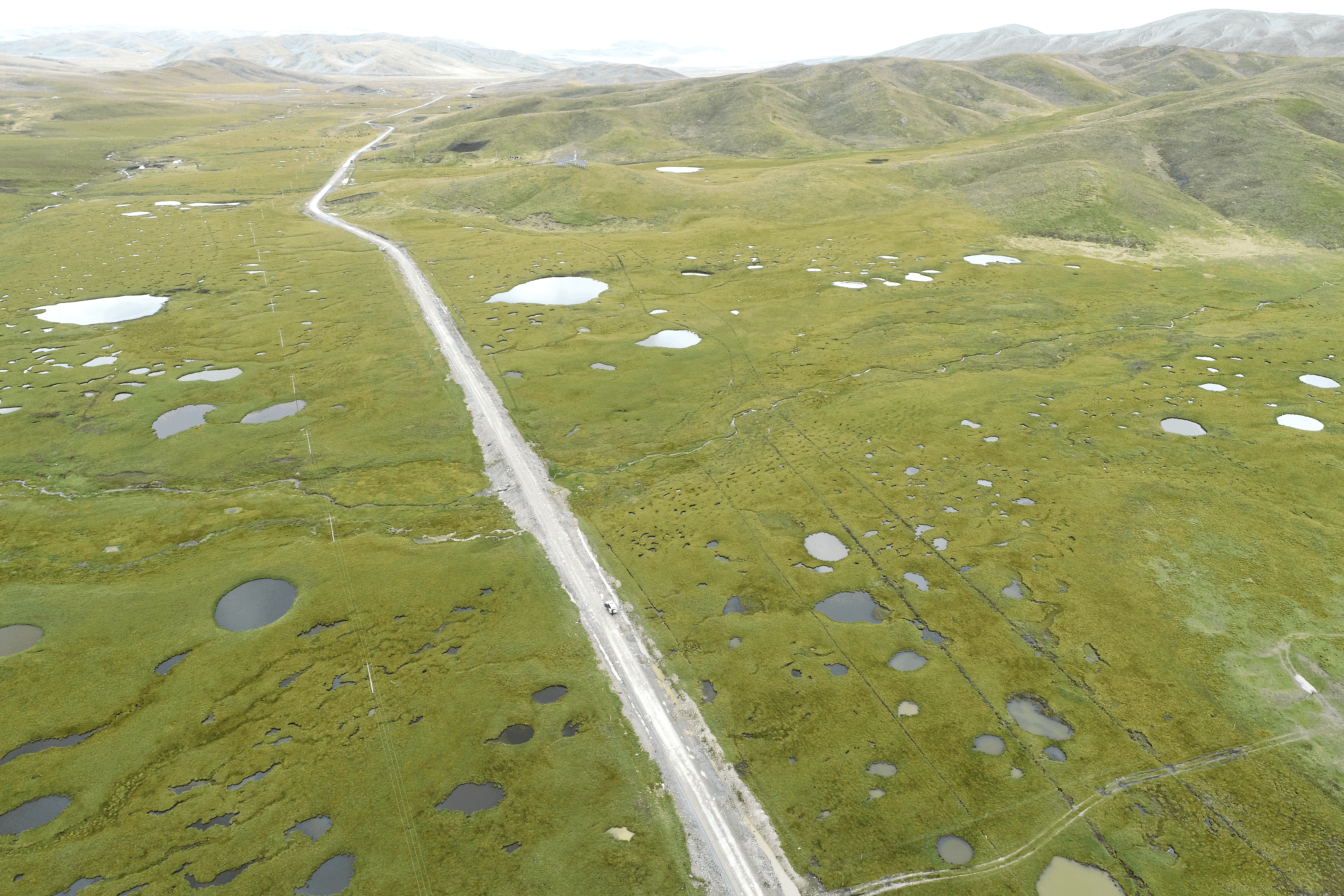




Why care about thermokarst lake methane emissions on the Earth’s Third Pole?
As the third most important greenhouse gas, methane (CH4) has been increasing by ~250%, exceeding the increased rate of carbon dioxide (CO2) by ~120% since the pre-industrial era. Thermokarst lakes, one type of abrupt permafrost thaw, are estimated to cover ~7% of the permafrost region and thought to be an important source of the CH4 emissions. However, previous observational evidence about thermokarst lake CH4 emissions mainly concentrated on the high-latitude permafrost regions. The Tibetan Plateau, known as Earth’s Third Pole due to its unique terrain, owns the largest high-altitude cryosphere around the world. Similar to the Arctic permafrost regions, the Tibetan Plateau has been experiencing fast climate warming and extensive permafrost thaw, inducing widespread thermokarst lakes across this permafrost region with the number of 161,300 and a total area of ∼2,800 km2. However, their CH4 emissions are still not well known by the global change research community. One major reason is that the rugged environment, such as remoteness, oxygen limitation, and traffic inconvenience conditions make any field studies in this region very challenging. Collectively, this knowledge gap prevents accurate prediction about the magnitude of carbon-climate feedback in this climate sensitive region.
How to conduct field monitor and laboratory analyses?
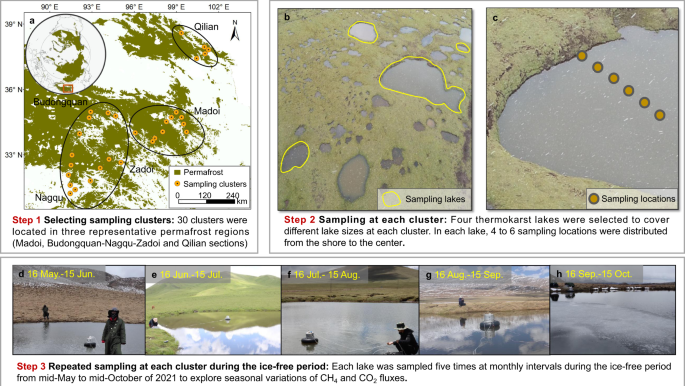
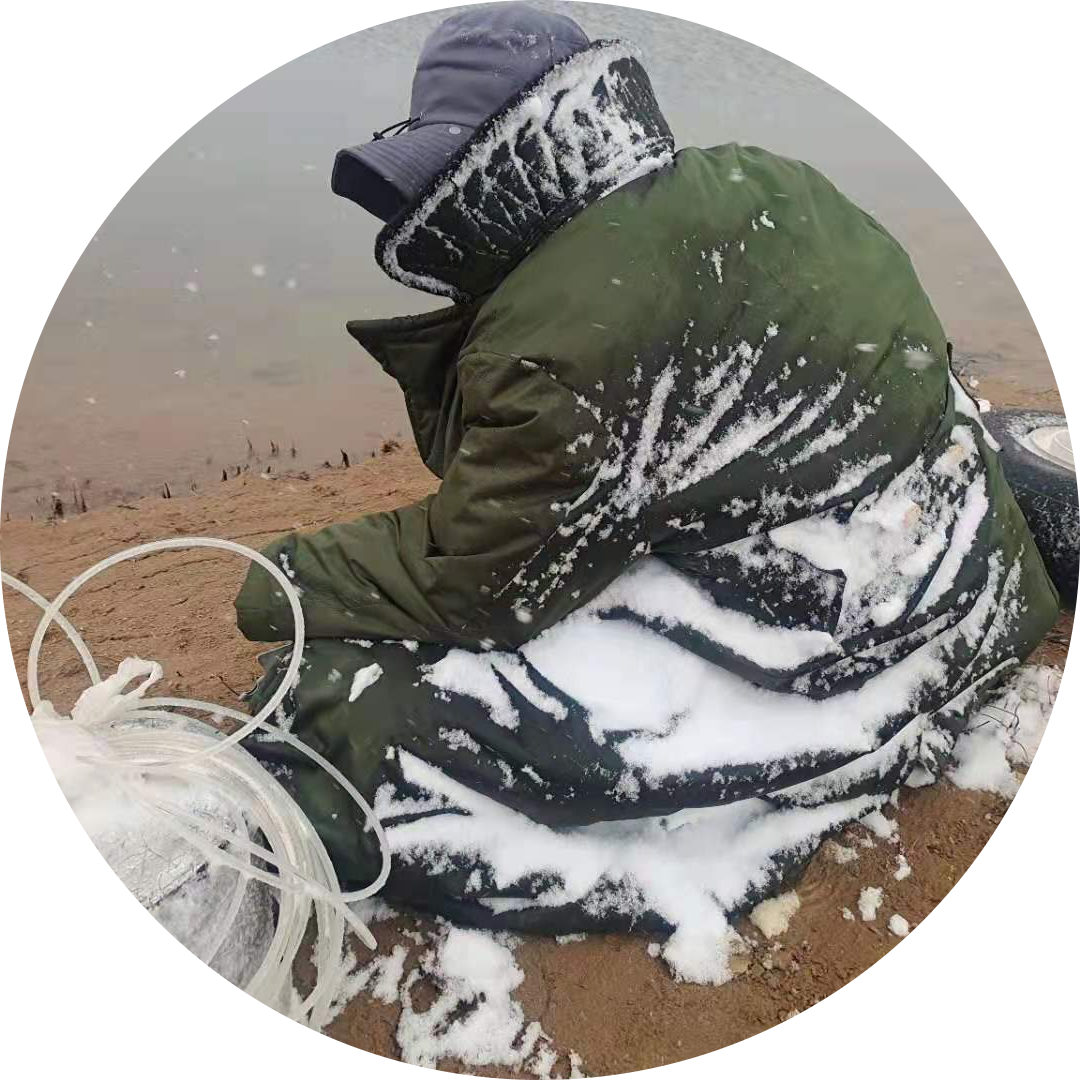
My research interest has been in exploring the response of greenhouse gas emissions to climate change since my PhD. My supervisor, Prof. Yuanhe Yang from Institute of Botany, Chinese Academy of Sciences, mainly focuses on permafrost carbon cycle on the Tibetan Plateau. In 2018, we produced an idea to figure out the characteristics of CH4 emissions from alpine thermokarst lakes on the Tibetan Plateau. With this goal in mind, we investigated the distribution of thermokarst lakes, and determined 120 thermokarst lakes in 30 monitoring clusters on the Earth’s Third Pole from July to August 2020. In the winter of 2020, the experimental design was determined with the help of Drs. Yuanhe Yang and Yunfeng Peng. During the ice-free period from mid-May to mid-October of 2021, my junior brother Zhihu Zheng and I carried out a large-scale sampling campaign to measure CH4 fluxes along a 1,100 km transect on the Tibetan Plateau. Data collection of in-situ flux was an incredibly hard work. During that period, I suffered a severe headache at the high elevations and was unable to sleep for days on end. Besides, I also encountered an earthquake with a magnitude of 7.4, car accident, and drowning event many times during field sampling, which almost took away my life. Fortunately, the unique dataset was successfully collected, which made all worth it. This article builds on efforts that have been given by my friends and collaborators. When Yutong Song, Luyao Kang and Shuqi Qin joined, our research group was strengthened in the microbiology, isotopic technique, and statistical analyses. Dr. Liwei Zhang from Peking University and Prof. Pengfei Liu from Lanzhou University provided valuable advice on flux calculation and the regarding bioinformatic analyses and interpretations. I also really appreciate the international collaborators, Drs. Benjamin W. Abbott, David Olefeldt, Christian Knoblauch and Katey Walter Anthony for their constructive comments on an early version of the manuscript. This article would not have been possible without their attendance.
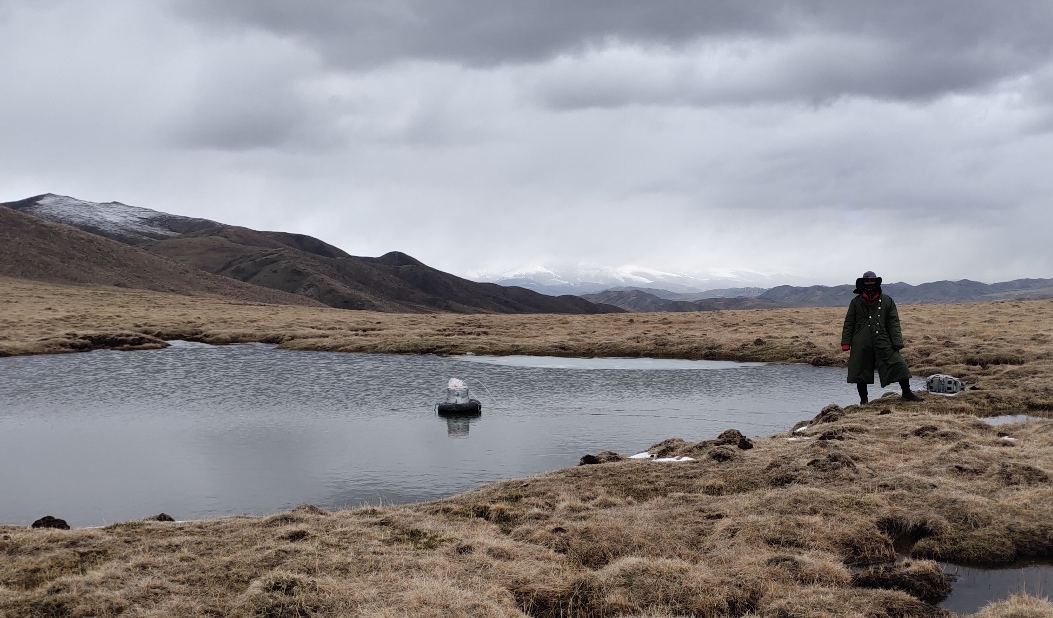
In-situ flux measurement. Photograph is taken by Zhihu Zheng.
What results were obtained?
Our research provides an insight into the spatial patterns, sources, and microbial characteristics of CH4 emissions from thermokarst lakes on the Earth’s Third Pole. One significant finding of the research is that thermokarst lakes on the Earth’s Third Pole were hot spots of CH4 emission with very high fluxes ranging from 0.1 to 39.2 mmol m-2 d−1, which is at the high end of the range reported from the Arctic thermokarst water bodies. Moreover, we amazedly found that old carbon was not the dominant source of CH4 production from thermokarst lakes on the Tibetan Plateau. It means that we should put more efforts into accurately predicting the effect of permafrost thaw on the spatial extent of thermokarst lakes in this permafrost region, rather than on the anaerobic decomposition rate of previously frozen soils in the future. Furthermore, our results demonstrated that CH4 was mainly derived from the hydrogenotrophic pathway, and the relative abundances of methanogenic genes correspond to the in-situ CH4 fluxes. Overall, our research aims to inform scientists and policymakers, helping to improve their ability to better predicting permafrost carbon-climate feedback on the Earth’s Third Pole and make mitigation policies accordingly. More details can be found in our paper ‘Characteristics of methane emissions from alpine thermokarst lakes on the Tibetan Plateau’ published in Nature Communications.
Outlook
It is known that warming-induced permafrost thaw can occur through the development of thermokarst landforms, but also via active layer deepening. However, based on current manipulative warming technologies, such as open top chambers and snow fences, it is difficult to simulate active layer deepening, especially in where the active layer is thick. Consequently, it remains challenging to quantify the responses of greenhouse gas emissions to increased active layer thickness under climate warming scenarios. In our research group, we have developed a novel warming experiment which could simulate both air and soil warming, as well as active layer deepening. This experiment platform has been established and successfully worked for two years, which provides great potentials to address above scientific questions. In the future, we look forward to discovering more interesting phenomena and the underlying mechanisms based on this novel platform to fill the knowledge gap of greenhouse gas emissions upon increased active layer thickness.
Follow the Topic
-
Nature Communications
An open access, multidisciplinary journal dedicated to publishing high-quality research in all areas of the biological, health, physical, chemical and Earth sciences.
Related Collections
With Collections, you can get published faster and increase your visibility.
Women's Health
Publishing Model: Hybrid
Deadline: Ongoing
Tumor Microenvironment Crosstalk and Therapeutic Implications
Publishing Model: Hybrid
Deadline: Nov 02, 2026


Please sign in or register for FREE
If you are a registered user on Research Communities by Springer Nature, please sign in