Towards unravelling the mechanisms of “clever” plant roots designing resilient microbiomes
Published in Microbiology




The above excerpt from our paper was the motivation behind this research work. The story began three years ago when we decided to conduct a quick study to explore the influence of plant defensive secondary metabolite, benzoxazinoids on the maize associated microbiomes. This idea was fostered by two researchers who had fallen in love with two extreme specialties of science; plant pathology and natural product chemistry and were supported by enthusiastic and energetic lab group members.
Fast forward, we had many discussions on the experimental design that will enable us to achieve our objective of profiling BXs effects on microbiomes at different stages of maize development. One key challenge that we had was the choice of growth system that will be appropriate for this study. Nevertheless, things worked out quite well when we settled on the rhizobox growth system. We setup the experiment in our open semi-field facility and thus the seedlings enjoyed the coruscating 2016 summer sunshine. Throughout the sample preparation and data analysis phases, we continuously discussed the progress of work! This was important for effective collaborative studies!
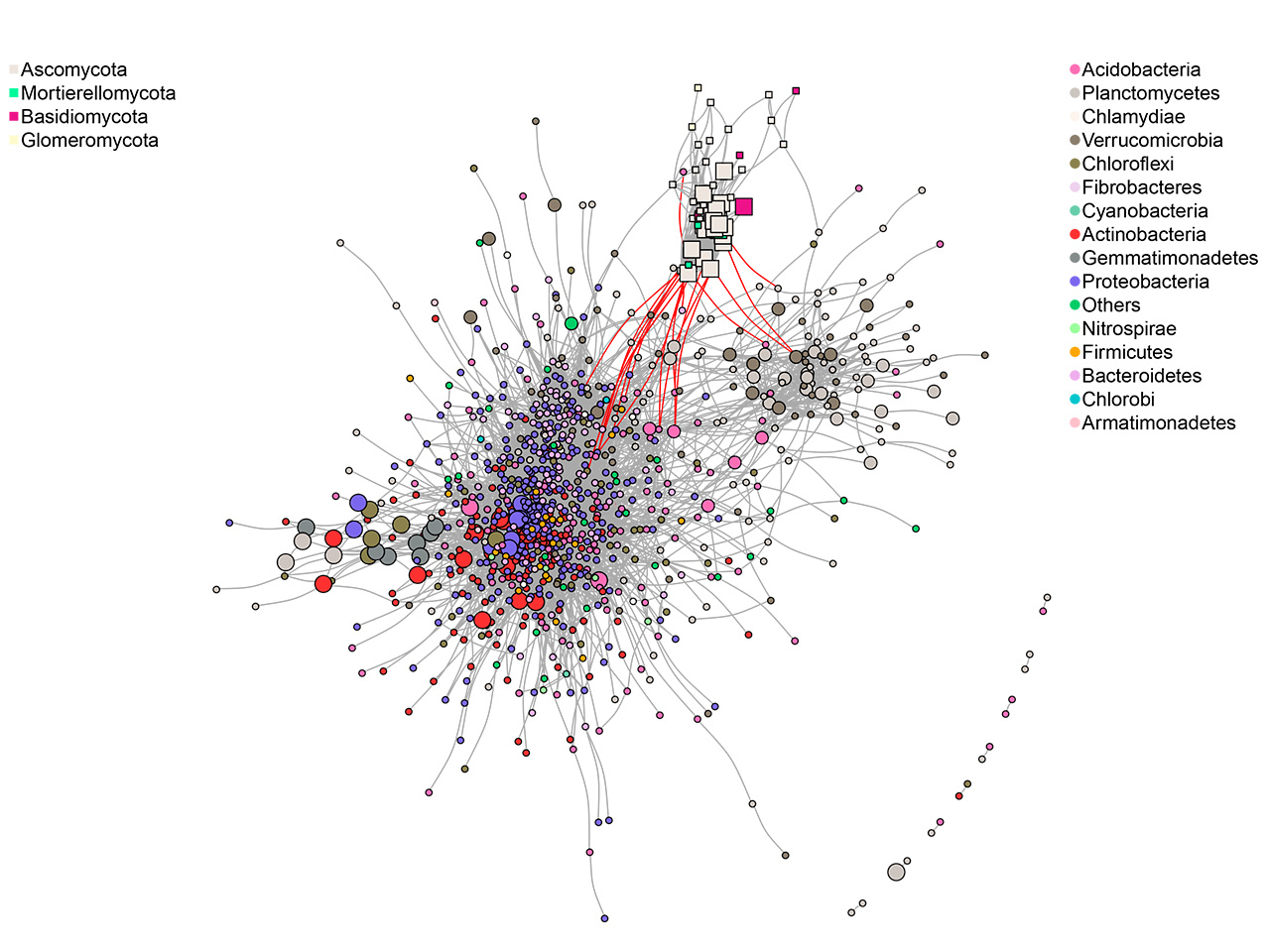
Data exploration stage came with new excitement as interesting results trickled in and we were enlivened with curiosity to probe the data into details. Overall, our work revealed the role of BXs as key modulators or “gatekeepers” during maize microbiome assemblage. This was further corroborated by network analysis, which showed that BXs affected specific microbial clusters of the microbiome. Moreover, we found that BXs negatively correlated with specific plant pathogens that are of great economic importance. We therefore suggest that the higher BX synthesis during the early development of maize and its effect on microbial communities might open new frontiers for maize breeding in the future.
Poster 1: Microbial network based on Spearman’s correlations in the roots of W22_1 and its mutant. OTUs are shown as nodes, and correlations as edges. Positive and negative correlations are shown with grey and red edges, respectively. Bacterial and fungal nodes are represented as square and circle symbols in the network, respectively. Indicator OTUs for bx1W22_1 and W22_1 are shown with a large and a medium node size while others are shown with small size to indicate the location of indicator species in overall network
Reference:
Kudjordjie EN, Sapkota R, Steffensen SK, Fomsgaard IS, Nicolaisen M. Maize synthesized benzoxazinoids affect the host associated microbiome. Microbiome; 2019;1–17.
https://microbiomejournal.biomedcentral.com/articles/10.1186/s40168-019-0677-7

Follow the Topic
-
Microbiome
This journal hopes to integrate researchers with common scientific objectives across a broad cross-section of sub-disciplines within microbial ecology. It covers studies of microbiomes colonizing humans, animals, plants or the environment, both built and natural or manipulated, as in agriculture.

Related Collections
With Collections, you can get published faster and increase your visibility.
Oncobiome
This collection of papers delves into the burgeoning field of oncobiome research, exploring the intricate relationship between cancer and the microbiome. The oncobiome encompasses the diverse microbial communities residing in and on the human body, which influence cancer development, progression, and treatment responses. By examining these interactions, our aim is to unravel the complex mechanisms through which the microbiome impacts oncogenesis and therapeutic outcomes.
This compilation highlights cutting-edge research, offering insights into potential diagnostic markers and novel therapeutic strategies, thereby advancing our understanding of cancer biology and paving the way for innovative, microbiome-targeted cancer treatments.
This is a cross-journal collection between:
Experimental Hematology and Oncology
Articles will undergo the standard peer-review process of the journal to which they are submitted and are subject to either the BMC editorial policies or those of BJC Reports. Articles will be added to the Collection as they are published. The Editors have no competing interests with the submissions which they handle through the peer review process. The peer review of any submissions for which the Editors have competing interests is handled by another Editorial Board Member who has no competing interests.
Publishing Model: Open Access
Deadline: Ongoing
The Apple Microbiome
Microbiome and Environmental Microbiome are calling for submissions to our Collection on the Apple Microbiome.
With world apple production estimated at 84 million tons, the microbiome of the apple has significant implications for agriculture, food security, and human health. Understanding the complex interactions between apple plants and their associated microbial communities can lead to improved crop management strategies, enhanced fruit quality and longevity, and sustainable agricultural practices. Recent advances have highlighted the role of specific bacteria and fungi in promoting plant health and resilience against specific pathogens. Moreover, detailed profiling of these microbial communities, revealing their diversity and functional potential facilitate exciting future developments, such as the identification of beneficial microbial consortia for biocontrol and the formulation of tailored probiotic treatments for both plants and humans. By advancing our collective understanding in this area, we can work towards a more sustainable and resilient agricultural system.
Topics of interest include but are not limited to:
-Microbial diversity and function associated with apples
-Effects of soil health and rhizosphere interactions on apple production
-Impact of climate change on the apple microbiome
-Role of the apple microbiome in fruit quality
-Microbiome-driven strategies for disease resistance
This collection is open for submissions from all authors on the condition that the manuscript falls within both the scope of the collection and the journal it is submitted to.
All submissions in this collection undergo the relevant journal’s standard peer review process. Similarly, all manuscripts authored by a Guest Editor(s) will be handled by the Editor-in-Chief of the relevant journal. As an open access publication, participating journals levy an article processing fee (Microbiome, Environmental Microbiome). We recognize that many key stakeholders may not have access to such resources and are committed to supporting participation in this issue wherever resources are a barrier. For more information about what support may be available, please visit OA funding and support, or email OAfundingpolicy@springernature.com or the Editor-in-Chief of the journal where the article is being submitted.
Publishing Model: Open Access
Deadline: Sep 30, 2026