Unveiling Europe's Air Quality: Breathing Easier, But Not There Yet
Published in Earth & Environment and Public Health


Europe has been actively fighting air pollution through a multidimensional approach. The EU sets strict air quality standards and member states are required to monitor and take action if levels are exceeded. Air quality plans are developed, often targeting traffic and industrial emissions. The continent-wide "Zero Pollution Action Plan" aims for a 55% reduction in by health impacts (premature deaths) of air pollution by 2030 and ultimately are no longer harmful to health and natural ecosystems by 2050. This includes promoting electric vehicles, cleaner industries, and sustainable agriculture.
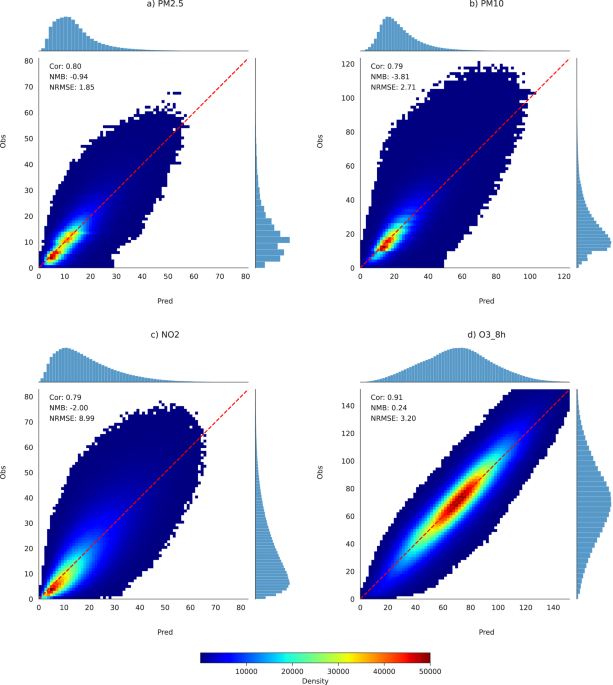
In this new data-driven analysis, we made use of multiple sources data from satellites, existing climate data, land use data and ground stations to estimate high-resolution surface level of air pollutants like PM2.5, PM10, NO2 and O3 across Europe from 2003-2019. The study, supported by early-adapt project, recreates a comprehensive daily air quality picture for the European continent, going beyond traditional monitoring stations which are sparsely distributed and mainly located in cities. The findings confirm the progress made in Europe: PM10 and NO2 levels significantly decreased across the continent, with annual reductions of 2.72% and 2.45%, respectively. However, challenges remain, including heterogeneous geographical distribution of unclean air quality, the challenge of O3 management and challenge of compound episodes.
Heterogeneous geographical distribution of unclean air quality
From 2003-2019, PM2.5 and PM10 levels were highest in northern Italy, eastern Europe, and South-East Europe. These regions are also experiencing slower reductions in these pollutants compared to central Europe, so they need to implement stricter regulations and invest in cleaner technologies for industries, energy production, and agriculture in these regions. Encouraging sustainable transportation options like electric vehicles and expanding green spaces could also significantly improve air quality.
High NO2 concentrations were primarily observed in numerous urban centers, particularly within northern Italy and several western European regions. This likely reflects the combined impact of higher population density and urbanization, leading to increased NO2 emissions primarily from transportation sources. Addressing this public health challenge requires multifaceted strategies, including promoting the widespread adoption of electric vehicles and cleaner public transportation options, coupled with implementing robust urban planning initiatives to mitigate traffic congestion.
the challenge of Ozone in management
Ground-level ozone (O3) poses a significant threat to human health and ecosystems across Europe. Unlike primary pollutants directly emitted into the atmosphere, O3 forms through complex photochemical reactions involving sunlight, nitrogen oxides (NOx), and volatile organic compounds (VOCs) – byproducts of combustion activities in transport, industry, and even natural processes. Worryingly, our findings reveal increasing exposure to O3 levels in Europe, especially in southern regions, despite reductions in other pollutants. This trend is likely exacerbated by stronger O3 formation under stronger sunlight and rising summer temperatures driven by climate change.
Conventional air pollution control strategies primarily focus on reducing primary pollutant emissions, but these may not be sufficient to effectively address the challenges posed by secondary pollutants like O3. Furthermore, the complex interplay between O3 formation and global warming necessitates a broader approach. Surface O3 itself also acts as a greenhouse gas, contributing to a vicious cycle of rising temperatures and ozone pollution. Therefore, tackling the ozone challenge requires a policy shift from single-pollutant management to foster international cooperation on climate change mitigation and air quality management. Implementing comprehensive solutions that not only address primary pollutant emissions but also consider their interaction with global warming and ozone formation is crucial.
The challenge of compound episodes
Our study also looked at the number of days on which the limits for two or more pollutants were exceeded simultaneously, a confluence known as a compound unclean day. Despite progress in reducing air pollution, 85% of Europeans still experienced at least one such day annually during 2012-2019. Worryingly, rising ozone exposure and its interaction with PM2.5 have led to a surge in PM2.5-O3 events, with their contribution increasing from 4.43% in 2004 to 35.23% in 2019, now the second most common type of compound unclean day. This trend is partly driven by rising ozone levels. When volatile organic gases or secondary organic aerosols in the atmosphere are oxidized by ozone, they condense as secondary PM2.5 particles, contributing to the increasing prevalence of PM2.5-O3 events. Also, climate change increases the likelihood of wildfires, contributing to elevated O3 and PM levels together. To address this persistent threat, targeted strategies are needed, such as focusing on reducing ozone precursors and managing wildfire risks in vulnerable areas.
While Europe has made significant progress in tackling air pollution, the fight is far from over. Remaining challenges include heterogeneous geographical distribution, persistent ozone concerns, and an alarming rise in compound pollution events. To effectively address these issues, national and European governments and agencies must prioritize region-specific strategies. For instance, areas with high PM2.5 and PM10 levels may require stricter regulations and investments in cleaner technologies for industries, energy production, and agriculture. In urban centers with NO2 hotspots, widespread adoption of electric vehicles, encouraging public transport and robust urban planning initiatives to mitigate traffic congestion are crucial. Addressing the growing threat of compound episodes necessitates focusing on ozone precursors and managing wildfire risks in vulnerable areas. By acknowledging these remaining challenges and implementing targeted solutions, Europe can continue its path towards cleaner air and a healthier future for its citizens and ecosystems.

Follow the Topic
-
Nature Communications
An open access, multidisciplinary journal dedicated to publishing high-quality research in all areas of the biological, health, physical, chemical and Earth sciences.

Related Collections
With Collections, you can get published faster and increase your visibility.
Women's Health
Publishing Model: Hybrid
Deadline: Ongoing
Tumor Microenvironment Crosstalk and Therapeutic Implications
Publishing Model: Hybrid
Deadline: Nov 02, 2026


Please sign in or register for FREE
If you are a registered user on Research Communities by Springer Nature, please sign in