Unveiling the defect/exciton properties and ultrafast carrier dynamics in high mobility p-type transparent copper iodide
Published in Physics



read the paper: https://www.nature.com/articles/s41467-022-34117-8
With a wide direct bandgap of 3.1 eV, p-type transparent copper iodide (CuI) has attracted increasing attentions in recent years because of its relatively high hole mobility and large exciton binding energy (~62 meV). A variety of intriguing optoelectronic applications of CuI, such as efficient hole transport materials, thin-film transistors, p-n heterojunctions, thermoelectrics etc, have been demonstrated. Despite numerous efforts devoted to the fundamental optoelectronic properties and device applications of CuI, some fundamental properties including the defect physics/evolution, excitonic properties, and particularly the ultrafast carrier dynamics (i.e., carrier generation, relaxation and trapping/recombination), are still quite controversial or has rarely been investigated.
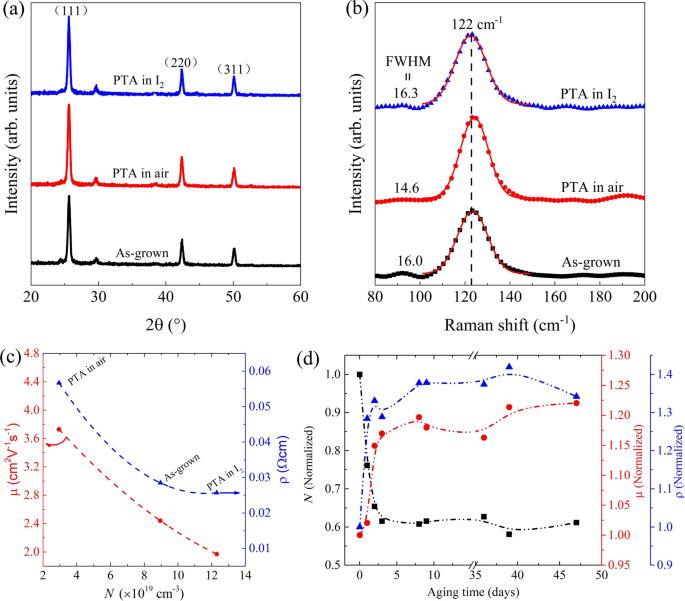
In our study, we synthesized the CuI thin films with a wide range of hole density from ~1017 to ~1020 cm-3 by controlling the concentration of native defects via post thermal annealing in different conditions. The optoelectronic properties and ultrafast carrier dynamics of CuI thin films were comprehensively studied by using a variety of analytical techniques including Hall-effect measurements, photoluminescence (PL) spectroscopy, spectroscopic ellipsometry, and femtosecond transient absorption (fs-TA) spectroscopy. Interestingly, distinct excitonic resonance of CuI was observed to persist at high hole density up to ~5×1019 cm-3 (around one order of magnitude higher than its Mott density), indicating the possible formation of Mahan exciton. The prominent PL peak at ~420 nm arising from the radiative recombination of electrons in the conduction band with the neutral copper vacancies is verified by the power-dependent steady-state PL measurements. By varying the excitation density (N0), the photogenerated carrier density dependent ultrafast physical processes including thermalization, hot carrier cooling, and recombination are elucidated. Both the effects of hot-phonon bottleneck and Auger heating are found to slow down the cooling rate in case of high excitation density. Effects of defects on the carrier recombination and the two-photon absorption induced carrier/exciton dynamics are also investigated. Fig. 1 schematically illustrates the overall relaxation pathways of photogenerated carriers in the CuI thin films .
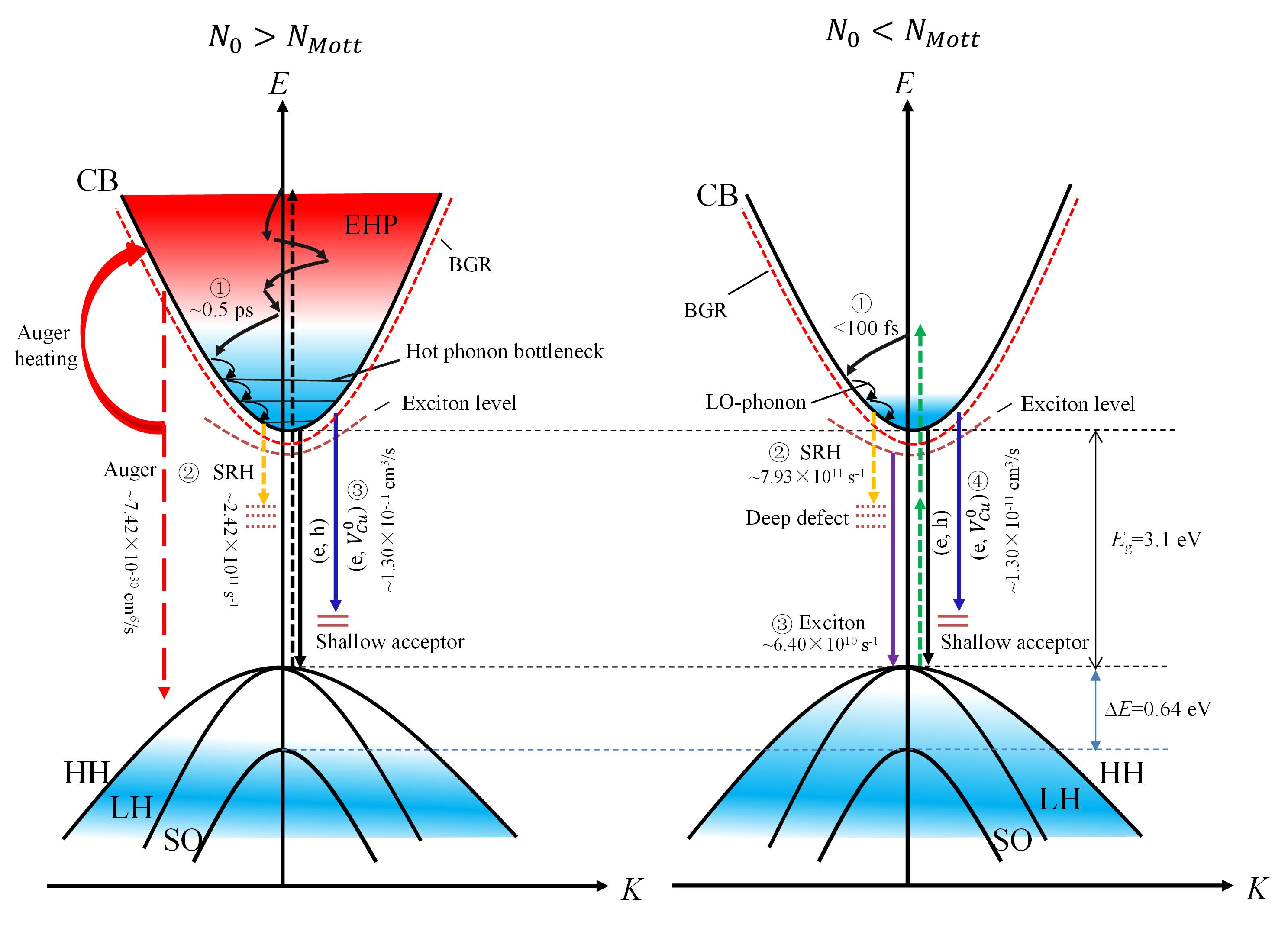
Our work provides detailed and in-depth understandings of the optoelectronic properties, excitonic prperties and ultrafast carrier dynamics of CuI, which are crucial to their optoelectronic applications. The discovery further demonstrates that the high mobility p-type transparent CuI is a unique material not only for optoelectronic applications but also for unveiling fundamental physical processes.
Follow the Topic
-
Nature Communications
An open access, multidisciplinary journal dedicated to publishing high-quality research in all areas of the biological, health, physical, chemical and Earth sciences.

Related Collections
With Collections, you can get published faster and increase your visibility.
Women's Health
Publishing Model: Hybrid
Deadline: Ongoing
Tumor Microenvironment Crosstalk and Therapeutic Implications
Publishing Model: Hybrid
Deadline: Nov 02, 2026