Urban meteorology-chemistry coupling in compound heat-ozone extremes
Published in Earth & Environment



Rising exposure to concurrent extreme heat and ozone (O₃) pollution have become a critical constraint on urban habitability in China. As demonstrated in Fig. 1, we have observed that both the frequency and intensity of heatwaves have almost tripled in China since the beginning of this century. Moreover, persistent heatwaves and elevated ozone frequently co-occur in these highly-populated city clusters of China, increasingly endangering city dwellers and urban environment (Ref. 1-3). However, limited understanding of the comprehensive mechanism hinders our ability to mitigate such compound events. In recent years our interest therefore has been focused on the urban meteorology-chemistry coupling in compound heat-ozone extremes over China’s megacities.
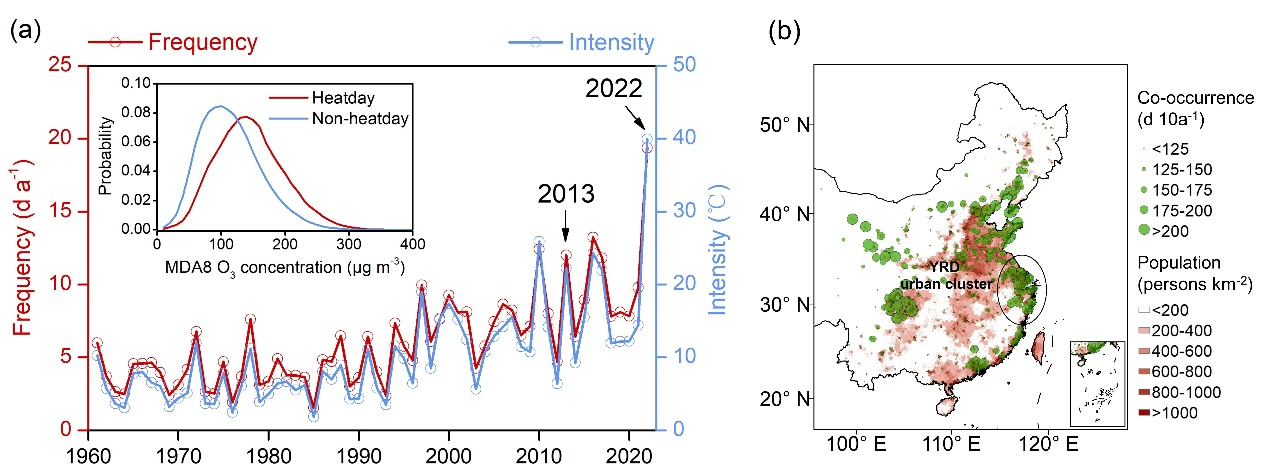
Fig. 1. Exacerbated summertime ozone pollution in China as the climate warms (Ref. 1). (a) Increasing frequency and intensity of heatwaves during June–August from 1961 to 2022 in China. Probability distribution of MDA8 O3 concentrations for heatdays and non-heatdays during 2013–2022 is inserted in panel (a). (b) Co-occurrence frequency of heatwave and O3 extremes across China from 2013 to 2022.
Elucidating the governing mechanisms of these compound events demands disentangling the tightly coupled human and natural systems. The years of 2013 and 2022 marked exceptionally hot summers falling outside the ranges of any extreme episodes recorded in China. Leveraging comprehensive field observations at the Station for Observing Regional Processes of the Earth System (SORPES) in Nanjing (Ref. 4) and statistical emission data, we show that persistent heatwaves accelerate photochemical ozone production by boosting anthropogenic and biogenic emissions (Fig. 2; Ref. 1). Furthermore, using meteorology-chemistry coupled modelling, we examined the roles of atmospheric physical and chemical processes in heat-stressed O3 pollution, and highlighted that heat-boosted emissions and suppressed dry deposition due to water-stressed vegetation led to a more than 30% increase in surface ozone pollution in China’s urban areas.
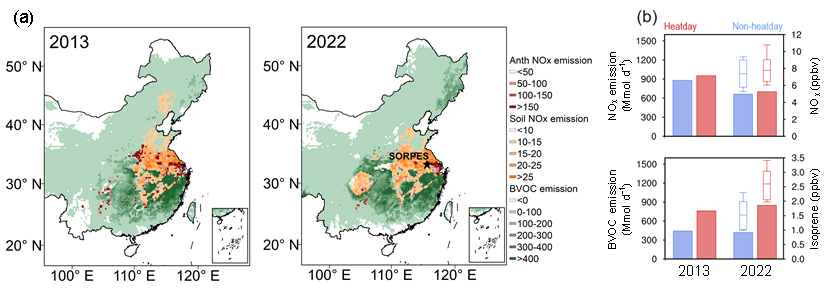
Fig. 2. Heatwave-boosted anthropogenic and biogenic emissions in China (Ref. 1). (a) Simulated increases in anthropogenic NOx, soil NOx and BVOC emissions in China during the persistent heatwaves in 2013 and 2022. (b) Simulated increases in total anthropogenic NOx and BVOC emissions in the Yangtze River region of China on heatdays during June–August in 2013 and 2022. Statistical concentration ranges for the daily average NOx and daily maximum isoprene concentrations observed at SORPES are also depicted as box charts in panel (b).
Beyond the interconnections near the surface, long-lasting and widespread heatwave-associated O3 pollution usually extends into the deeper troposphere. Yet vertical insights into the photochemical stratification and intricate connection between heatwaves and O3 are limited due to sparse vertical observations. To close this observational gap, we conducted an intensive airship field campaign near the SORPES in the early summer of 2023, and obtained hundreds of vertical profiles from the surface to a maximum altitude of 1.2 km, which thus shed more lights into the photochemical and boundary layer processes involved in urban O3 pollution. Leveraging airship vertical measurements and meteorology-chemistry coupled modeling, we revealed that heatwave-reinforced turbulence redistributes precursors vertically, which features a notable increase of nitrogen oxides (NOx) aloft while a distinct decline near the surface (Fig. 3; Ref. 5). By reallocating precursors vertically, heatwaves shift the stratification of the photochemical regime and accelerate O3 formation both aloft and at ground level across China’s megacities.
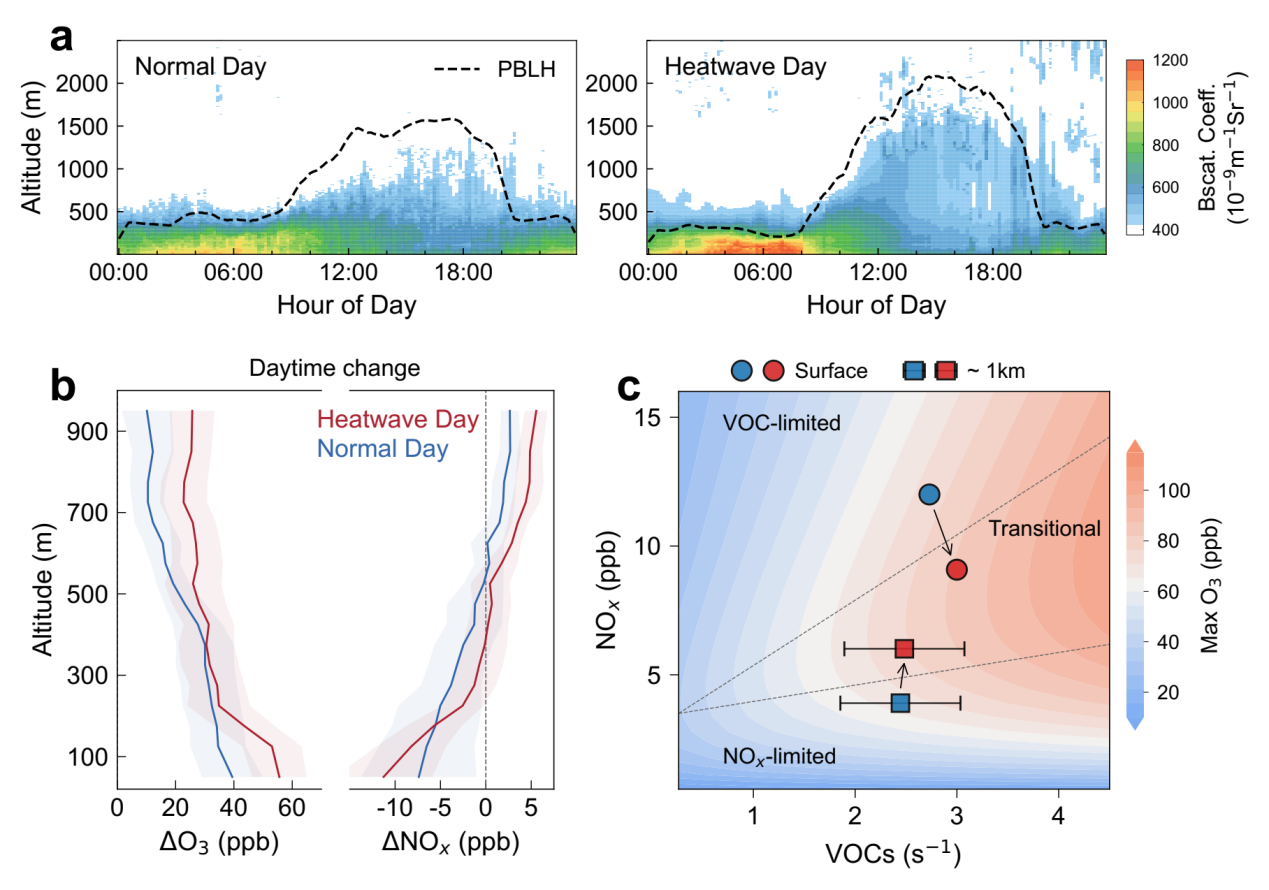
Fig. 3. Responses of urban boundary layer, O3 and NOx to heatwaves (Ref. 5). a, Backscattering coefficient and planetary boundary layer height (PBLH) on normal days and heatwave days at SORPES in May–June 2023. b, Daytime evolution in O3 and NOx profiles from morning (7:00–9:00 LT) to afternoon (12:00–16:00 LT). c, Isopleth diagram of daily maximum O3 against daytime NOx concentration and VOCs reactivity. Circles indicate the mean value of NOx concentration and VOC reactivity at the surface on normal days (blue circle) and heatwave days (red circle).
On the basis of meteorology-chemistry modeling, it is estimated that stringent emission control targeting nitrogen oxides could mitigate the heatwave-exacerbated O3 extremes by narrowing the vertical disparity of photochemical sensitivity. Although heatwaves are projected to intensify, urban emission reductions due to China’s carbon neutrality pledge could alleviate O3 pollution by 41–47% in four city clusters of China during heatwaves. Stringent emission controls help tackle the dual challenges of air pollution and global warming, as well as strengthen the climate resilience of cities and underscore the critical leverage of urban emission control in compound heat–ozone extremes.
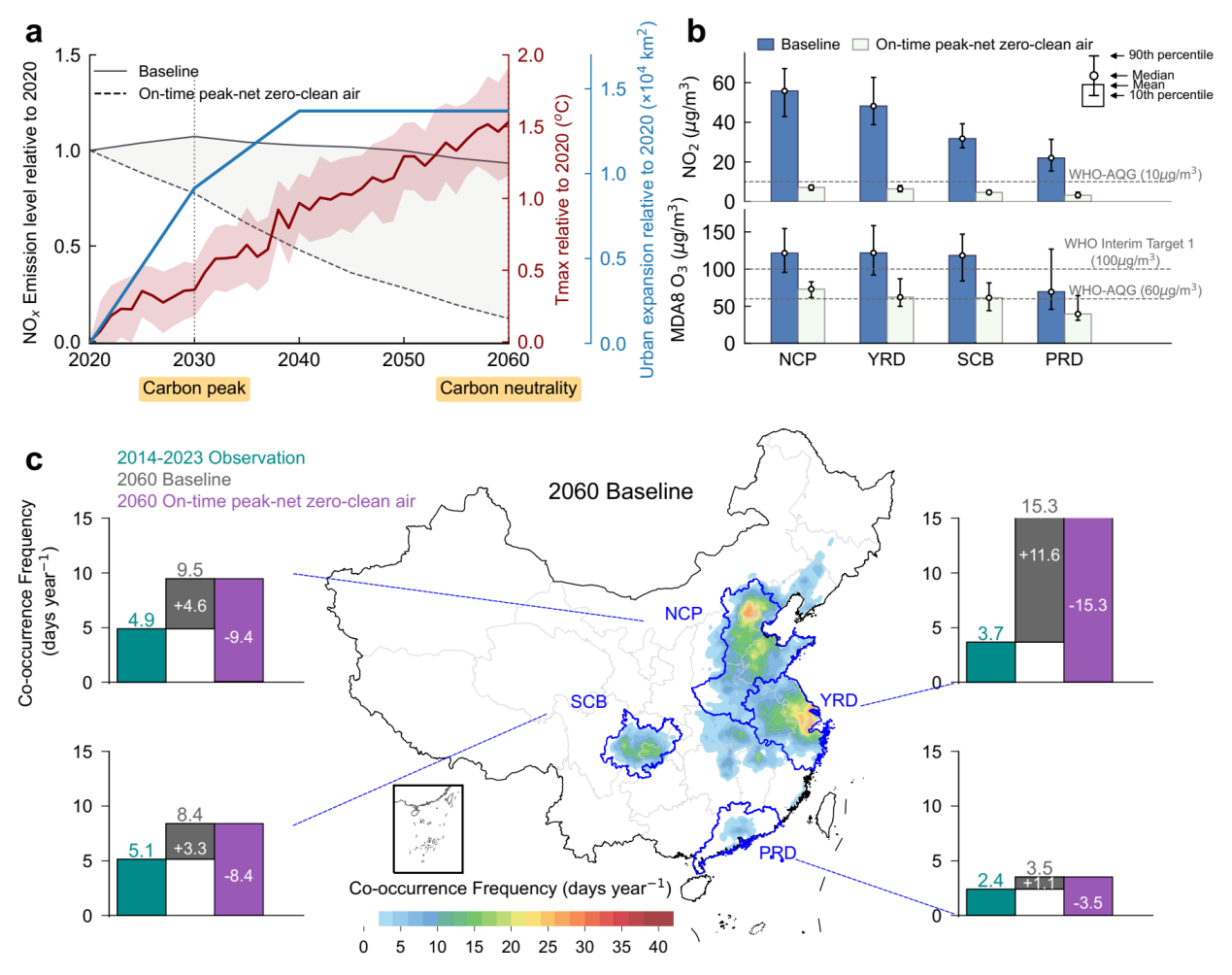
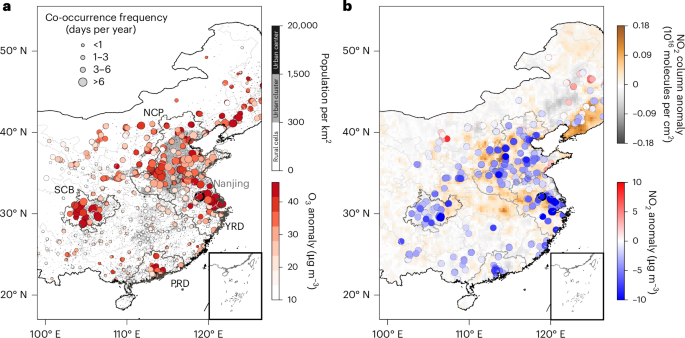
Fig. 4. Future co-occurrence of heatwave and O3 extremes during warm season (Ref. 5). a, Trends of China’s NOx emissions under the baseline scenario and on-time peak-net zero-clean air scenario, along with daily maximum temperature (red line) and urban area (blue line) under the SSP2-4.5 scenario from 2020 to 2060. b, Warm-season NO2 concentrations and MDA8 O3 levels under heatwaves across four city clusters under the 2060 baseline and on-time peak-net zero-clean air scenarios. c, Spatial distribution of heatwaves and O3 pollution co-occurrence frequency under the 2060 baseline scenario in China. Grey and purple bars indicate the impacts of climate change and emission control, respectively.
Our study disentangles the urban meteorology-chemistry coupling in compound heat-ozone extremes, and also indicates the importance of urban emission control in mitigating compound heat-air pollution extreme. For more details about these studies, please read the paper, “Urban meteorology-chemistry coupling in compound heat-ozone extremes”, in Nature Cities (Ref. 5), as well as those listed in the references below.
References
[1] Li, M., Huang, X.* et al., Sci. Bull., 69, 2938-2947 (2024).
[2] Yan, D., Li, M.* et al., Geophys. Res. Lett., 52 (2025).
[3] Wang, W., Zhou, Y., Li, M.* et al., Sci. China Earth Sci., 68, 1448–1457 (2025).
[4] Ding, A.*, Huang, X. et al., Atmos. Chem. Phys., 19, 11791-11801 (2019).
[5] Zhou, X.#, Li, M.#, Huang, X.* et al. Nat. Cities (2025).

Follow the Topic
-
Nature Cities
This journal aims to deepen and integrate basic and applied understanding of the character and dynamics of cities, including their roles, impacts and influences — past, present and future.





Please sign in or register for FREE
If you are a registered user on Research Communities by Springer Nature, please sign in