Using AI to quantify the sensitivity of extreme precipitation to climate warming
Published in Earth & Environment
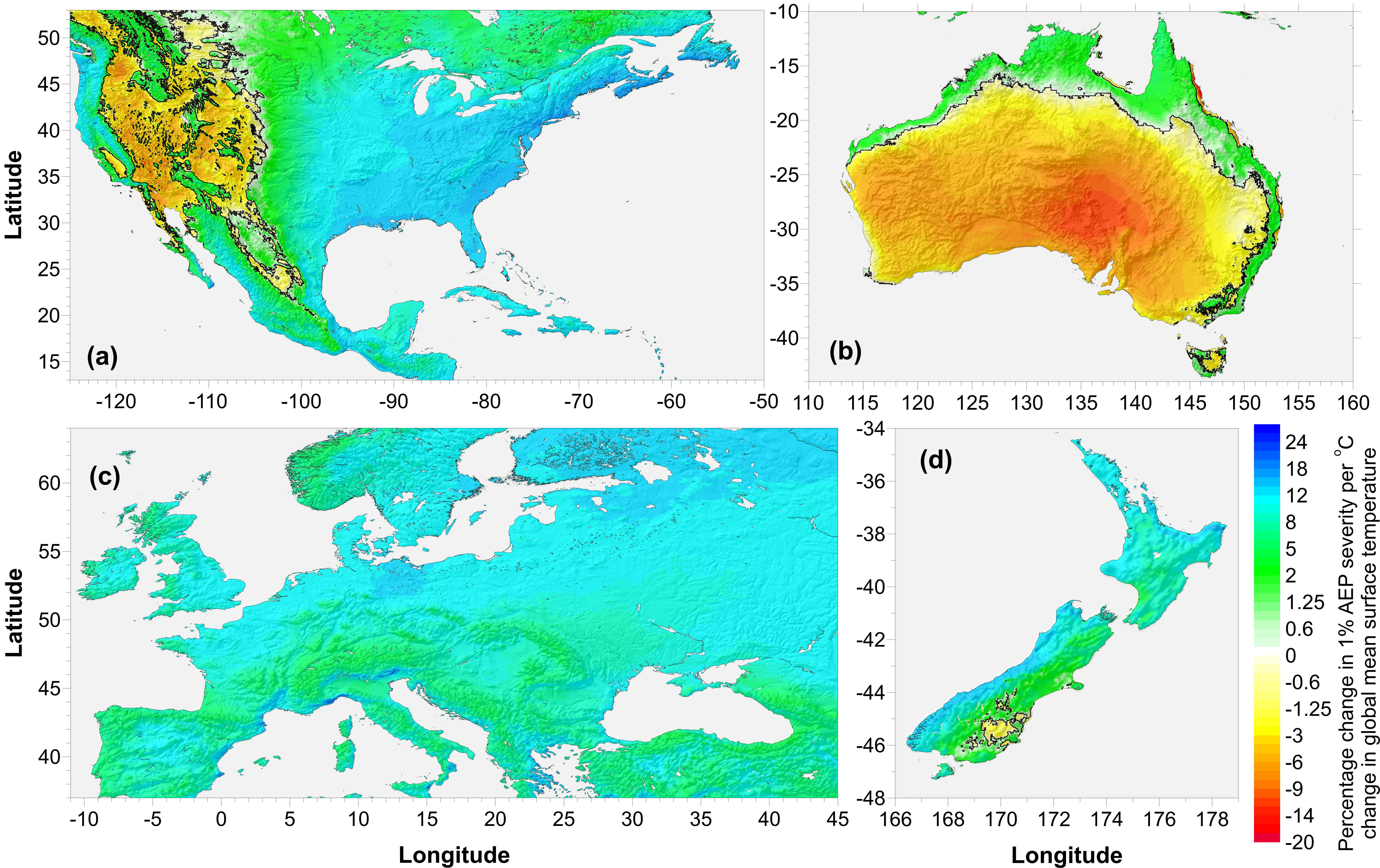


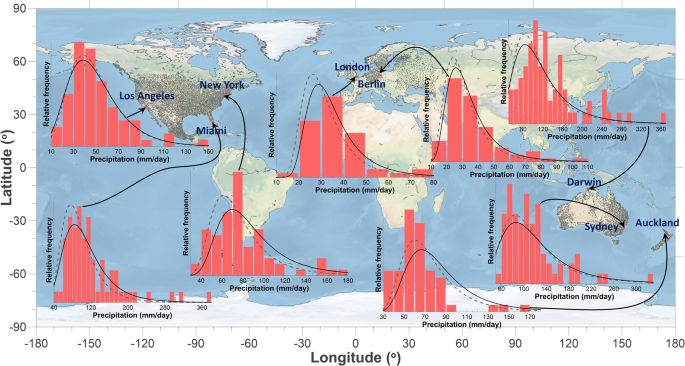

This paper links two disparate domains: climate and deep learning (a branch of artificial intelligence). Leroy Bird, lead-author of the paper, developed and implemented the deep learning-based method (a convolutional neural network; CNN) to infer the three Generalized Extreme Value (GEV) parameters describing daily precipitation extremes across North America, Europe, Australia, and New Zealand, as well as their non-stationary components. The primary non-stationary component we consider in this study is how the GEV parameters change with global mean temperature. Greg Bodeker and Kyle Clem, co-authors of the paper, provided physical interpretation of the CNN-derived results in a climate context. The paper demonstrates that the CNN can generalise across the 1-year block maxima precipitation data extracted from 10,000 sites – based only on their latitude, longitude, and elevation – to derive GEV fits that are robust against the limitations of the individual observational records. Because a deep learning-based method is employed using only observed precipitation data, the results avoid the physical shortcomings and computational barriers of regional and global climate models in simulating the sensitivity of extreme precipitation to global climate change and at extremely high resolution (1.5 km x 1.5 km). The resultant maps of extreme precipitation depth, and their sensitivity to climate warming, show spatial patterns of variability far higher than has been perceived to date. They also show where and by how much the response in extreme precipitation depths to global warming differ from expectations based in the Clausius–Clapeyron relationship.
To overcome the challenges of working across two domains, we implemented a method for developing the paper that may be of interest to others working on cross-domain research. While the analyses were being undertaken, we held frequent online meetings between the geographically distributed team members to interpret the results and determine if they made physical sense. This was an important first-order sanity check rather than developing a deep understanding of what had been done or how it had been done. Once the analyses had been finalised, Bird (providing the deep learning expertise) and Bodeker (providing some of the climate science expertise) held a series of multi-hour online calls that were recorded. This was often in the form of a question-and-answer session. Bodeker then wrote the content of the paper based on those recordings, with subsequent Zoom calls being used to address questions that arose in the interim. This process forced a non-expert in deep learning (Bodeker) to understand in sufficient depth what had been done in terms of the mechanics of the CNN, to communicate that to a potentially equally non-expert audience. We found this approach to be very useful in working toward our goal of presenting the material in the paper in a way that is accessible to readers who have no expertise in deep learning models. In particular, we found that it may not always be best for the person who did the analysis to write the description of the analysis. Instead, we found having a co-author who had little involvement in the core of the technical analysis write the paper – with routine checks and Q&A sessions with the technical expert – was effective, and we hope the paper is better for it and more accessible to a broad audience.

Follow the Topic
-
Communications Earth & Environment
An open access journal from Nature Portfolio that publishes high-quality research, reviews and commentary in the Earth, environmental and planetary sciences.

Related Collections
With Collections, you can get published faster and increase your visibility.
Hazards in Mountain Regions
Publishing Model: Open Access
Deadline: Nov 02, 2026
Carbon Dioxide Removal
Publishing Model: Hybrid
Deadline: Jan 16, 2027


Please sign in or register for FREE
If you are a registered user on Research Communities by Springer Nature, please sign in