Visual search performance depends on the congruency of olfactory sensations: Your nose knows what you are looking for!
Published in Neuroscience and Behavioural Sciences & Psychology
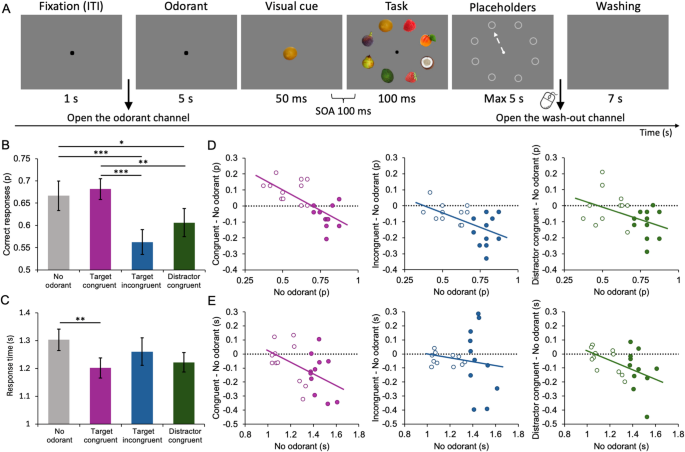

Our findings point to an odorant-visual object congruency effect. On-going nasal exposure to congruent aromas enhances search performance of visual targets presented among distractors. The size of the congruency effect depends on the baseline performance level in individual participants when they were tested without the presence of an odorant. Our results suggest that our olfactory sense influences the saliency of a visual target presented among distractors. Such multisensory effects could influence our food choices during everyday grocery-shopping decisions.
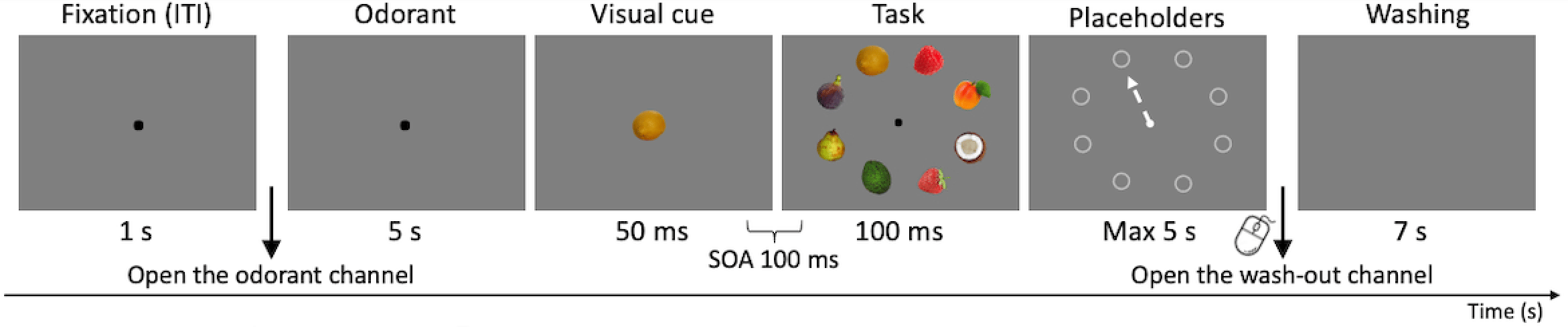
The figure depicts a typical trial where the participant is exposed to the scent of a fruit (e.g., a lemon) and shortly thereafter is cued to search for a lemon among a circular array of fruits. The correct response is given by moving the cursor to the placeholder where the target was located.
For more details, see the Open Access publication in Scientific Reports:

Follow the Topic
-
Scientific Reports
An open access journal publishing original research from across all areas of the natural sciences, psychology, medicine and engineering.

Related Collections
With Collections, you can get published faster and increase your visibility.
Phytochemicals and health
Publishing Model: Open Access
Deadline: Oct 28, 2026
Cancer Prevention and Control
Publishing Model: Hybrid
Deadline: Feb 19, 2027