Walking through fastidious acidophilic nitrous oxide-reducing microorganisms
Published in Earth & Environment, Ecology & Evolution, and Microbiology


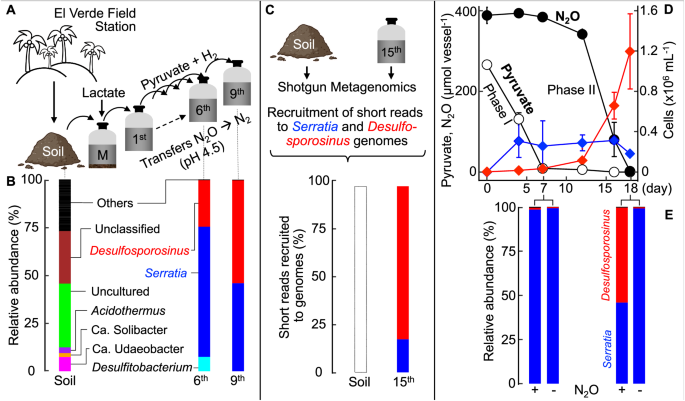

Use of nitrogen fertilizer is essential to increase crop yield and meet the growing food demand, but it also causes environmental issues such as soil acidification and nitrogen enrichment. The two issues react to cause another climate issue: N2O emissions. Microbial N2O reduction is, so far, the only known N2O sink, and is particularly sensitive to acidic pH. Thus, soil acidification enhances N2O emissions via either increasing N2O production or decreasing N2O consumption. However, acidic soils harbor a vast diverse microbial guild (NosZ) defined as N2O sink, which makes no sense if the N2O reduction process is not at play. This led us to question whether N2O reducers have adapted to acidic environments.
A fundamental principle is rooted in our work: low pH N2O reducers should be sourced from acidic soils. A preliminary soil microbiome investigation in the Luquillo Experimental Forest soils (Fig. 1) suggest the soils have characteristic acidic pH, and thrive tremendous N2O reducing microorganisms. However, the functionality of those microbial guild requires further validation. We sampled soils from field sites located in LEF, and cultivated the soils in N2O-feeding mineral salt medium with pH 4.5 and 7, which is typically referred as microcosm study. The N2O reduction performance of pH 4.5 microcosms distinguish apparently from the pH 7 microcosms: it took over 2-month to commence N2O reduction at pH 4.5, but only one-week at pH 7.

Further cultivation transitioning from the soil microcosms to soil-free enrichment culture is not straightforward: the soil-free enrichment culture simply lost N2O reduction activity upon transfer. This discrepancy between microcosm and soil-free enrichment culture indicates, at least, that soils were providing either niche-specific pH or nutrient complying growth requirement of N2O reducers. We then invested extensive efforts to modify the substrate combinations (e.g., acetate + N2O, formate + N2O, pyruvate + N2O), aiming to initiate N2O reduction in soil-free enrichment culture. Fortunately, a two population co-culture sustaining N2O reduction at acidic pH, was obtained following 16-month investigation.
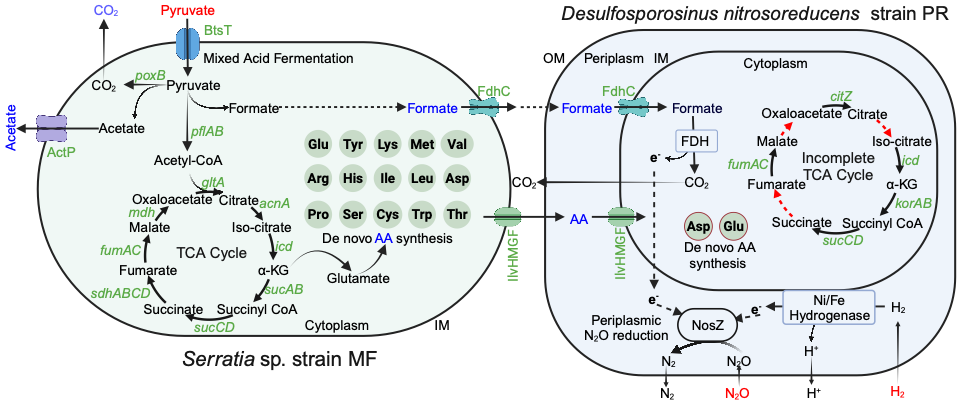
By in-depth characterization of this co-culture, we clearly show the first proof of experimental evidence that naturally occurring soil microorganisms can sustain N2O reduction at acidic pH. An intricate interspecies interaction (Fig. 2) between soil resident microbiome and N2O reducers may explain the unsuccessful cultivation of low pH N2O reducers in the past. Our on-going work continues to discover broader taxa that are involved in low pH N2O reduction.
Follow the Topic
-
Nature Communications
An open access, multidisciplinary journal dedicated to publishing high-quality research in all areas of the biological, health, physical, chemical and Earth sciences.

Related Collections
With Collections, you can get published faster and increase your visibility.
Women's Health
Publishing Model: Hybrid
Deadline: Ongoing
Tumor Microenvironment Crosstalk and Therapeutic Implications
Publishing Model: Hybrid
Deadline: Nov 02, 2026