What cancer taught me about being a colleague
Published in Social Sciences, Earth & Environment, and Sustainability
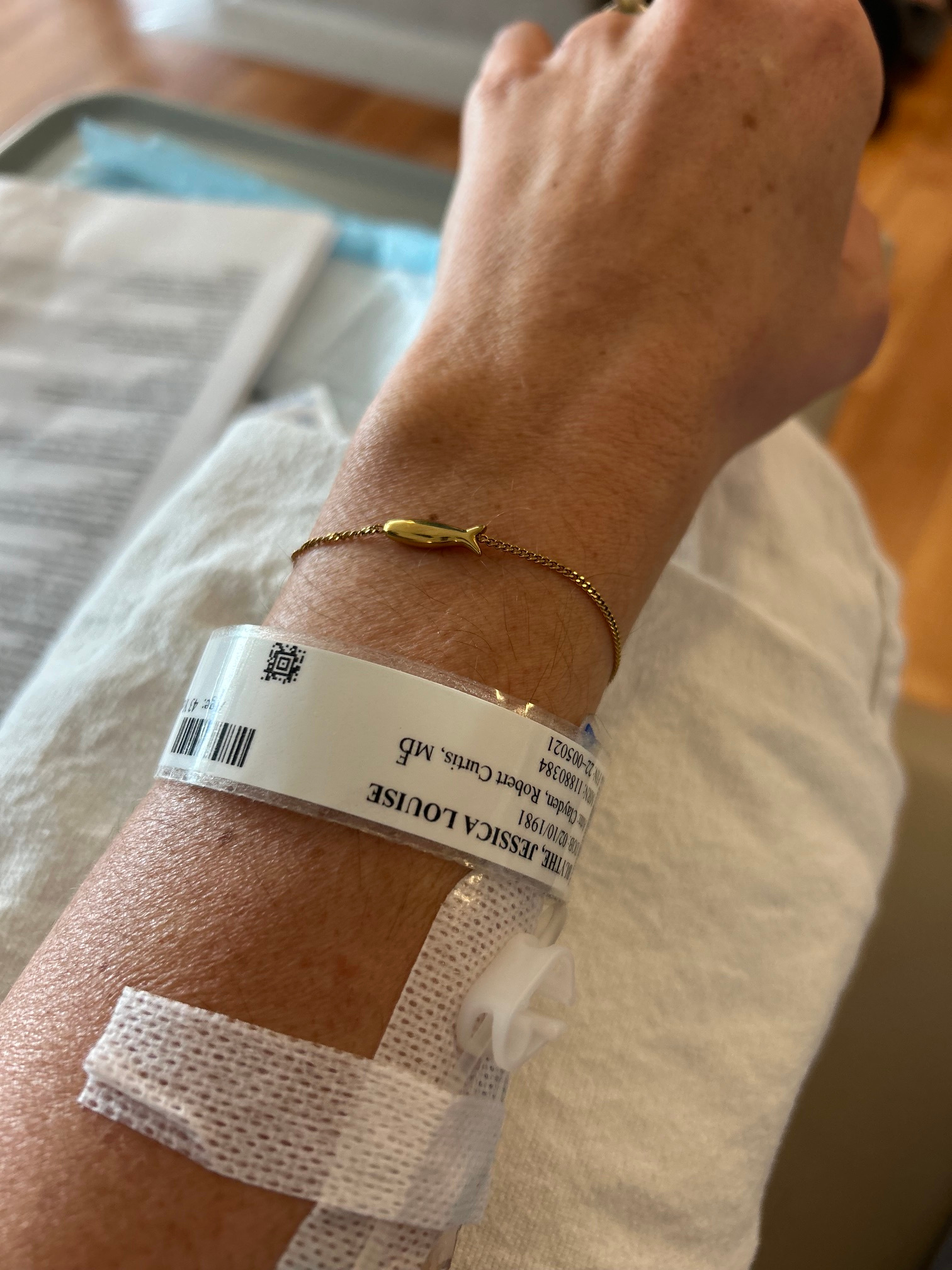
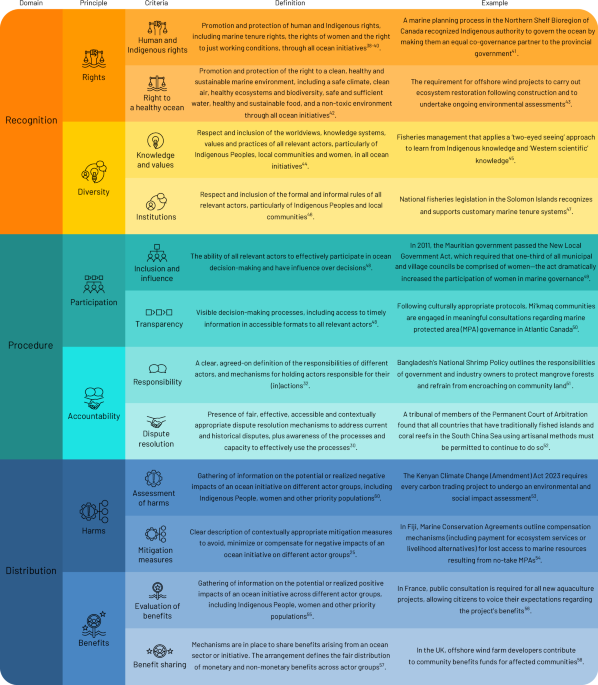

When I began six months of chemotherapy for stage IV follicular lymphoma, I was midway through the revisions on the Ocean Equity Index (https://www.nature.com/articles/s41586-025-09976-y), a paper marking the culmination of three years of work. As my days filled with doctor’s appointments, blood tests, and an avalanche of new oncology terminology, I quietly wondered whether the paper would survive. But as the news of my diagnosis spread, something else happened: my colleagues sprang into action.
Cancer is an intensely individual experience, yet one that carries collective professional impact. When it arrives, uninvited, academic life continues. Grants push forward, graduate students remain active, courses must be taught. Flipping through my “Oncology Journey” binder in a waiting room dominated by silver-haired and sensibly retired people, I saw no trace of mid-career academics juggling unfinished manuscripts, layered responsibilities (including childcare), and unruly intellectual obsessions.
Cancer pays no mind to your job; it affects researchers as readily as anyone else. Yet there is little guidance on navigating cancer as a researcher or a colleague. Too often, we struggle over how best to support each other behind closed doors. In this Behind the Paper post, I reflect on three things cancer taught me about being a colleague.
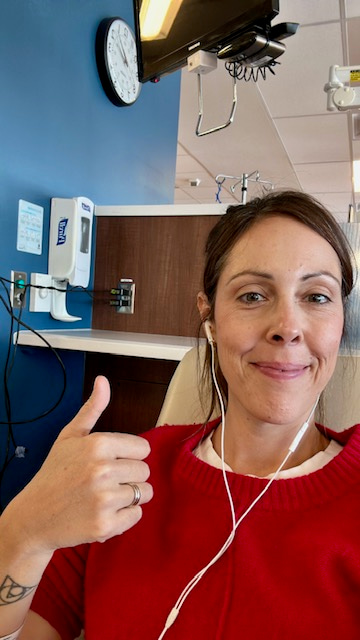
Jessica Blythe at the Walker Family Cancer Centre in St. Catharines, Ontario on her first day of chemotherapy on March 10, 2025.
1. Reach out
The first and most important thing we can do for a colleague with cancer is to reach out. Most of us stay silent, worried about saying the wrong thing or crossing a professional boundary. But silence communicates too. I've never felt offended by someone who doesn't know what to say, but I've felt hurt by those who don't reach out at all.
It doesn’t have to be complicated. Send a quick email. Don’t over think it. After receiving my out-of-office reply, a former student told me she spent ten days drafting and redrafting her message to get the tone right (cancer email_v12_FINAL). There's no need to write a novel. You can’t go wrong with: “I’m so sorry, I can’t imagine what you’re going through.” One colleague sent me near daily GIFs of strong women, which I found surprisingly comforting. Your colleague won’t care if you get it the words wrong. As writer and leukemia survivor Suleika Jaouad (2012) reflects, to talk about cancer is first to fail - then to fail better the next time.
2. Discuss preferences for work engagement
Academics often blur the line between vocation and obsession. We occasionally wake up at 3 a.m. to write down an idea. Reading papers can feel nourishing. Writing can feel creative. This means that during treatment, work can offer a lifeline, a little island of normalcy, a reminder of identity beyond the diagnosis.
But cancer is exhausting. My chemotherapy, bendamustine which is a derivative of mustard gas and administered by a nurse in a biohazard gown (Mukherjee, 2025), left me horizontal for up to a week at a time. My laptop sat closed. Work was out of the question.
Colleagues can help by asking how a researcher with cancer would like to stay connected or whether they need to disconnect entirely. The director of my centre asked whether I wanted to receive emails. Simple. Direct. Helpful. It acknowledged that my needs might change and that I was still the expert on my own life.
Of course, cancer is profoundly inequitable (Boyer, 2019). The ability to remain engaged with work during treatment largely depends on structural factors, such as access to paid leave, fewer caregiving responsibilities, and the privileging of formal or legally recognized relationships over informal care networks. While some find solace in work, others are simply trying to get through the next hour. Whether someone answers emails from the infusion chair or disappears from their inbox for six months tells us very little about their character, and a great deal about their circumstances.
3. Offer practical support
Cancer creates an endless stream of paperwork, side effects, and uncertainties. A third way to support a colleague with cancer is to offer practical support.
The second author on the Ocean Equity Index stepped up as corresponding author and is the only reason the revisions were submitted at all. Another colleague took over as Graduate Program Director while I was on leave. My editorial duties were put on hold for 12 months, no questions asked. Once, while I was unwell during a meeting and desperately needed a break, a perceptive colleague came to the rescue by loudly declaring, "I need a bio break!" He sacrificed his dignity so I could preserve mine.
These gestures may seem small. They were not. One of the strangest things about serious illness is how ordinary tasks become extraordinary. Replying to an email. Reading a document longer than a page. Every task that someone lifted from my shoulders created space for healing.
Academics are often reluctant to ask for help. We build careers around expertise, competence, and independence. Cancer disrupts that identity. Suddenly, the most difficult task is not writing the grant, it's admitting that you cannot. Years from now, I will not remember the meetings I missed or the deadlines I postponed. I will remember the people who carried pieces of my workload when I could not.
Conclusion
In Pulitzer Prize winning book, The Undying, Anne Boyer reflects on how cancer has moved from silence to saturation. Where earlier generations of scientists, like Rachel Carson, confronted silence, censorship, and stigma, we now face an abundance of cancer stories, awareness campaigns, and narratives about strength that risk prescribing a singular story for a disease that is intersectional, fragmented, and profoundly individual.
And yet, there is value in speaking about cancer. Not to claim universal lessons, but because sharing stories helps us recognize one another. It creates possibilities for understanding, solidarity, and empathy. This matters in academia, where work and identity are so often intertwined, and where productivity can become a measure of worth.
We do not need the perfect words. Often the most meaningful acts are the simplest: reach out, ask what’s needed, and carry part of the load. We cannot take away another person’s diagnosis, but we can ensure that no one carries it alone. Academia, after all, is a community based on reciprocity (for reviews, collaboration, co-creation, etc.).
Thank you to my colleagues for the generosity, flexibility, and care that made it possible to continue and, at times, to step back.
References
Boyer, A. (2019). The Undying: Pain, Vulnerability, Mortality, Medicine, Art, Time, Dreams, Data, Exhaustion, Cancer, and Care. Farrar, Straus and Giroux, 2019.
Jaouad, Suleika (2012). 10 things <em>not</em> to say to a cancer patient. HuffPost. https://www.huffpost.com/entry/cancer-advice_b_1205633
Mukherjee, S. (2025). The emperor of all maladies: a biography of cancer. Simon and Schuster, 2025.

Follow the Topic
-
Nature
A weekly international journal publishing the finest peer-reviewed research in all fields of science and technology on the basis of its originality, importance, interdisciplinary interest, timeliness, accessibility, elegance and surprising conclusions.

What are SDG Topics?
An introduction to Sustainable Development Goals (SDGs) Topics and their role in highlighting sustainable development research.
Continue reading announcementRelated Collections
With Collections, you can get published faster and increase your visibility.
Carbon Dioxide Removal
Publishing Model: Hybrid
Deadline: Jan 16, 2027
Cancer Neuroscience: from mechanisms to therapy
Publishing Model: Hybrid
Deadline: Jan 30, 2027