When a holiday plant goes rogue: The case of English holly in the PNW
Published in Earth & Environment and Plant Science

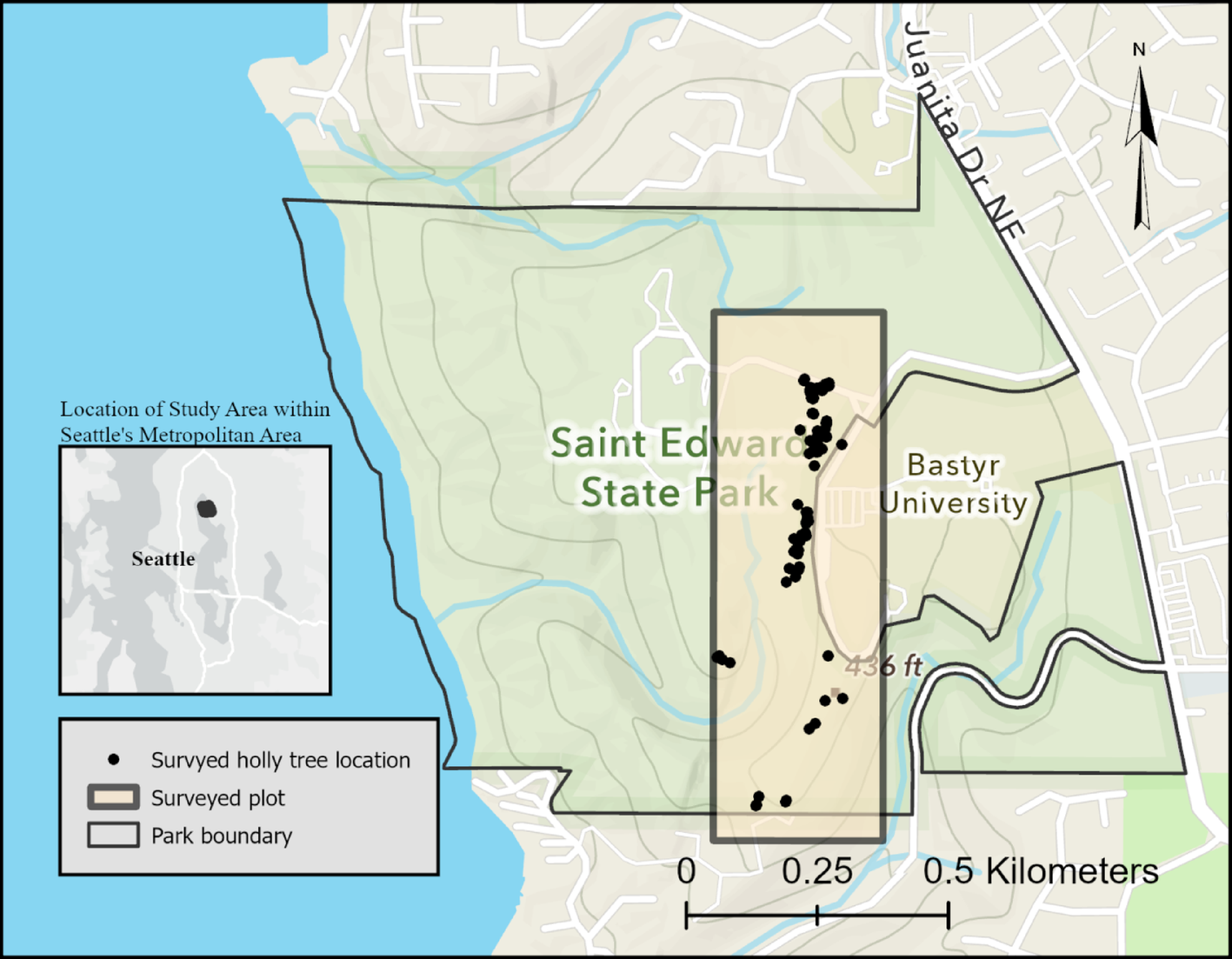

Invasive plant species threaten forest ecosystems by outcompeting native flora for essential resources such as sunlight, water, and nutrients. One such invader, English holly (Ilex aquifolium), a shade-tolerant evergreen shrub or tree native to Eurasia and northern Africa, has become increasingly problematic in the Pacific Northwest of the United States.
This study investigates the environmental factors influencing I. aquifolium distribution and spread using species distribution modeling (maximum entropy) and spatial analysis (Ripley’s K function) in an urban forest near Seattle, Washington. Results indicate that evergreen forests support holly establishment more than deciduous vegetation. Temperature emerged as a strong positive predictor of holly presence, suggesting that climate change could accelerate its invasion.
In contrast, soil nutrient levels showed a slight negative association with holly occurrence, potentially indicating either holly’s tolerance for nutrient-poor soils or a disadvantage in nutrient-rich environments. Additionally, holly may deplete soil nutrients through uptake or by altering soil chemistry. Further, the clustered pattern of holly dispersion is likely driven by a combination of short-distance seed dispersal and vegetative spread.
By identifying the ecological conditions that favor holly’s spread, this study provides insights to inform management strategies aimed at mitigating its impact on native biodiversity, forest succession, and ecosystem services in urban forests in the Pacific Northwest of the United States.
Access full article here: https://rdcu.be/eYZqi

My research centers on human–environment interactions, with a longstanding focus on land change science, geographic information science (GISc), and remote sensing as tools for advancing understanding of biogeophysical and socio-environmental dynamics. I investigate questions about land use and land cover change, the spatial and temporal dynamics of natural and anthropogenic landscapes, and the implications of these changes for ecosystem functioning, biogeochemical cycling, and human welfare. My work bridges the human and physical dimensions of global change, emphasizing the theoretical and empirical potential of GIS not merely as a tool, but as a scientific framework for generating transformative geospatial knowledge. Key areas of interest include socio-environmental geography, spatial theory, climate and land-use change, with regional emphases in Latin America and the Pacific Northwest.
Follow the Topic
-
Discover Plants
A fully open access, peer-reviewed journal supporting multidisciplinary research across all fields relevant to molecular, cellular, tissue, organ and whole organism research as well as plant breeding, plant pathology, and the interaction of plants with the environment.

Related Collections
With Collections, you can get published faster and increase your visibility.
Plant–Soil Microbiome Interactions: Microbial Diversity, Networks, and Sustainable Crop Production
This collection focuses on the close relationships between plants, soils, and the many microorganisms that live around plant roots. These microbes are essential for healthy crops and strong ecosystems. They help plants absorb nutrients, store carbon in soil, tolerate stress such as drought, and resist diseases. Instead of working alone, microbes function as connected communities, shaped by plant roots, soil conditions, and the environment.
This collection presents new research on how microbial diversity and community connections affect crop growth and soil health. Special attention is given to network-based studies that identify important microbes, group functions, and interaction patterns that keep microbiomes stable and productive. Topics include how plants communicate with microbes, how root secretions shape microbial communities, the use of genetic tools to study microbial functions, and models that explain microbiome changes over time and space.
The collection also links basic science with real farming practices. It explores ways to use beneficial microbes to improve agriculture, such as microbial fertilizers, mixed microbial communities, soil health measurements, climate-resilient farming systems, and regenerative practices that support healthy soils.
By combining ecological knowledge, modern biological tools, and field studies, this collection aims to better understand plant–soil microbiome systems and apply this knowledge to improve crop production, protect the environment, and support global food security.
Keywords: rhizosphere microbiome; plant–soil feedbacks; microbiome networks; microbial diversity; nutrient cycling; plant growth-promoting rhizobacteria (PGPR); soil health
Publishing Model: Open Access
Deadline: Nov 14, 2026
Nanotechnology for Plant Development & Health Management
Agricultural sustainability is a concern that is rising profoundly around the globe. Where it directly impacts the germination, growth, yield, and overall agricultural productivity, and indirectly, human consumers are also affected. Global climate change is significantly influencing agriculture presently, so the focus is on more sustainable solutions to this issue, which mostly include phytochemicals and nanomaterials. Nanomaterials are supposed to be unpredictable and novel, which enhances their potential for targeting plant growth, development, and stress mitigation. Further, nanomaterials have found applications in various industries as well, which is how the nanomaterials are released directly or indirectly into the atmosphere, including soil and water. Hence, making it is important to evaluate the impact of nanomaterials on plants. Therefore, in the present scenario, it is essential to focus on the impact of NPs synthesized chemically, physically, biologically on various crops in the lab in vitro/ in vivo as well as in field conditions. Further, plant disease detection using nano-based sensors and stress management using nano-fertilizers is another aspect that can be benefited by the application of nanomaterials. This issue will provide an insight on how various nanomaterials possess the potential to target the global issue of agricultural productivity with the drastically increasing human population.
Keywords: Abiotic stress; Biotic stress; Plant health; Agricultural productivity; Crop management; Nanosensor; Plant pathology management
Publishing Model: Open Access
Deadline: Oct 09, 2026