Why the Timing of AI Deployment Matters for the Carbon Budget
Published in Earth & Environment
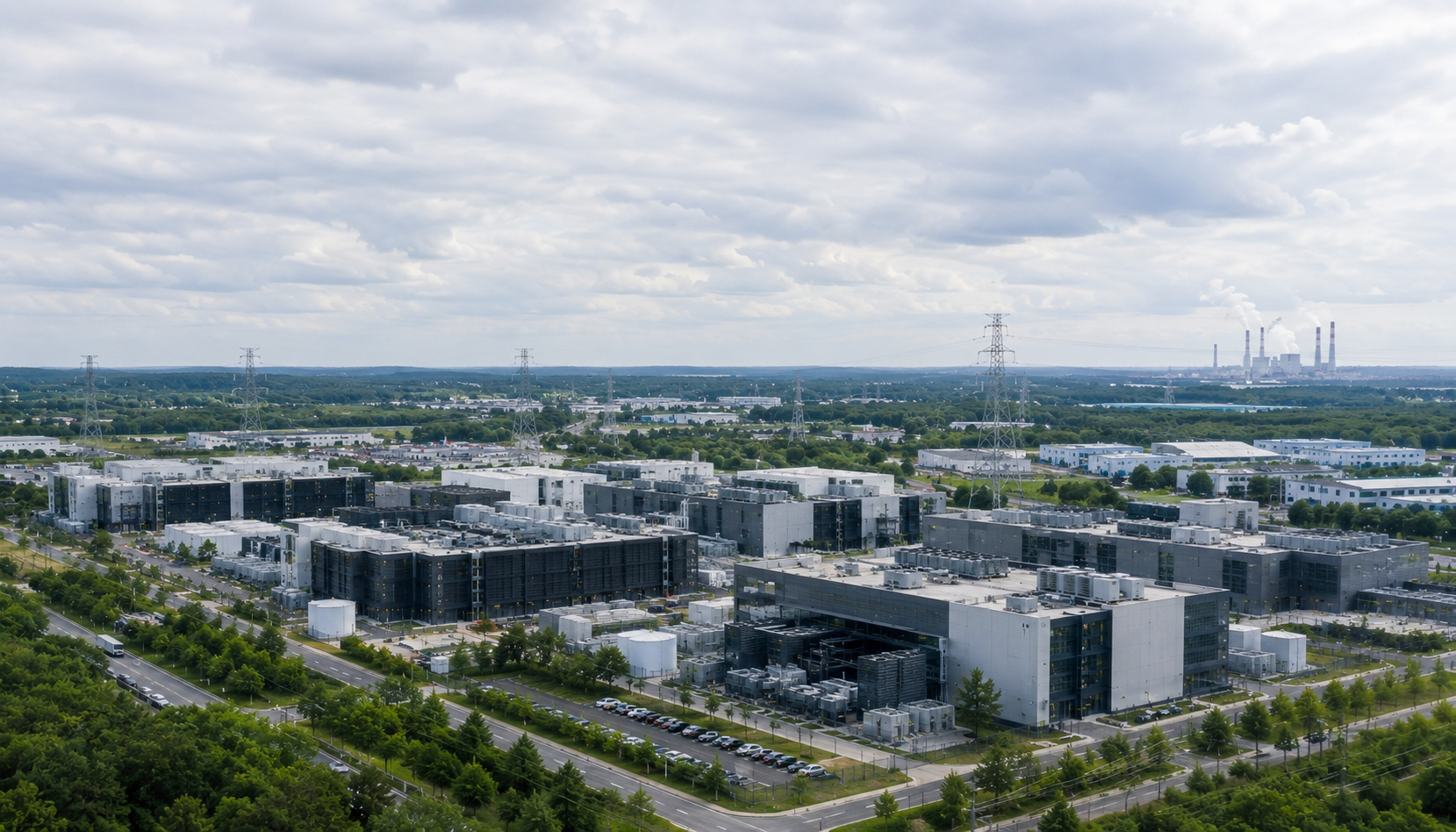





Artificial intelligence is increasingly presented as a tool that can accelerate climate action. It can help improve energy-system planning, optimize industrial processes, support climate modelling, and identify new opportunities for reducing emissions. Yet while these potential benefits are important, our paper, “Rapid artificial intelligence deployment increases near-term pressure on global carbon budgets,” began with a simple but underexplored question: what happens if AI infrastructure expands faster than the clean-energy system can absorb its growing electricity demand?
We wanted to move beyond the simple debate over whether AI is “good” or “bad” for the climate. Instead, we focused on timing. In climate policy, timing is not a minor technical detail. A tonne of carbon dioxide emitted today immediately occupies part of the remaining carbon budget, while avoided emissions from future efficiency gains may arrive only later.
The central idea of the paper is therefore carbon debt. Rapid AI deployment can generate near-term emissions through electricity demand, data-centre expansion, and supporting infrastructure. Even if AI later contributes to emissions reductions, there may be a period during which the climate system carries an additional burden. This temporal mismatch matters because global carbon budgets are already narrow, and the next decade remains critical for limiting warming.
One of the most challenging parts of the work was how to represent this timing clearly and fairly. We did not want to frame AI as inherently harmful, but we also did not want to assume that future technological efficiency would automatically solve the problem. The analysis therefore had to examine deployment pathways, uncertainty ranges, cumulative emissions, delayed system-level savings, and the point at which avoided emissions may begin to compensate for earlier carbon costs.
The review process helped sharpen this message. It pushed us to be more precise about scenario interpretation, uncertainty, and the distinction between annual emissions and cumulative carbon-budget pressure. That process made the final paper stronger. The result is not an argument against AI. It is an argument for climate-aligned AI deployment: faster clean electricity supply, higher energy efficiency, transparent emissions accounting, and governance that considers cumulative carbon-budget impacts rather than only long-term potential benefits.
For us, the most important lesson from this work is that the climate relevance of a technology depends not only on what it may eventually achieve, but also on when its costs and benefits occur. In a world of shrinking carbon budgets, the sequence of deployment matters.

Prof. Yassine Charabi is a climate scientist whose research examines the dynamics of climate change, carbon-budget constraints, mitigation pathways, energy-system transformation, and sustainable transitions. His work is concerned with one of the central questions of contemporary climate science: how societies can reconcile development, technological change, and energy demand with the finite limits of the global carbon budget.
He has been recognized among the Top 2% Scientists Worldwide in the Stanford University/Elsevier ranking since 2022 and served as a Lead Author for the Fifth Assessment Report of the Intergovernmental Panel on Climate Change, Working Group I. Across more than 100 scientific publications, his research has contributed to climate modelling, climate-impact assessment, mitigation analysis, energy transitions, resilience systems, and environmental sustainability.
Prof. Charabi’s work combines climate-system analysis with policy-relevant assessment. His research focuses on the timing, feasibility, and systemic consequences of climate action, particularly where emissions trajectories, energy infrastructure, technological deployment, and sustainability objectives intersect. A central theme of his scholarship is that climate action must be evaluated not only by its long-term promise, but also by its cumulative impact, temporal dynamics, and alignment with the remaining carbon budget.
His current research interests include climate modelling and simulation, carbon-budget accounting, mitigation pathways, energy transitions, climate-risk and resilience systems, sustainable development, and the climate implications of emerging technologies.
Follow the Topic
-
Communications Earth & Environment
An open access journal from Nature Portfolio that publishes high-quality research, reviews and commentary in the Earth, environmental and planetary sciences.

Related Collections
With Collections, you can get published faster and increase your visibility.
Hazards in Mountain Regions
Publishing Model: Open Access
Deadline: Nov 02, 2026
Carbon Dioxide Removal
Publishing Model: Hybrid
Deadline: Jan 16, 2027
Please sign in or register for FREE
If you are a registered user on Research Communities by Springer Nature, please sign in