A case of antiferrochirality in a liquid crystal phase of counter-rotating staircases
Published in Materials





Whoever designed the gearbox in Fig. 1a must be scratching their head. Two engaged cogwheels or many in a line are free to rotate alternatively in opposite directions. But the cogwheel at the third apex of the triangle cannot simultaneously rotate counter to both of its neighbours. Similarly, packing helices closely creates no problem as long as they form a 2D ribbon, as shown on the example of the line of right- and left-handed screws in Fig. 1b.
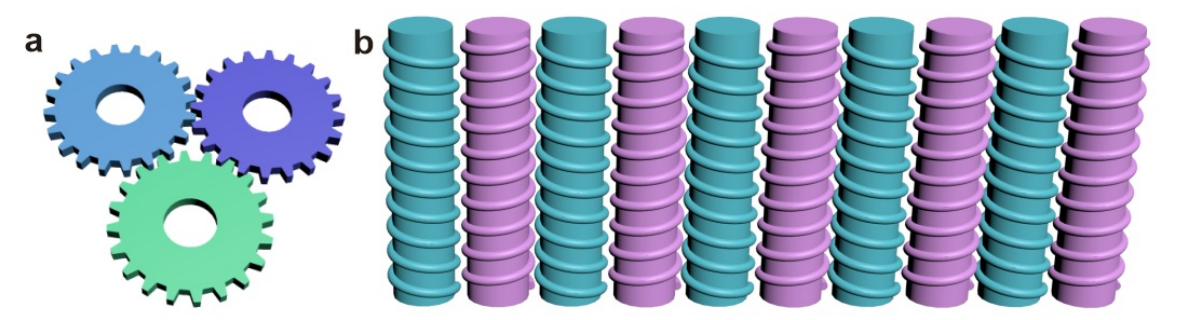
Fig. 1 (a) Cogwheels, (b) left- and right-handed screws without heads.
Helices can be found in many synthetic chemical and biochemical systems, and their packing in condensed matter has attracted considerable interests. The packing of screws in Fig. 1b is a good starting point to understand packing of molecular helices. But bulk systems are 3D, not 2D. Trying to pack those lines of screws together efficiently side-by-side brings us back to the problem in Fig. 1a. The frustration of packing opposite signs on a triangular lattice is a common problem in condensed matter and goes beyond packing of helices. The classic example is the absence of an ordered ground state in hexagonal antiferromagnetic crystals; a spin cannot be opposite to all of its six neighbours at the same time.
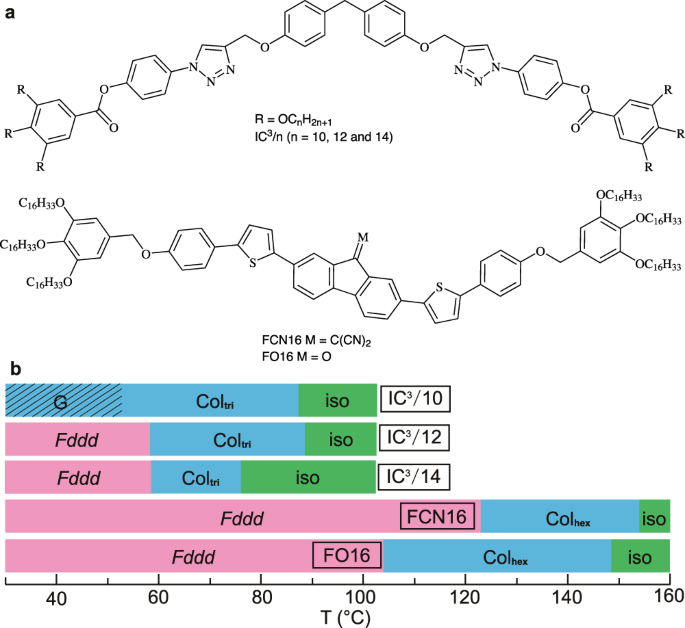
The helices we study are in fact twisted ribbons comprising dumbbell-shaped molecules with a relatively rigid rod-like core bearing three flexible paraffinic chains at each end – Fig. 2a. These form two liquid crystalline phases in which the molecules form columns, or ribbons, lying perpendicular to the column axis. The high-temperature phase is a simple hexagonal packing of cylinders. The cylinders are the result of dynamic averaging of the many twists and turns of the mobile ribbons. However at lower temperatures a new liquid crystalline phase is identified, described in the paper (https://www.nature.com/articles/s41467-022-28024-1) by Ya-xin Li et al. The phase has a complex structure and is composed of an equal number of very regular right- and left-handed helically twisted ribbons. Although the molecules themselves have no chirality, the ribbons are chiral as they twist in the same direction along their entire length.
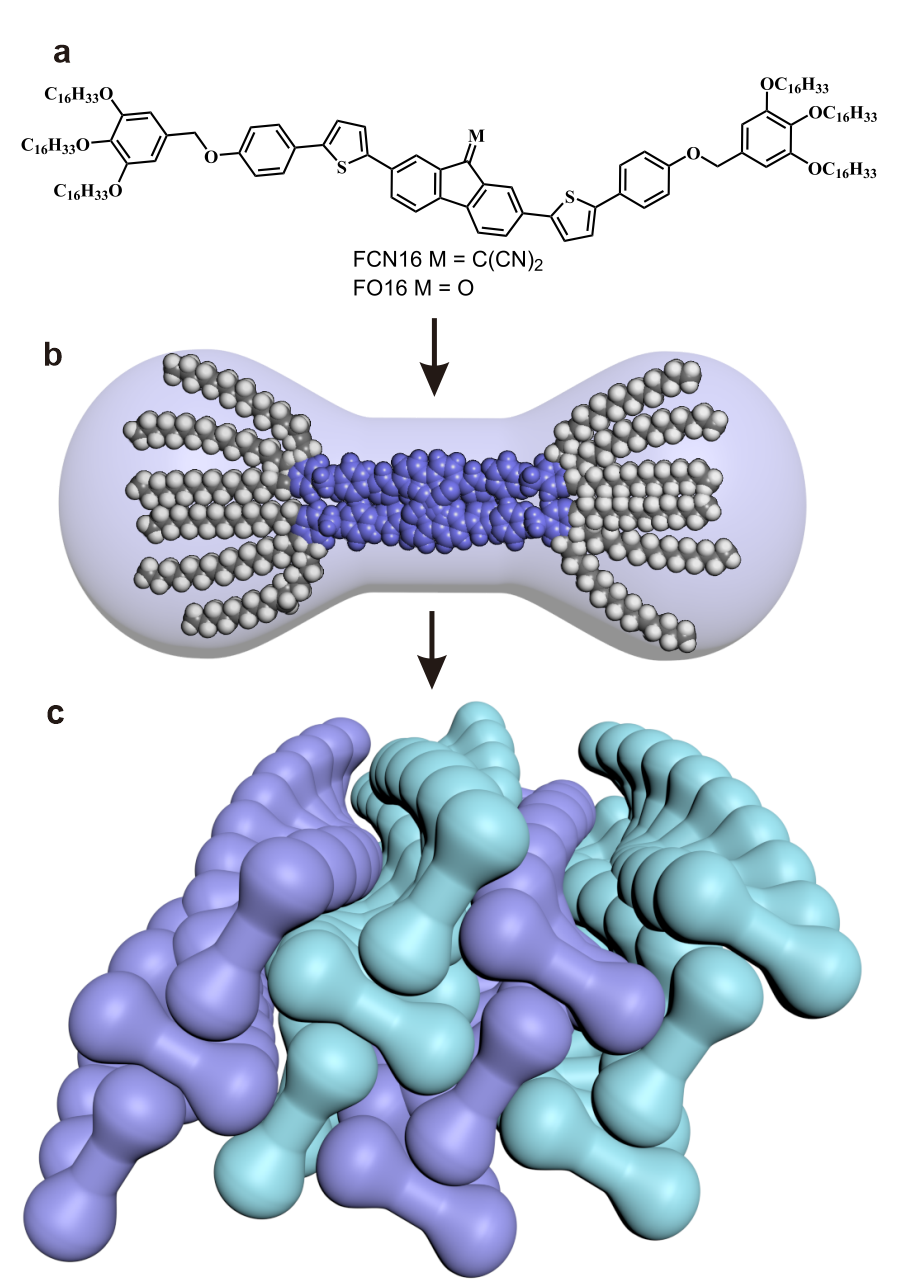
Fig. 2 Chemical formula of straight and bent-core molecules.
The twist of the ribbons is a compromise between the tendency of the aromatic rod-like cores to be parallel to their neighbours and thus maximize the overlap of their π-orbitals, and the steric repulsion of the bulging soft paraffinic end-brushes (Fig. 2b). In fact it turns out that two molecules pair up to form a dumbbell-shaped raft, as in Fig 2b.
In order to pack efficiently, four dumbbell-shaped rafts in a unit cell of Fddd symmetry rotate clockwise and the other four rotate anti-clockwise (Figs. 2c and 3). The alternating helices are also observed directly by atomic force microscopy (AFM) on compound FCN16 (Fig. 3i, j). The ~53 Å distance between helical columns in Fig. 3i and the ~35 Å helical pitch match almost exactly the electron density (ED) map and the proposed structural model of Fddd. Edge dislocations, stacking faults of mismatched chiral columns, and helix reversal defects are also seen in Fig. 3i, j.
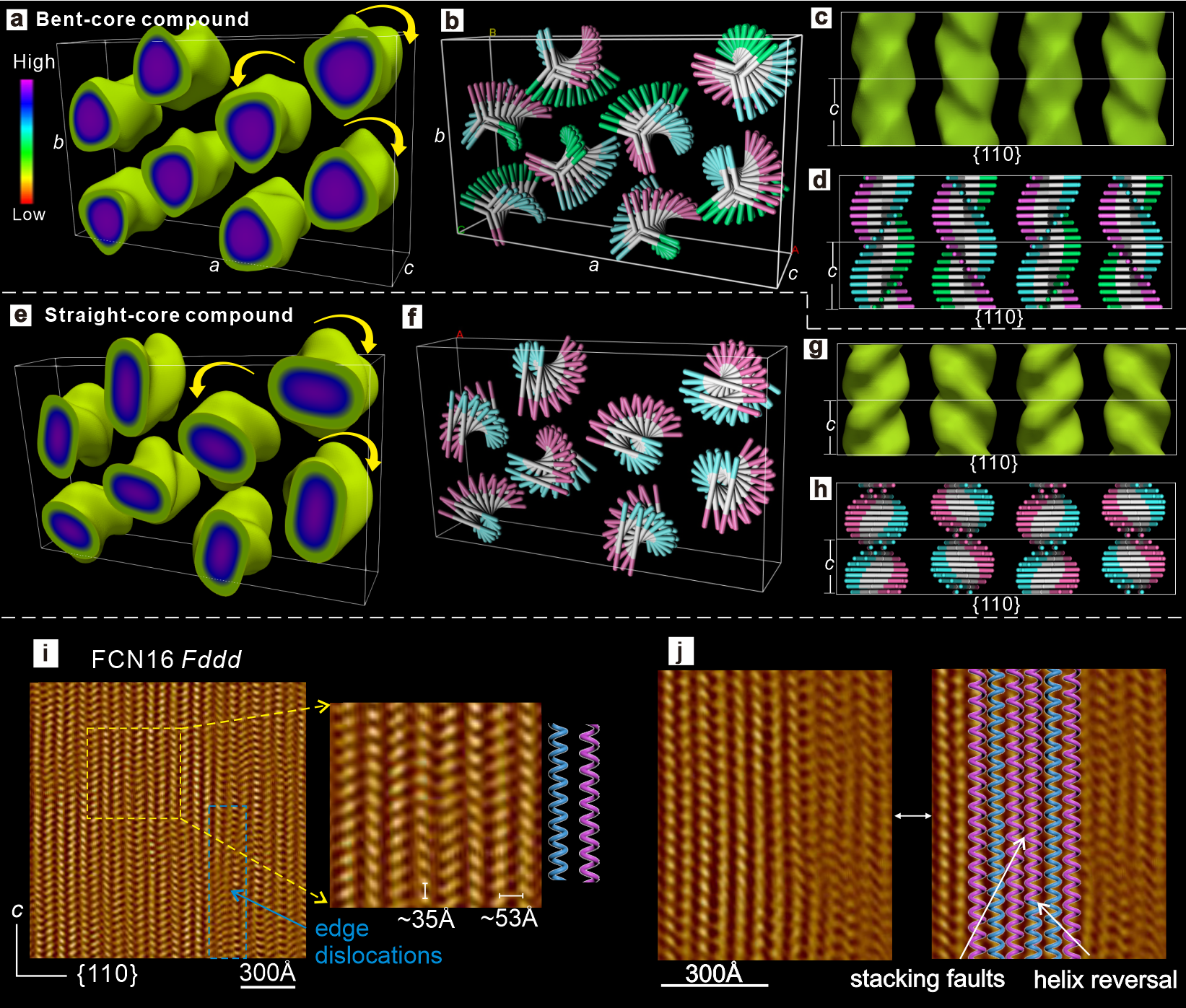
Fig. 3 ED maps, schematic models and AFM images.
In summary, a complex 3D liquid-crystal phase is discovered in straight-core compounds, having orthorhombic Fddd symmetry and consisting of counter-rotating helical columns. The findings provide a way of packing objects and they also open a new approach to homochirality in achiral compounds, with promising optical/chiroptical properties.
For more information, please visit our paper.
Follow the Topic
-
Nature Communications
An open access, multidisciplinary journal dedicated to publishing high-quality research in all areas of the biological, health, physical, chemical and Earth sciences.

Related Collections
With Collections, you can get published faster and increase your visibility.
Women's Health
Publishing Model: Hybrid
Deadline: Ongoing
Tumor Microenvironment Crosstalk and Therapeutic Implications
Publishing Model: Hybrid
Deadline: Nov 02, 2026