Brains in the Branches: how chickadees outsmart our harsh winters
Published in Ecology & Evolution and Behavioural Sciences & Psychology




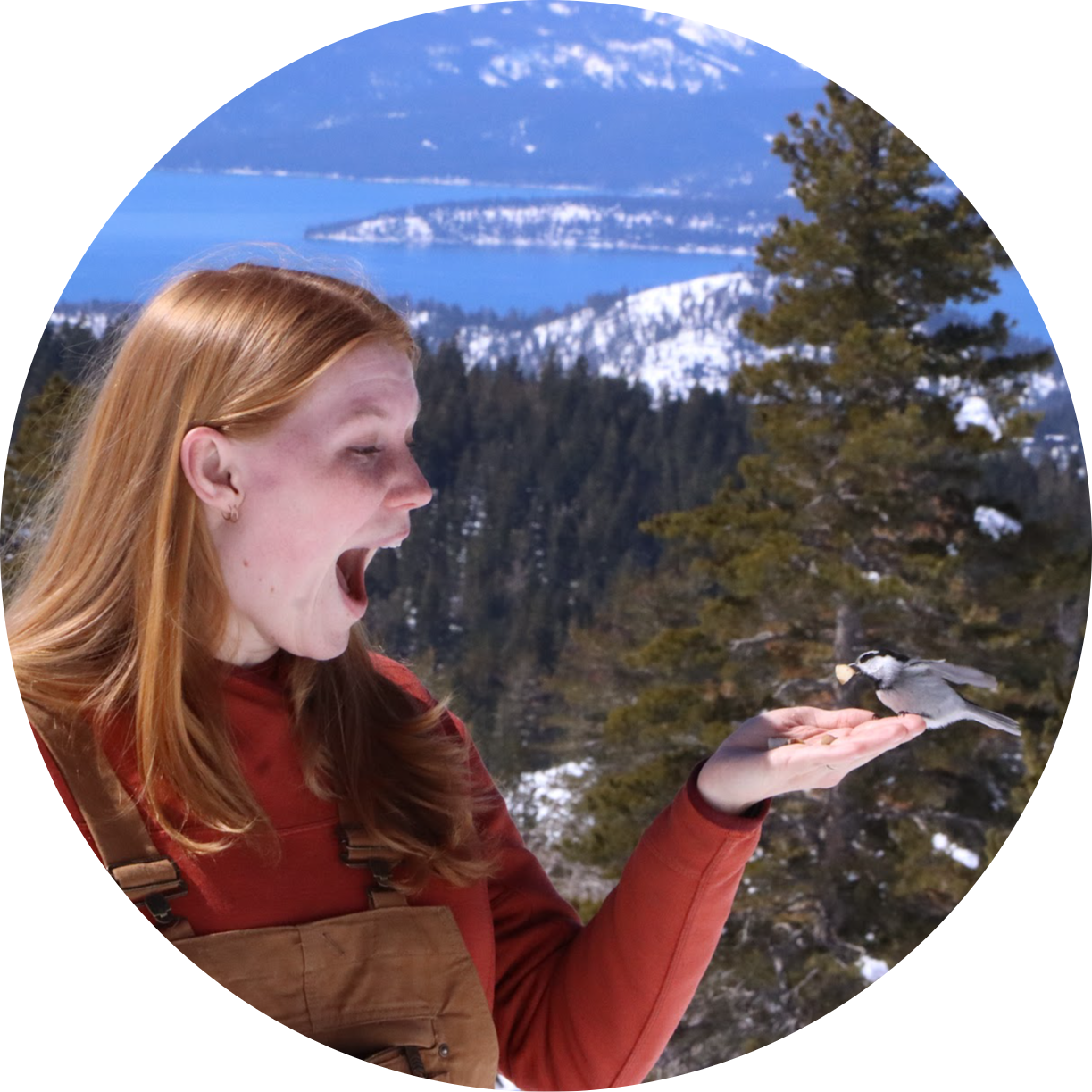
You’ve probably heard of a chickadee, if only from Christmas cards, but they have fascinated scientists for a particular reason: this tiny little bird has a crazy capacity for memory.
We’re up in the eastern Sierra Nevadas, one pass over from where the infamous Donner party got trapped trying to cross the mountain pass. The environment up here is beautiful, but not kind– not only is the air thin from how high up we are, but the summers are blisteringly hot and the winters are bone-chillingly cold, with up to fifteen feet of snow on the ground. Yet somehow, these little birds thrive.
But how? Turns out, they hide and recover tens of thousands of seeds across the forest to eat over the winter, making them a prime candidate to test theories on how the brain works and how specialised brain tasks– like crazy spatial cognition– have evolved.
Noah Camuso, a journalist and screenwriter from Oregon, and Ai Ana Richmond, a PhD student at the University of Nevada Reno and the first author of the paper, have made this video on the findings of a recent paper on cognitive flexibility in these charming little birds. Feel free to watch along to learn more– and maybe feel a little silly the next time you forget your keys!
Follow the Topic
-
Animal Cognition
Animal Cognition is an interdisciplinary journal offering current research on all aspects of animal (and human) cognition in an evolutionary framework.

Related Collections
With Collections, you can get published faster and increase your visibility.
Curiosity and Information-Seeking in Animals
Curiosity, the intrinsic motivation to investigate and gain information, is fundamental to human intelligence. However, like other cognitive capacities that were thought to be unique to humans, mounting evidence demonstrates that other animals also possess a tendency to gain information and resolve uncertainty independently of extrinsic rewards. These findings challenge conventional thinking about the evolution of reward processing mechanisms that operate in non-human brains. Moreover, the neuroscience and psychology of curiosity have recently received increased attention due to curiosity's importance in healthy cognitive function, and its implications for the development of artificial general intelligence. Despite recent advances in our understanding of curiosity, fundamental questions remain about the cognitive mechanisms, neural substrates, and origins of this enigmatic ability in humans and other animals.
In this collection we aim to highlight novel research investigating curiosity across contexts and taxa, shining a light on a variety of experimental methods that promise to refine our understanding of the definitive features of curiosity, the cognitive mechanisms that underpin it, and its developmental and evolutionary origins.
All manuscripts will undergo full peer-review using the standards for a regular submission to Animal Cognition. The Editors have no competing interests with the submissions which they handle through the peer-review process. The peer-review of any submissions for which the Editors have competing interests is handled by another Editorial Board Member who has no competing interests.
Publishing Model: Open Access
Deadline: Nov 30, 2026
Comparative Cognition Society’s Research Award: A Special Collection in Honor of Robert G. Cook
This Collection is a collection of papers in honour of the contributions of Dr. Robert G. Cook, who was awarded the Comparative Cognition Society’s Research Award in 2026. The research award is dedicated to honouring scientists who have made major contributions to our understanding of animal cognition during their careers.
Dr. Cook’s contributions to comparative cognition span across species and domains, with an emphasis on exposing mechanistic differences in the evolution of cognitive processes. A large volume of his contributions exposes the mechanisms of perception, attention, and concept formation. His most well-cited contributions include studies on categorisation, memorisation, and abstract concept processes across primates, rodents, and birds. Additional contributions include the development of the midsession reversal paradigm, dynamic stimulus processing, and computer-intensive experimental designs.
Please note that this collection is for invited authors only. Contact the Guest Editors if you would like to discuss a contribution to this issue. All manuscripts will undergo full peer-review using the standards for a regular submission to Animal Cognition. The Editors have no competing interests with the submissions which they handle through the peer-review process. The peer-review of any submissions for which the Editors have competing interests is handled by another Editorial Board Member who has no competing interests.
Publishing Model: Open Access
Deadline: Nov 30, 2026