Large Eddy Simulation of diurnally evolving atmospheric boundary layer under the influence of an annular solar eclipse
Published in Earth & Environment and Mathematics


Introduction:
A solar eclipse is not just a spectacular sight - it also acts like a natural experiment for scientists. When the Moon blocks the Sun’s light, even for a short time, it causes sudden changes in the Earth’s atmosphere. These changes can reveal how sensitive the air near the surface is to variations in sunlight.
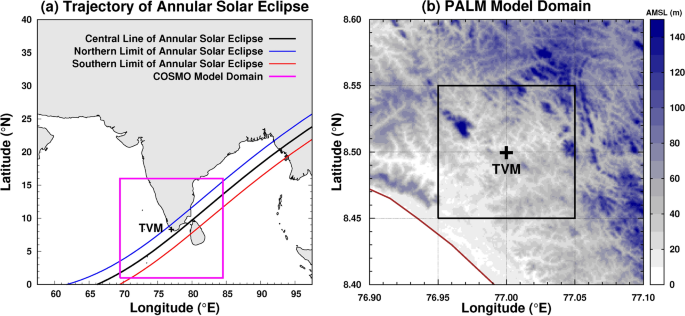
This study focuses on the annular solar eclipse of 15 January 2010 that passed over Thiruvananthapuram, India. It was one of the longest eclipses of the century, lasting nearly seven minutes at its peak. Scientists already knew eclipses could cause cooling and changes in wind and turbulence, but most earlier studies relied only on observations. The present investigation used a powerful computer modelling approach called Large Eddy Simulation (LES) to dig deeper into what happens in the lower atmosphere, or the atmospheric boundary layer (ABL), during such an event.
What is the Atmospheric Boundary Layer (ABL)?
The ABL is the lowest part of the atmosphere, directly influenced by the Earth’s surface. It responds quickly to heating, cooling, and surface changes. Sunlight normally warms the ground, which in turn warms the air, creating rising currents and turbulence. During an eclipse, however, this heating is abruptly cut off.
How was the Study done?
This investigation made use of the PALM (Parallelized Large Eddy Simulation Model) to simulate the atmosphere around Thiruvananthapuram. Two scenarios were compared:
-
-
LESControl - a normal clear-sky day without an eclipse.
-
LESEclipse - the actual eclipse conditions with reduced solar radiation.
-
The model was supported with weather data from ground stations and balloons, ensuring accuracy.
Key Findings
-
-
Sharp drop in sunlight – During the eclipse, solar radiation plummeted almost as if sunset had arrived hours early.
-
Cooling of air and soil – Temperatures of both air and ground fell noticeably, with soil cooling by more than 4°C.
-
Weaker turbulence – Normally, sunlight creates rising air currents and turbulence. The eclipse suppressed these, lowering turbulence intensity.
-
Shallower boundary layer – With reduced turbulence, the ABL could not grow as tall as usual. Its height dropped from about 1.5 km to just 600 m.
-
Slower recovery – After the eclipse, the atmosphere took time to return to its normal state. Even though sunlight returned, turbulence and vertical mixing stayed weaker for several hours.
-
Heat and momentum transport reduced – The eclipse cut down the ability of the atmosphere to mix heat and momentum between layers, shown by reduced eddy diffusivity values.
-
Why does this matter?
The study shows that a brief solar eclipse can mimic a “mini sunset” in the middle of the day, altering local weather processes. These findings are important because:
-
-
They reveal how sensitive the atmosphere is to sudden changes in solar energy.
-
They provide insights for improving weather and climate models, especially for short-term events.
-
They highlight that even temporary drops in sunlight could have measurable impacts on boundary-layer dynamics.
-
Conclusions
This work is among the first to use high-resolution large eddy simulations to capture how a solar eclipse reshapes the lowest layers of the atmosphere. It confirms that eclipses can cool the surface, weaken turbulence, lower the boundary layer, and delay atmospheric recovery. Beyond the scientific curiosity, the study proposes a robust LES framework for recreation of the meteorological conditions within the ABL over a given location under the influence of a solar eclipse.

By profession, I am a Researcher, but by nature - I happen to be a Philosopher.
If I try to describe myself in brief - I am a fun-loving, humorous person with an inherent blend of sensitive and sentimental emotions with an enormous amount of energy stored within.
I try to enjoy the "Life" to its maximum, as it doesn't have any "REWIND" button. Gone is Gone. We must move on.
The primary motto of our life must be - "TO LEARN", because the "LEARNING" is a never-ending process.
The more we learn, the more we remain younger. Mistakes are bound to happen. Learn from them, and move on.
In this world of so-called good and bad people, we can not avoid 'ARGUMENTS'.
I prefer not getting indulged in arguments leading to - "Who is wrong?"
Rather, I would love to change the direction of arguments towards - "What is wrong?". This helps, it surely helps.
To a very larger extent, I am an 'Optimist', and try to adopt two simple rules in my life:
---> (RULE NUMBER 1): TRY TO CHANGE THE THINGS THAT YOU CAN NOT ACCEPT.
---> (RULE NUMBER 2): TRY TO ACCEPT THE THINGS, THAT YOU CAN NOT CHANGE.
Inevitably, we may find the world with full of 'Competitions'. In plain words - "A NEVER-ENDING RACE".
WHAT IS THIS RACE FOR? I REALLY DON'T KNOW.
But sooner or later, we are made to believe that you are in one LAP, and you must RUN to survive. In such a situation, I remind myself of an African saying which suits the best to deal with such a race.
IF YOU WANT TO GO FASTER, GO ALONE.
BUT IF YOU WANT TO GO LONGER, GO IN A GROUP.
Learning is a never-ending process. Following this philosophy, I always try to learn something new everyday.
My hobbies include cricket, music, movies, cooking, and computer-based games. I have got a strong passion for FORTRAN programming, LINUX shell scripts, LaTeX FrontEnd programming, and any other tasks that might make our life simpler.
Follow the Topic
-
Scientific Reports
An open access journal publishing original research from across all areas of the natural sciences, psychology, medicine and engineering.

Related Collections
With Collections, you can get published faster and increase your visibility.
Cancer Prevention and Control
Publishing Model: Hybrid
Deadline: Feb 19, 2027
Healthy Aging
Publishing Model: Open Access
Deadline: Dec 31, 2026