RF-enabled soft thermistors overcoming decades-old range limitation
Published in Electrical & Electronic Engineering, Materials, and Physics


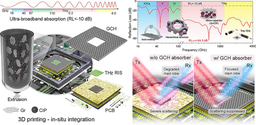
Formulating a new sustainable/soft material: Using carbon fibre and PDMS (a silicone-based polymer) we built a scalable highly flexible and stretchable robust composite that behaves as a highly sensitive positive temperature coefficient thermistor. Material choices followed the objective of avoiding metal particles (for cost/sustainability) and adopting biocompatible materials.
A Microwave/RF (and not DC) readout: as with all positive temperature coefficient (PTC) thermistors, our material was highly sensitive, but only over a very limited temperature range; the DC resistance becomes unreadable beyond 50-80°C (>100 MOhm). The sheet resistance and observed bulk conductivity, on the other hand, remains moderately low at RF/microwave frequencies, due to the presence of the conductive particles (carbon fibres) inside the material. This meant, using the permittivity and RF conductivity, we were able to observe temperature/electrical changes beyond 200°C (maximum measurement temperatue was 230°C).
Creating a Seamless Wireless Interface: with the material properties being temperature-dependent, we designed planar antennas using the thermistor as a dielectric substrate. Thus, controlling the amplitude of radiated signals using temperature. In a practical demonstration, we used an RFID tag to show that the signal strength (RSSI) of the backscattered signals from the battery-free tag could exhibit high temperature dependence. This means that we can have many distributed sensors with no on-board processing or power supplies.
The findings and underlying data can be openly accessed at: https://doi.org/10.1038/s41467-024-44735-z

Follow the Topic
-
Nature Communications
An open access, multidisciplinary journal dedicated to publishing high-quality research in all areas of the biological, health, physical, chemical and Earth sciences.

Related Collections
With Collections, you can get published faster and increase your visibility.
Women's Health
Publishing Model: Hybrid
Deadline: Ongoing
Tumor Microenvironment Crosstalk and Therapeutic Implications
Publishing Model: Hybrid
Deadline: Nov 02, 2026