A world first in Hydrogeology: monitoring and modeling of a long duration flow reversal at a submarine spring
Published in Earth & Environment
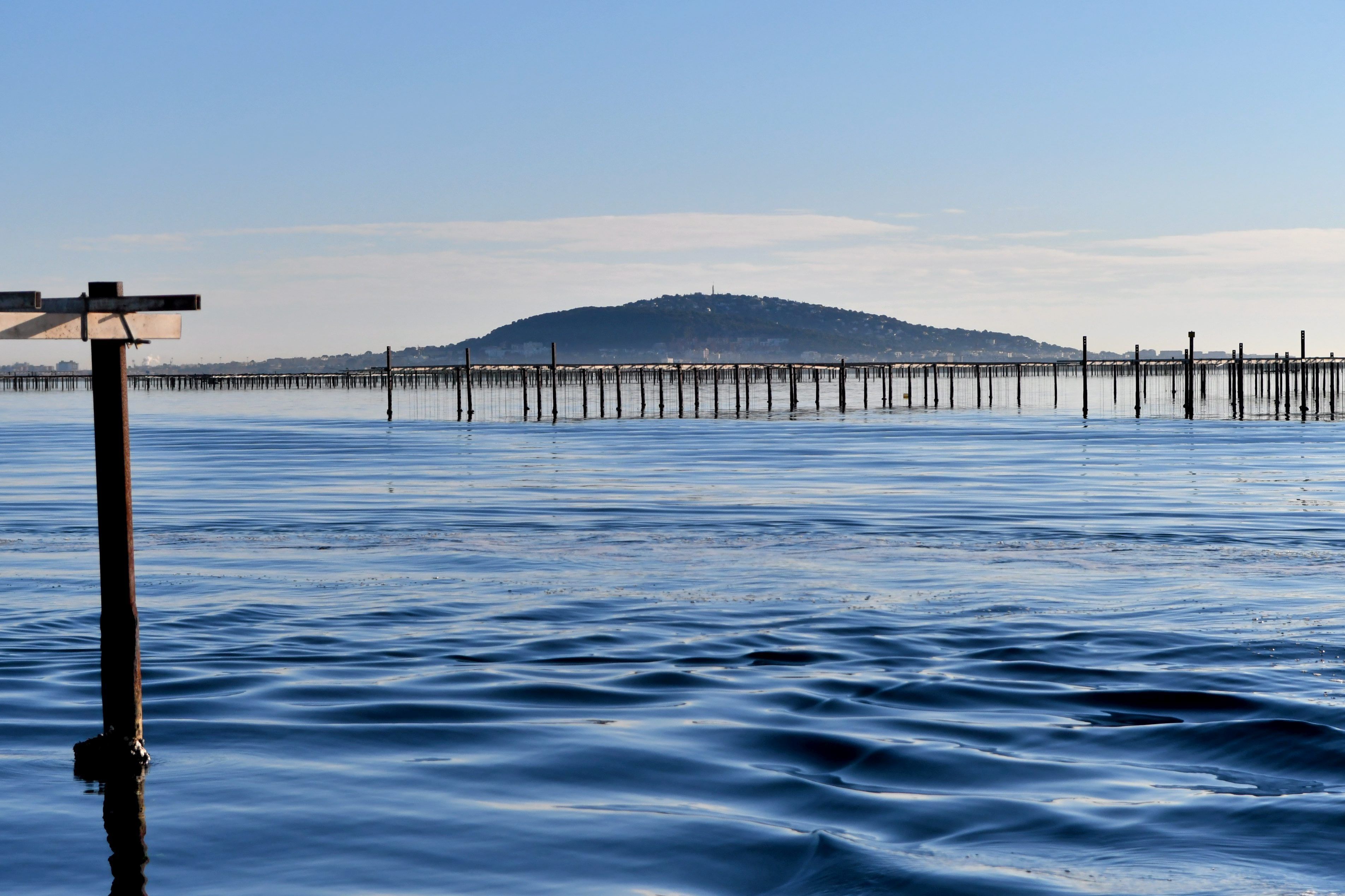





The Thau lagoon is a vast brackish water lagoon covering 70 km², located on the Occitanie coast, 30 km southwest of Montpellier, and in the immediate vicinity of the town of Sète. At the bottom of the lagoon, about 30 meters deep, lies a submarine karst spring (or Submarine Groundwater Discharge) : the Vise spring.
Flow reversal: An Exceptional Phenomenon and a Risk to Water Quality
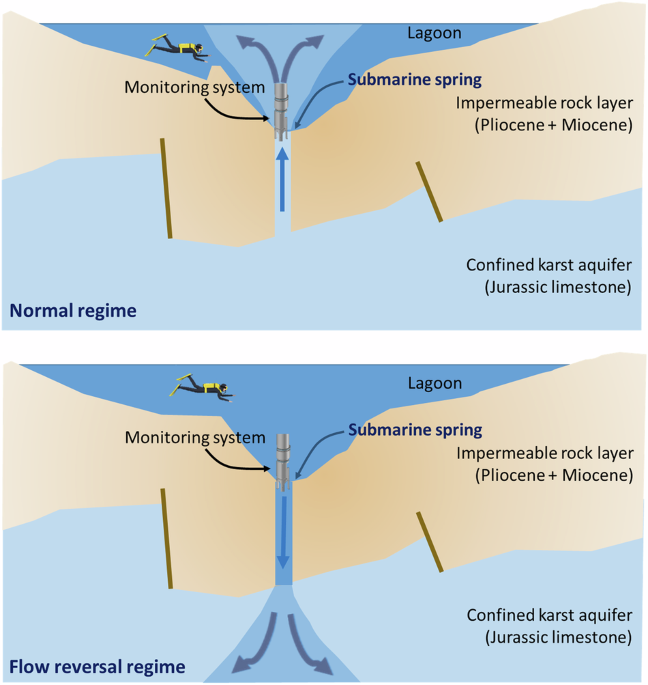
Under normal conditions, this spring drains groundwater from the Thau karst aquifer and supplies freshwater to the lagoon. However, during periods of drought, after a gust of wind over the lagoon, the water flows can reverse, and the saltwater from the lagoon infiltrates through the spring to contaminate the karst aquifer: this is the inversac or flow reversal.
Well-known to the residents around the Thau Lagoon, this exceptional hydrogeological phenomenon leads to the gradual salinization of the aquifer beneath the Thau lagoon.
Preserving the Thau aquifer is crucial for maintaining ecological balances, supporting shellfish farming activities, ensuring the supply of drinking water for local population, and preserving thermalism in Balaruc-les-Bains.
What is a flow reversal phenomenon ? (French video)
A measurement system unique in the world to understand the flow reversal phenomenon
As part of the Dem'Eaux Thau research project, and with the help of local partners, major financial and scientific efforts have been made to equip the spring with a measurement system that is unique in the world. This has made it possible to monitor the flow reversal phenomenon and its impact on the karstic aquifer, and to gain a better understanding of how it works.
In a paper published in Nature Communications Earth & Environment, BRGM researchers and their partners present the results of this work. They demonstrate that the driving parameter for changes in the hydrosystem's regime is the difference in pressure between the aquifer and the lagoon, controlled by changes in the density of the salt water in the lagoon. In fact, salt water - which is denser - exerts greater pressure than fresh water.
The authors reveal the existence of two tipping points:
- When the pressure difference between the aquifer and the lagoon becomes very low or even negative, the system suddenly deteriorates and switches from normal conditions to saltwater intrusion.
- A much greater pressure difference is then required to return the system to its normal state. The denser salt water fills the vertical karstic conduit and acts as a plug, which explains the long duration of the flow reversal (several months).
In a context of climate change, flow reversal in submarine karstic springs could be more frequent and longer in the future due to rising sea levels and reduced groundwater recharge, threatening freshwater resources.
An innovative experimental system is being installed to stop the inversac phenomenon
A vigilance system to anticipate the risk of future flow reversal was set up and successfully tested during the last flow reversal episode, in October 2023.
Following on from this work, an innovative experimental system is being installed in July 2025. Its aim: to stop the flow reversal phenomenon. Specially adapted to the characteristics of the site and made up of several modules, it has been installed at a depth of 30 metres, at the point where the Vise spring flows into the lagoon. The aim is to carry out tests to limit saltwater intrusion into the aquifer while maintaining the natural flow of freshwater.
The results of this unprecedented experiment could be transferred to other sites threatened by the salinisation of their water resources.
To find out more
More about the Dem'Eaux Thau project: https://www.brgm.fr/fr/reference-projet-acheve/dem-eaux-thau-gestion-ressources-eau-souterraine-aquifere-cotier-karstique
Read : Nature Communications Earth & Environment : Hysteresis of submarine karst springs reveals tipping points in flow reversal and saline intrusion phenomena, par Maréchal Jean-Christophe, Ladouche Bernard, Lamotte Claudine, Dewandel Benoit, Hakoun Vivien, Perrochet Pierre [https://rdcu.be/eCtmu]

Follow the Topic
-
Communications Earth & Environment
An open access journal from Nature Portfolio that publishes high-quality research, reviews and commentary in the Earth, environmental and planetary sciences.

Related Collections
With Collections, you can get published faster and increase your visibility.
Hazards in Mountain Regions
Publishing Model: Open Access
Deadline: Nov 02, 2026
Carbon Dioxide Removal
Publishing Model: Hybrid
Deadline: Jan 16, 2027





Please sign in or register for FREE
If you are a registered user on Research Communities by Springer Nature, please sign in