Behind RaCaS: How the Human Drive for Understanding Won a Global Competition in Decision Making
Published in Neuroscience, Behavioural Sciences & Psychology, and Economics





The Choice Engineering Competition
Five years ago, my colleague Dr. Oren Amsalem and I, both still PhD students in Computational Neuroscience, came across an announcement that seemed tailor-made for our interests in human cognition and modelling. The Choice Engineering Competition (CEC), co-hosted by Nature Communications, challenged multidisciplinary teams around the world to design algorithms – rooted either in psychological “choice architecture” or quantitative reinforcement models.
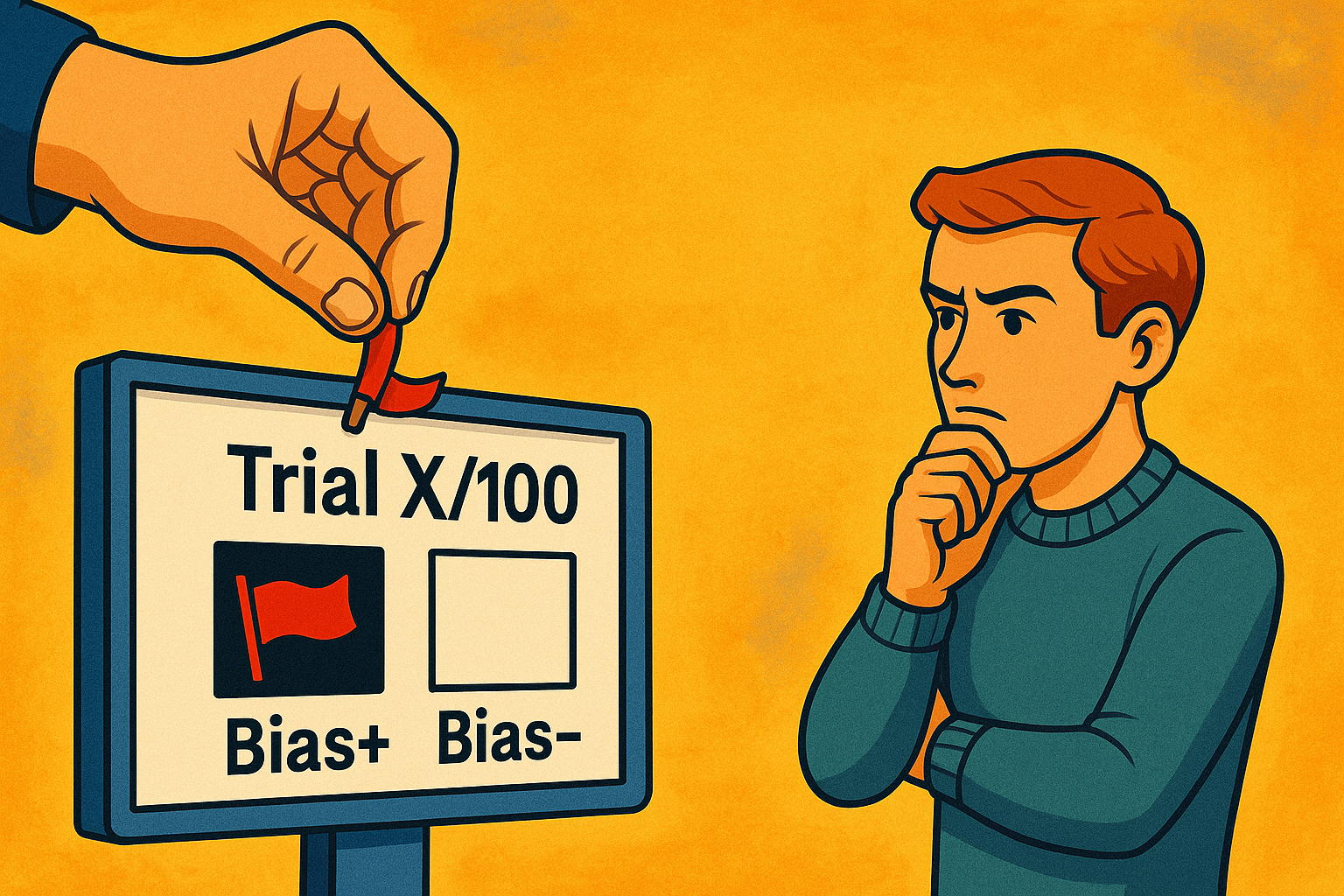
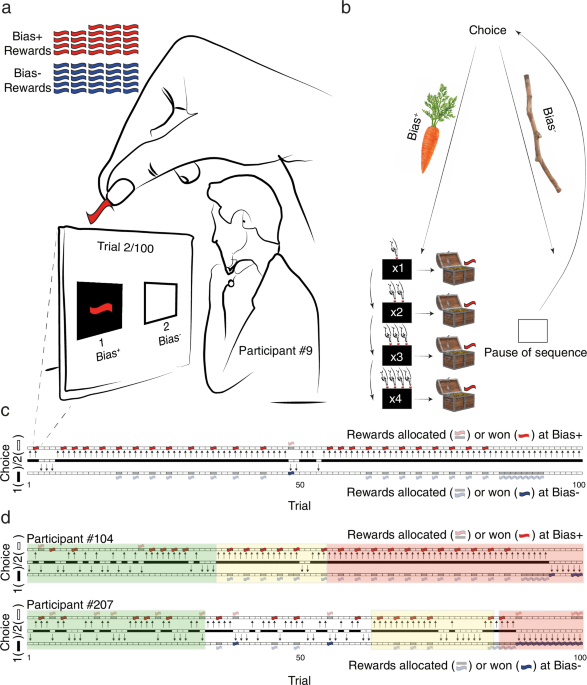
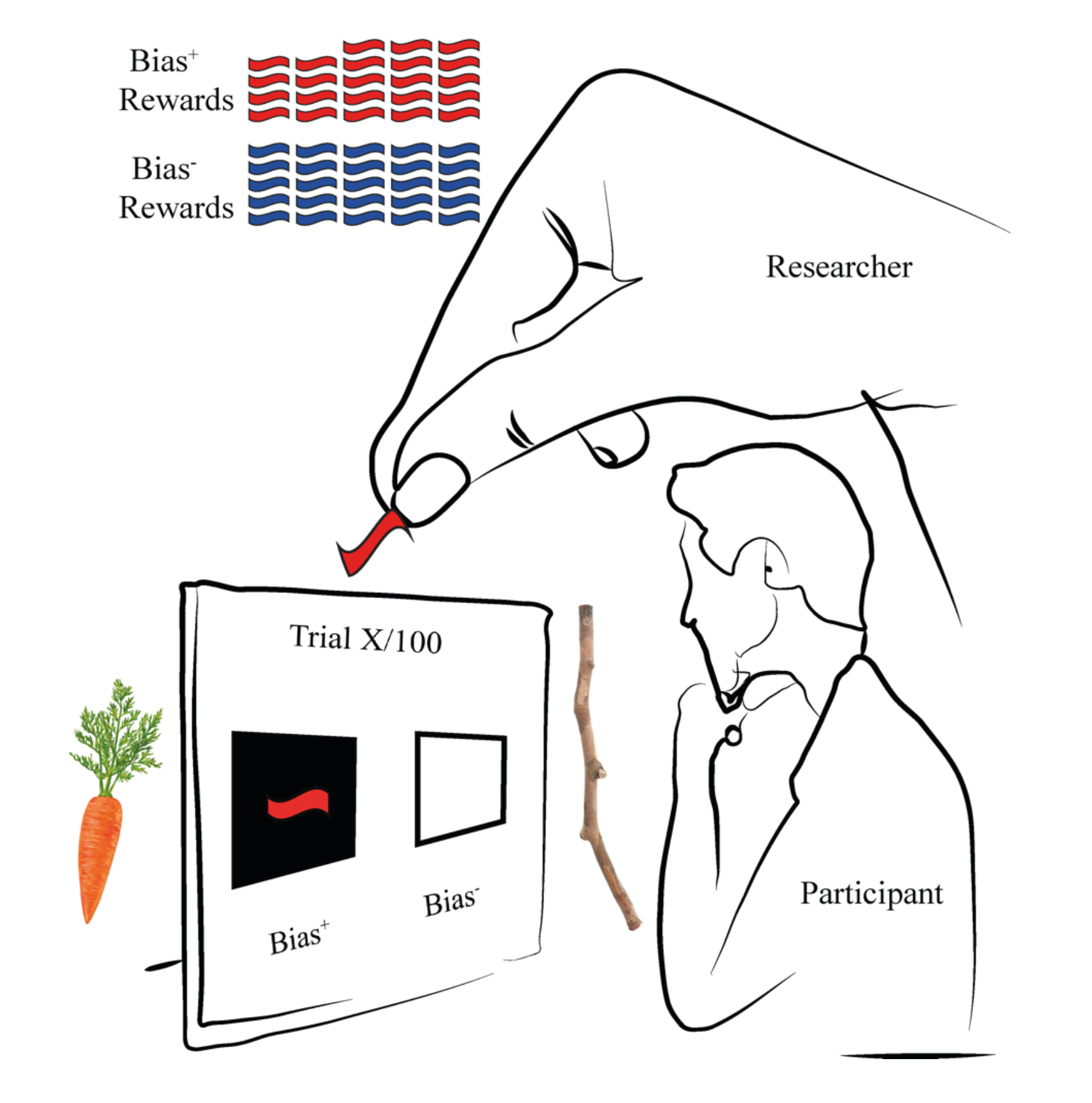
In the CEC, thousands of human participants were repeatedly presented with two possible choices, for a total of 100 decisions. All performed the same task; their goal was to collect as many rewards as possible; after each choice they were informed whether they had obtained a reward or not. Unbeknownst to them, the true competition took place between the researchers, whose goal was completely different.
The researchers’ goal was to manipulate the participants’ decisions in this deceptively simple two-alternative forced-choice task. Their mission was to allocate a total of 50 monetary rewards evenly across two options in 100 sequential trials (25 rewards for each option). The catch? Nudge human participants to favour one side (“Bias+”) despite the rewards being split evenly.
The CEC featured two tracks: “Static”, where reward schedules were fixed in advance, and “Dynamic”, where reward allocation could adapt in real-time in response to the participants' choices. Drawn to this marriage of theory and empirical testing, we jumped at the chance to participate.
Designing Static Schedules
We began by tackling the Static track. We were aiming to craft predetermined reward sequences that subtly influenced choices by following an intuitive logic: Bias+ rewards were clustered early in the sequence to induce a primacy effect, while Bias- rewards were either hidden or delayed until the end, evoking "learned helplessness." To obscure Bias- rewards, we hypothesized that people are unlikely to switch their choice immediately after receiving a reward (we referred to it as the “if it ain’t broke, don’t fix it” principle). These static schedules proved to be strong performers – our best configuration elicited roughly a 64% preference for the Bias+ option and was not significantly different than the algorithm which scored first in the Static track.
Designing RaCaS: The Dynamic Algorithm
Building a dynamic algorithm was far more challenging, both conceptually and technically. We were constantly thinking about ways to tackle this problem. Our breakthrough came during informal lab testing of the static schedules, when we tested the algorithms ourselves alongside generous colleagues and lab-members who dutifully clicked through hundreds of trials. Over and over, participants remarked, “I think I’ve figured out the logic,” or “I know how to get the rewards.” Our empirical (yet somewhat anecdotal at the time) observation hinted that participants were attracted not merely by rewards – they were drawn to the feeling that they understood and could predict the unfolding pattern, maybe even control it. This joint realization, stemming from these insights together with our personal experiences, echoed fascinating concepts I have encountered as an undergraduate studying psychology, on the centrality of agency in human motivation.
So, we pivoted: what if a sense of predictable structure, not just reward, could drive choice in the CEC task? Our answer was RaCaS (Regularity as Carrot and Stick), a dynamic algorithm crafted on the hypothesis that an evolving, predictable pattern could become intrinsically rewarding - perhaps even more motivating than the actual payoffs.
We designed RaCaS so that the Bias+ option featured an unfolding regularity: a “carrot” sequence of rewards spaced at intervals that grew as commitment deepened. If participants deflected to Bias-, the sequence would temporarily lose predictability – the “stick.” We iteratively refined the algorithm with internal pretests, calibrating when to lengthen or reset the reward schedule. Although the idea was very simple, due to different edge cases and various scenarios, the resulting code was more complex than we anticipated. We view RaCaS as a first step; future parameter tuning would likely further enhance its effectiveness.
Competition Results
The CEC tested all submitted algorithms with 3,521 Amazon Mechanical Turk participants, each completing 100 trials. Our excitement peaked when we learned that RaCaS produced a mean 69.8% preference for the Bias+ option – outperforming every other static and dynamic entry. In other words, even with perfectly balanced rewards, participants reliably gravitated toward the structured, predictable choice. This empirical validation confirmed our hunch: evolving regularity doesn’t just guide choice, it can become a powerful, intrinsic motivator.
After receiving the competition results, we shared them with Prof. Baruch Eitam - the cognitive scientist who first discovered “motivation from agency.” On a personal note, Baruch was the scholar who introduced me to these foundational ideas during my undergraduate studies, profoundly shaping my perspective. Seeing RaCaS’s outcome echo his theories was particularly meaningful. Baruch found our findings intriguing, encouraged us to publish, and ultimately joined the project, playing a key role in conceptualizing and helping us connect our results to the broader psychological field.
Broader Implications & Future Directions
RaCaS’s success reveals a compelling lesson: the human desire for predictability and control can be harnessed algorithmically to steer decisions – sometimes even more effectively than direct incentives. This raises important questions, especially as “nudges” face increased scrutiny: hidden patterns and subtle structures can strongly influence behaviour, sometimes in ways misaligned with people’s goals.
Looking forward, two priorities emerge:
- Mechanistic Dissection: Clarify whether predictability, agency, reinforcement, or other factors underlie RaCaS’s effects, incorporating subjective reports and pattern-recognition tasks.
- Ethical Boundaries: Explore how RaCaS-like interventions can be applied – or guarded against – in real-world settings, maximizing benefits while minimizing misuse (“dark sludges”).
Acknowledgments & Reflections
We thank the CEC organizers for the rigorous testbed, and our institutions – The Edmond and Lily Safra Center for Brain Sciences (ELSC) at HUJI; The Sainsbury Wellcome Centre (SWC) at UCL, the University of Haifa, and Harvard Medical School – for their support. This experience fundamentally reshaped our understanding of curiosity, control, and the hidden forces guiding human choice. We hope our work sparks new inquiry into the unseen patterns shaping decisions, inside and outside the lab.

An interdisciplinary scientist specializing in Computational Neuroscience, Human Behaviour, Modeling and AI.
Follow the Topic
-
Nature Communications
An open access, multidisciplinary journal dedicated to publishing high-quality research in all areas of the biological, health, physical, chemical and Earth sciences.

Related Collections
With Collections, you can get published faster and increase your visibility.
Women's Health
Publishing Model: Hybrid
Deadline: Ongoing
Tumor Microenvironment Crosstalk and Therapeutic Implications
Publishing Model: Hybrid
Deadline: Nov 02, 2026