Behind the Paper: Atmospheric Rivers Emerge as Future Freshwater Reserves and Heat Stocks
Published in Earth & Environment






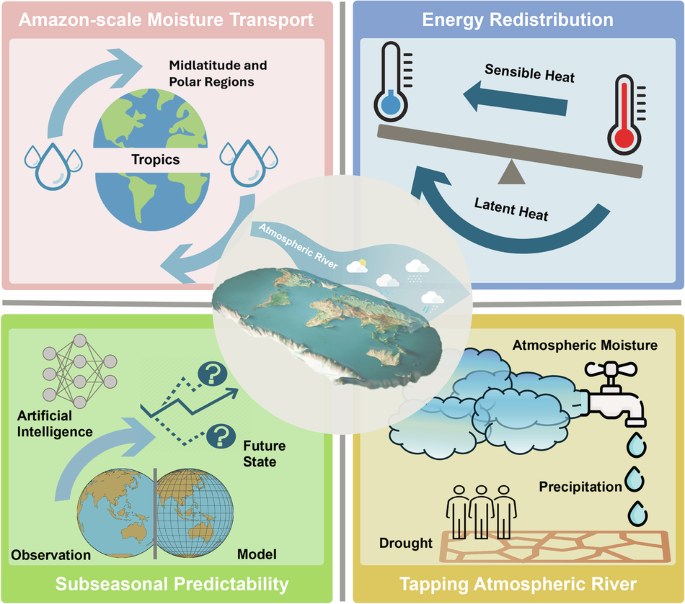

Atmospheric rivers (ARs) have long fascinated me. When I first encountered the term when I started my PhD studiy at Columbia in 2009, they were still a niche topic in atmospheric science—occasionally mentioned in weather briefings or satellite imagery discussions, but not yet at the center of climate research. Fast forward to today, ARs have emerged as one of the most dynamic frontiers in climate science, hydrology, and extreme weather prediction. This paper, Atmospheric rivers emerge as future freshwater reserves and heat stocks, represents not only years of scientific inquiry but also a personal journey that has unfolded alongside the rapid growth of an entire research community.
The Rise of ARs in Climate Science
ARs are long, narrow corridors of concentrated water vapor in the atmosphere, capable of transporting more moisture than the Amazon River discharges at its mouth. ARs transport vast amounts of moisture—often exceeding the discharge of the Amazon River—into major river basins around the world, playing a dominant role in extreme precipitation along the west coasts of continents, from North America to Europe and East Asia.
But ARs are more than just “rivers in the sky.” In this study, we argue that they should be recognized as dual-function climate carriers: freshwater reserves and heat stocks in the sky. They don’t just move water—they also redistribute vast amounts of energy across continents and oceans, influencing everything from river discharge to sea surface temperatures and land heatwaves.
Despite their growing recognition, our understanding of ARs—particularly under climate change—remains incomplete. How do they evolve on subseasonal timescales? How do they interact with regional hydrology? And critically, could they be more than hazards—could they become resources?
A Global, Energy-Informed Perspective
In this study, we take a unified approach by integrating hydrological and thermodynamic perspectives to examine ARs globally. Using multi-decadal reanalysis data and future climate projections from CMIP6 models under the high-emissions scenario SSP5-8.5, we quantify both the freshwater and heat transported by ARs—and how these may change by the end of the 21st century.
Our findings reveal a striking transformation:
- By 2100, 70% of mid-latitude ARs are projected to transport more moisture than the mean discharge of the Amazon River (approximately 160,000 kg/s)—up from about 60% in the historical period.
- These events are not only intensifying but also shifting poleward, consistent with broader changes in atmospheric circulation under global warming.
- The meridional transport of moist static energy by ARs is increasing and migrating toward higher latitudes, underscoring their expanding role in redistributing heat across the planet.
We also identify distinct “heat archetypes” among ARs: some are dominated by latent heat release, driving extreme rainfall and flooding; others carry more sensible heat, contributing to anomalous warming and even compound heat-humidity events. These differences shape downstream impacts on river basins, sea surface temperatures, and regional climate extremes.
ARs as Dual-Function Climate Carriers: Freshwater Reserves and Heat Stocks
This dual transport of moisture and energy is the core insight of our paper. We propose that ARs should no longer be viewed solely through the lens of flood risk. Instead, they are integrated climate carriers—simultaneously delivering large pulses of water and heat across continents.
In key river basins like the Yangtze, Loire, and Sacramento, AR-driven moisture inputs closely align with annual river flow cycles, particularly during flood seasons. This coherence suggests ARs aren’t outliers—they’re integral to the rhythm of water availability. As climate change amplifies AR intensity, their potential role as managed atmospheric reservoirs grows more compelling.
At the same time, the heat they carry—especially in sensible form—can precondition landscapes for wildfires, delay snowmelt, or even trigger early-season heatwaves. For example, an AR making landfall with strong sensible heating can elevate near-surface temperatures days before rainfall begins, creating dangerous pre-flood warming conditions.
Thus, ARs are not just weather events—they are climate-scale conveyors of both water and thermal energy, linking oceanic evaporation to continental hydrology and heat extremes.
From Prediction to Resilience: Forecasting Precipitation and Heatwaves
One of the most promising implications of this work lies in improving subseasonal to seasonal (S2S) forecasts. Because ARs act as precursors to extreme events, better prediction of their occurrence, trajectory, and thermodynamic structure can significantly enhance early warning systems.
Heavy precipitation: By identifying ARs 5–7 days in advance, water managers can prepare for flood risks or, conversely, capture stormwater during droughts.
Heatwaves: Our analysis shows that certain AR types deliver substantial sensible heat to the surface, sometimes leading to pre-precipitation warming events. Recognizing these “warm ARs” could improve heatwave forecasts, especially in coastal and mountainous regions where temperature swings are amplified.
In this way, treating ARs as dual carriers enhances not only our scientific understanding but also our practical ability to anticipate compound extremes—events where flooding and heat interact to strain infrastructure and ecosystems.
A Growing Community
Over the past decade, I’ve witnessed the AR research field evolve from a small cluster of observational studies into a vibrant, interdisciplinary community. Advances in satellite remote sensing, reanalysis products, machine learning, and high-resolution modeling have dramatically improved our ability to detect, track, and forecast ARs. Collaborative initiatives like ARTMIP and UNESCO-backed SEPRESS programs are closing critical gaps in process understanding.
This paper is a product of that momentum—a collaborative effort grounded in climate dynamics, hydrology, and atmospheric thermodynamics. My coauthors are my students, each bringing unique expertise from diverse fields including remote sensing, atmospheric science, engineering, and statistics. It is deeply rewarding to see how their interdisciplinary perspectives have converged to advance a unified understanding of atmospheric rivers. I’m especially proud that this work moves beyond treating ARs as mere meteorological phenomena, positioning them instead as central agents in the future of water security and the global energy balance—dual-function carriers that shape both freshwater availability and extreme climate events.
Looking Ahead
Much remains unknown: How will AR frequency and structure change under different emission pathways? Can we improve S2S forecasts to support water management decisions? And how do ARs interact with other climate modes—such as El Niño or the stratospheric polar vortex—in shaping extreme events?
As climate change accelerates the hydrological cycle, ARs will likely grow in intensity and influence. My hope is that this work encourages scientists, policymakers, and the public to see ARs through a dual lens: yes, they bring risk—but they may also carry opportunities for resilience.
After approaching two decades of studying these sky-borne rivers, I’m reminded that the same systems that challenge our infrastructure may also hold clues to sustaining life in a warmer world. Perhaps the future of water security isn’t just underground or in reservoirs—but flowing above us, in the invisible currents of the atmosphere.
Citation:
Lu, M.†*, Song, Y.†, Huang, W., & Zhang, L. (2025). Atmospheric rivers emerge as future freshwater reserves and heat stocks. Communications Earth & Environment.
† Co-first authors | * Corresponding author
Mengqian, who currently holds the positions of Director of the Otto Poon Centre for Climate Resilience and Sustainability, Director of World Sustainable Development Institute and Director of the Digital Meteorological Services Innovation Lab at HKUST Shanghai Centre, is also an Associate Professor of Hydrometeorology in the Dept. of Civil and Environmental Engineering, Dept. of Ocean Science and Dept. of Finance at HKUST. She is the Chairman of The International Association For Hydro-Environment Engineering And Research – Hong Kong Chapter and the Founder and Chair of The Climate, Weather and Water Forum (CWWF). She is also the chair of UNESCO Decade Science program “Seamless Prediction and Services for Natural and Built Environments” (SEPRESS), 2025 – 2032.
Mengqian graduated with First-Class Honors from the Hong Kong University of Science and Technology (HKUST) in 2009, receiving the Academic Achievement Medal. She went on to complete her Ph.D. in Earth and Environmental Engineering at Columbia University in 2014. Her research centers on understanding and predicting hydrometeorological extremes—including heavy rainfall, floods, tropical cyclones, heatwaves, and their compound hazards. Her ultimate goal is to enhance seamless forecasting and services that support sustainable development.
Follow the Topic
-
Communications Earth & Environment
An open access journal from Nature Portfolio that publishes high-quality research, reviews and commentary in the Earth, environmental and planetary sciences.

Related Collections
With Collections, you can get published faster and increase your visibility.
Hazards in Mountain Regions
Publishing Model: Open Access
Deadline: Nov 02, 2026
Carbon Dioxide Removal
Publishing Model: Hybrid
Deadline: Jan 16, 2027





Please sign in or register for FREE
If you are a registered user on Research Communities by Springer Nature, please sign in