Behind the Scenes: Understanding How Food Environments Shape Diets and Disease in South Asia
Published in Social Sciences, Sustainability, and Law, Politics & International Studies
South Asia is undergoing profound demographic and nutritional change. Rapid urbanisation, rising incomes and shifting lifestyles are transforming not only the foods people consume but also the environments in which those choices are made. Traditional diets rich in grains, legumes, fruits and vegetables are increasingly displaced by more energy‑dense options that are high in unhealthy sugars, salt and fats. These shifts are occurring alongside steep rises in diet‑related noncommunicable diseases (NCDs), including obesity and type 2 diabetes.
Unhealthy diet is a key modifiable risk factor for NCDs, and evidence has clearly documented that prevention is more effective than treatment. Policies that regulate the food environment to encourage the consumption of healthy diets and discourage the consumption of unhealthy ones could be especially impactful. Evidence shows that exposure to unhealthy food environments through availability, affordability and advertising plays a critical role in shaping dietary behaviours (Atanasova et al., 2022a). However, to date, policies related to food environments in the South Asia region have focused largely on hygiene and food safety standards, with few focusing on preventing unhealthy diets (Pineda et al., 2024).
As part of the Global Health Research Unit (GHRU) South Asia Biobank, funded by the UK National Institute for Health and Care Research (NIHR) (16/136/68; 132960), a group of researchers based at the Centre for Health Economics and Policy Innovation (CHEPI) at Imperial Business School set out to understand how features of the food environment may influence adults’ diets and NCD risk across Bangladesh, India, Pakistan and Sri Lanka.
Availability of healthy and unhealthy food retailers
One aspect of the food environment we explored is the relative availability of healthy and unhealthy shops. In our study sample, many adults lived in neighbourhoods where fast‑food restaurants and convenience retailers were far more common than healthier retailers such as supermarkets or fruit and vegetable sellers. We find that living in areas with a higher share of fast‑food restaurants was associated with higher body mass index (BMI), larger waist circumference, higher fasting blood glucose levels, and greater likelihood of obesity and type 2 diabetes (around 9% higher obesity risk and around 8% higher diabetes risk) (Atanasova et al., 2022b; Kusuma et al., 2022). These associations were consistently stronger among women, who were more likely to live near unhealthy retailers. In contrast, living in neighbourhoods with more supermarkets was associated with lower BMI (around 3 BMI units), smaller waist circumference (around 6 cm) and lower risk of obesity (around 18%) (Atanasova et al., 2022b). Overall, these findings suggest that the type of food retailers people encounter near their homes may play an important role in shaping NCD risk and present a promising area for preventative policy action.
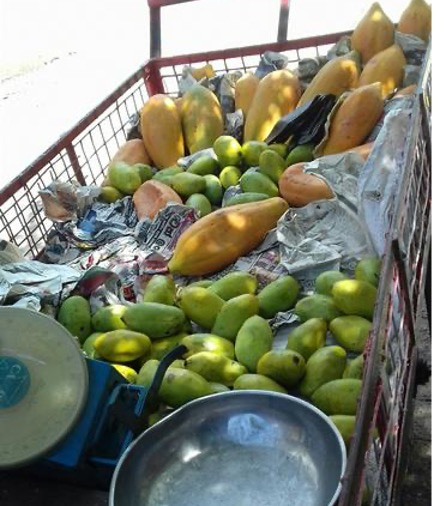

Sample images of mobile food carts from environmental mapping. Source: Kusuma et al., (2022).
Outdoor food advertising
We also examined the food advertisements that surround people as they go about their days. Across more than 8,000 outdoor food ads featuring nearly 20,000 products, we found that the advertising landscape was dominated by unhealthy foods: ~88% of advertised products were unhealthy, with ice creams (~33%) and sugar‑sweetened beverages (~23%) being the most common products (Atanasova et al., 2026a). The ads also commonly employed marketing techniques such as price promotions and promotional characters, and the majority were for multinational brands (Atanasova et al., 2026b).
In many sites, individuals could encounter dozens of unhealthy food ads within just 300 metres of their homes. We found that higher exposure to unhealthy ads was associated with more energy-dense diets (~0.02 kcal/g), with slightly stronger effects for ads featuring price discounts and multinational branding (Atanasova et al., 2026a; 2026b). Women and higher‑income adults tended to live in areas with more unhealthy advertising and showed higher intakes of free sugars and saturated fats when exposed to ads for high‑fat or high‑sugar products.
These results are small but meaningful at a population scale, particularly given that outdoor advertising is encountered daily and might be impossible to avoid. These associations persisted even after accounting for retailer availability, indicating that advertising may acts as an independent pathway that can shape dietary behaviour.
Reflecting on the findings, Professor Marisa Miraldo, who led this programme of research noted:
“Right now, multinational marketing budgets are effectively shaping what people eat more consistently than public health systems can. That imbalance is one of the most under‑discussed drivers of obesity and diabetes.”
- Professor Marisa Miraldo, Professor in Health Economics and Policy, Imperial Business School
Furthermore, Dr. Zoey Verdun, Research Associate, co-author on the studies, added:
“When people are constantly surrounded by ads for unhealthy products such as confectionaries and sugary drinks, it is no surprise that these products become part of their everyday diets. Our work shows that outdoor advertising quietly shapes what people eat, even when they are not actively aware of it.”
- Zoey Verdun, Research Associate, CHEPI, Imperial Business School
Bottom line: what should be done?
The food environments that surround adults in South Asia are not currently supporting healthy diets. To build healthier and more equitable environments, coordinated action is needed to improve availability, ensure affordability and regulate advertising. This includes zoning measures that limit fast‑food density while encouraging healthier retailers; subsidies for nutritious staples paired with taxes on sugary drinks and high‑fat products; and restrictions on unhealthy outdoor food advertising. Given the disproportionate exposure faced by women, our findings raise concerns that food environments might be widening gender gaps in NCDs across South Asia. Therefore, interventions should be gender‑responsive and focused on improving the healthfulness of neighbourhood spaces. Together, these steps could help create health‑enabling environments that could curb the rising rates of obesity and NCDs across South Asia.
Relevant Studies:
Atanasova, P., Andretti, B., Verdun, Z., Wellappuli, N., Frost, G., Sassi, F., … & Miraldo, M. (2026a). Mapping outdoor food advertising and its association with adult dietary intake in South Asia. Manuscript in preparation.
Atanasova, P., Andretti, B., Verdun, Z., Wellappuli, N., Frost, G., Sassi, F., … & Miraldo, M. (2026b). Marketing strategies in unhealthy outdoor food advertisement and their association with adults’ diets. Manuscript in preparation.
Atanasova, P., Kusuma, D., Pineda, E., Anjana, R. M., De Silva, L., Hanif, A. A., ... & Miraldo, M. (2022b). Food environments and obesity: A geospatial analysis of the South Asia Biobank, income and sex inequalities. SSM-Population Health, 17, 101055.
Atanasova, P., Kusuma, D., Pineda, E., Frost, G., Sassi, F., & Miraldo, M. (2022a). The impact of the consumer and neighbourhood food environment on dietary intake and obesity-related outcomes: A systematic review of causal impact studies. Social science & medicine, 299, 114879.
Kusuma, D., Atanasova, P., Pineda, E., Anjana, R. M., De Silva, L., Hanif, A. A., ... & Miraldo, M. (2022). Food environment and diabetes mellitus in South Asia: A geospatial analysis of health outcome data. PLoS medicine, 19(4), e1003970.
Pineda, E., Atanasova, P., Wellappuli, N. T., Kusuma, D., Herath, H., Segal, A. B., ... & Miraldo, M. (2024). Policy implementation and recommended actions to create healthy food environments using the Healthy Food Environment Policy Index (Food-EPI): a comparative analysis in South Asia. The Lancet Regional Health-Southeast Asia, 26.