Blade-coated Dion-Jacobson perovskite solar cells in air with efficiency over 19% and operational stability exceeding 6000 hours
Published in Materials


Blade-coated Dion-Jacobson perovskite solar cells in air with efficiency over 19% and operational stability exceeding 6000 hours
Weichuan Zhang & Huiqiong Zhou
Efficiency, stability and scalable large-area device fabricating process of perovskite solar cells are three key scientific issues toward industrialization. In contrast to the three-dimensional (3D) perovskite solar cells, Ruddlesden-Popper (RP) and Dion-Jacobson (DJ) materials have recently attracted extensive attention in the two-dimensional (2D) perovskite categories due to their excellent figure-of-merit performances and potential for effectively improving stability.1
Despite great efforts have been made to enhance cell performances, the efficiencies of these two types of perovskite solar cells are still commonly less than 19%.2,3 For the scalable device fabricating process, DJ perovskites also lack the exploration of scalable large-area device processes, and RP perovskites of similar configurations achieve efficiencies of about 16% on only a few blading-coating processes.4 Theoretically, DJ types with ditopic diammonium cations strengthen the connection between inorganic layers and increase the overall structural rigidity, which should enhance the material stability.5 However, studies on RP and DJ series show that DJ perovskites are relatively less stable in atmospheric environment, and the factors affecting the stability of DJ perovskites are also lacking in relevant exploration.6,7
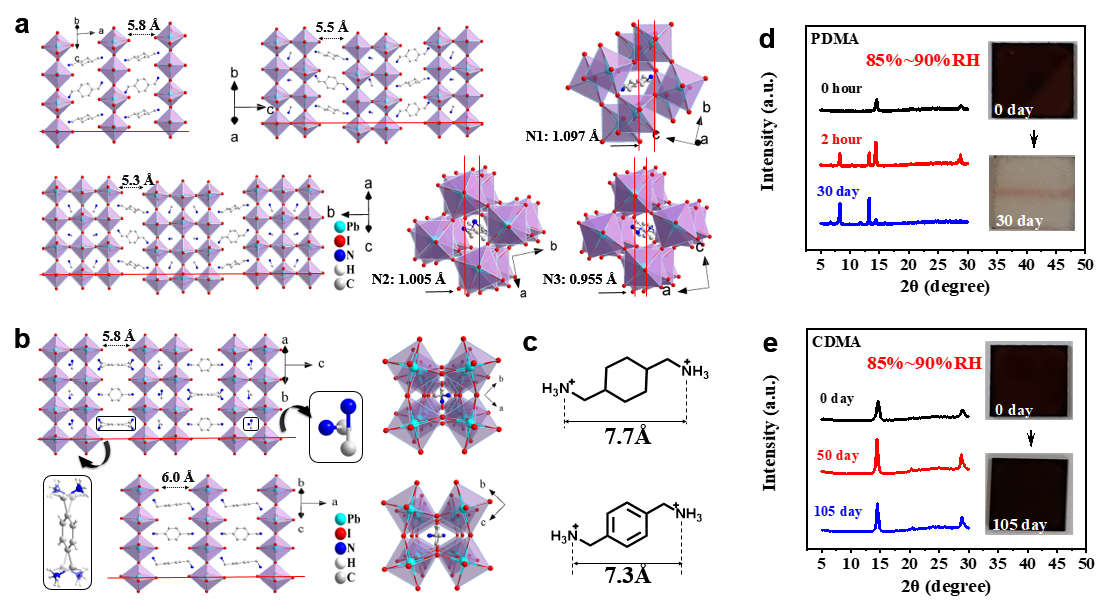
Figure 1. Perovskite structures and their stability. a. Side-view and top-view of single-crystal structures of (CDMA)(MA)n-1PbnI3n+1 (n =1–3). The red lines are used to highlight the displacement of adjacent inorganic slabs. b. Side-view and top-view of single-crystal structures of (PDMA)(MA)n-1PbnI3n+1 (n = 1 and 2). c. Interlayer spacer cations of CDMA and PDMA. d, e XRD patterns of films exposed in a constant temperature humidity chamber with relative humidity (RH) of 85–90% under dark at room temperature.
To solve these serious issues and challenges, the studies were first stared on the stability. It is considered that the stability of perovskite solar cells can be improved by optimizing the fabrication process and the original material components. Among these, materials are the internal factor that determines the stability of the solar cells. Therefore, we start with the improvement of DJ material, and study the relationship among the structural composition, configuration, and stability. On this basis, we investigated the structure and stability of DJ perovskites reported recently. It is found that the stability of DJ materials with interlayer alignment configurations of perovskite [PbI6]4- octahedra is generally poor. We suspect that a slight-interlayer-displacement configuration of DJ perovskites may have different effects on structural stability. We then tried to design and synthesize new DJ perovskites, and found that the 1,4-cyclohexanedimethanammonium cation (CDMA) can form a series of DJ perovskites with expected slight-interlayer-displacement configuration. More importantly, this category of DJ perovskite materials showed extreme material stability (Figure 1).
We further examined their application in solar cells. Considering the docking of laboratory-based small area devices and industrialization in the future, we adopted the blade-coating method, a scalable device fabricating process. However, the fabrication of blade-coated DJ perovskites is challenging, due to the difficulties in the film-formation for DJ perovskites and the differences in the crystallization process between spin- and blade-coating processes. Therefore, we optimized the precursor formulation by introducing ionic liquid components, and then successfully achieved high-quality DJ perovskite films from blade-coating method. Compared with the interlayer aligned DJ perovskites (e.g., 1,4-phenylenedimethanammonium, PDMA), the films of slight-interlayer-displacement perovskites based on CDMA exhibit excellent orientation, phase distribution and strain-released characteristics, which further improves the performance and stability of the devices.
As a result, we achieved a best power conversion efficiency of 19.11% by the scalable blade-coated technique for the light-interlayer-displacement DJ perovskite solar cells (nominal n = 5, Figure 2).
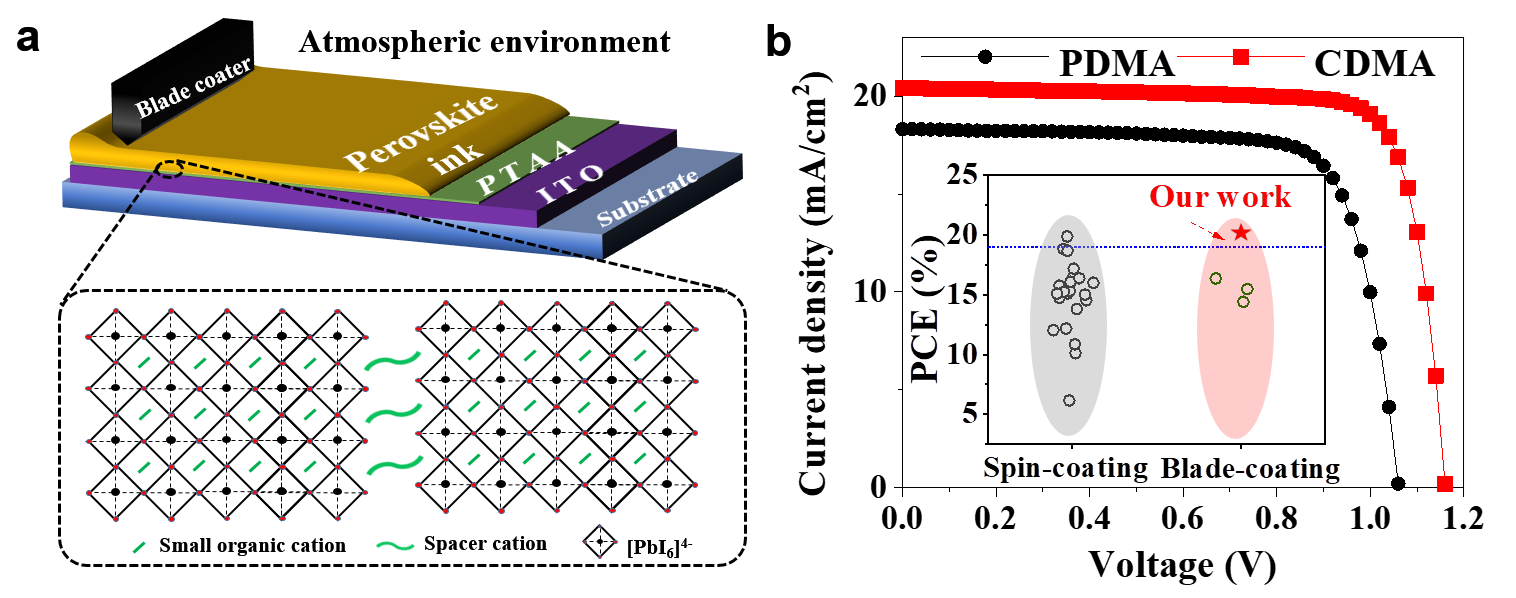
Figure 2. Device performance. a. Schematic illustration of the blade-coating film and the corresponding device configuration under atmospheric environment at room temperature. b. J-V curves of the best-performance solar cells with p-i-n structure. Inset: Comparison of the photovoltaic performance of recently published 2D perovskite solar cells.
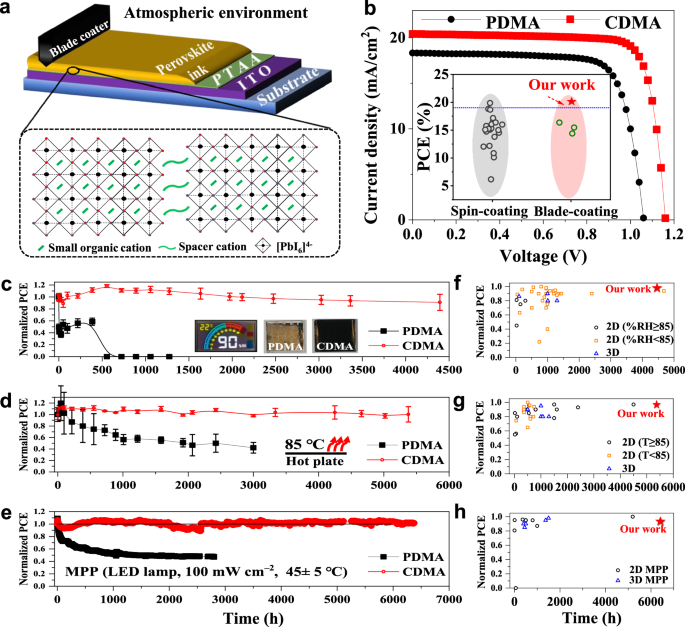
Most importantly, these cells based on the light-interlayer-displacement DJ perovskites show extraordinary humidity, thermal, and operational stability. After kept in a 90% RH or 85°C continuous aging condition for over 4000 h or 5000 h, respectively, the devices without encapsulation show an 8% degradation for the humidity stability test and negligible efficiency loss for thermal stability measurement. Particularly, the operational stability under maximum power point tracking shows negligible efficiency loss exceeding 6000 h (Figure 3).
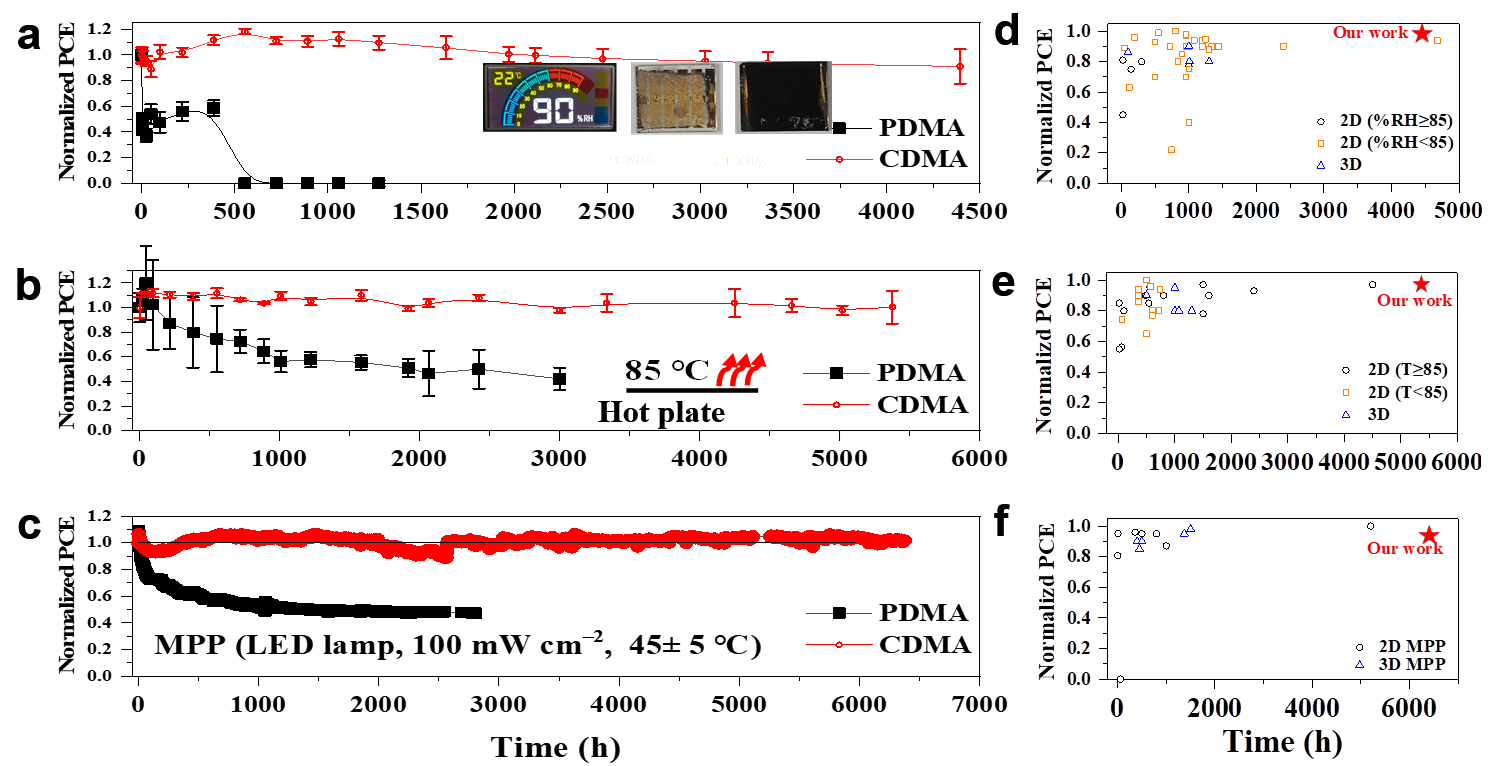
Figure 3. Device stability. a. Normalized PCEs of the unencapsulated solar cells stored in a constant temperature humidity chamber (~90% RH). b. Thermal stability of solar cells treating at an 85 °C hotplate in N2 atmosphere. c. Maximum power point tracking measurement at ~45 °C in N2 atmosphere. Summary of the stability characterization, d. moisture stability; e. thermal stability; f. MPP stability; of most of the reported 2D perovskite solar cells, and compared with recent reported typical highly efficient and stable 3D cells.
The applications of the light-interlayer-displacement DJ perovskites by blade-coating process might spur new developments in the commercialization process of solar cells, and also has great potential in other potential applications, such as 2D/3D perovskite photovoltaics, light-emitting diodes, photodetectors, etc.
For more details, please check out our paper “Ultrastable and efficient slight-interlayer-displacement 2D Dion-Jacobson perovskite solar cells” in Nature Communications (https://www.nature.com/articles/s41467-024-50018-4). 8
- Li, X., Hoffman, J. M. & Kanatzidis, M. G. The 2D Halide Perovskite Rulebook: How the Spacer Influences Everything from the Structure to Optoelectronic Device Efficiency. Chem. Rev. 121, 2230-2291 (2021).
- Gao, Y., Dong, X. & Liu, Y. Recent Progress of Layered Perovskite Solar Cells Incorporating Aromatic Spacers. Nanomicro Lett 15, 169 (2023).
- Dong, X. et al. Improve the Charge Carrier Transporting in Two‐Dimensional Ruddlesden–Popper Perovskite Solar Cells. Adv. Mater. 36 (2024).
- Meng, K. et al. Humidity-Insensitive, Large-Area-Applicable, Hot-Air-Assisted Ambient Fabrication of 2D Perovskite Solar Cells. Adv. Mater. 35, e2209712 (2023).
- Li, X. et al. Two-Dimensional Halide Perovskites Incorporating Straight Chain Symmetric Diammonium Ions, (NH3CmH2mNH3)(CH3NH3)n-1PbnI3n+1 ( m = 4-9; n = 1-4). J. Am. Chem. Soc. 140, 12226-12238 (2018).
- Vasileiadou, E. S. et al. Insight on the Stability of Thick Layers in 2D Ruddlesden-Popper and Dion-Jacobson Lead Iodide Perovskites. J. Am. Chem. Soc. 143, 2523-2536 (2021).
- Dučinskas, A. et al. Unravelling the Behavior of Dion–Jacobson Layered Hybrid Perovskites in Humid Environments. ACS Energy Lett. 6, 337-344 (2020).
- Zhang, W. et al. Ultrastable and efficient slight-interlayer-displacement 2D Dion-Jacobson perovskite solar cells. Nat. Commun. 15, 5709 (2024).

Follow the Topic
-
Nature Communications
An open access, multidisciplinary journal dedicated to publishing high-quality research in all areas of the biological, health, physical, chemical and Earth sciences.

Related Collections
With Collections, you can get published faster and increase your visibility.
Women's Health
Publishing Model: Hybrid
Deadline: Ongoing
Tumor Microenvironment Crosstalk and Therapeutic Implications
Publishing Model: Hybrid
Deadline: Nov 02, 2026