Bridging the Distance: Equity in Dementia Care Across Rural Australia
Published in Social Sciences, Sustainability, and General & Internal Medicine






Why place matters in dementia care
Dementia care is evolving rapidly, with advancements in diagnostics, treatments, and personalised care models. Yet, these innovations risk deepening existing inequities if access is not addressed. Our study focuses on geographic equity, examining how rurality impacts access to dementia diagnosis, management, and care across Australia.
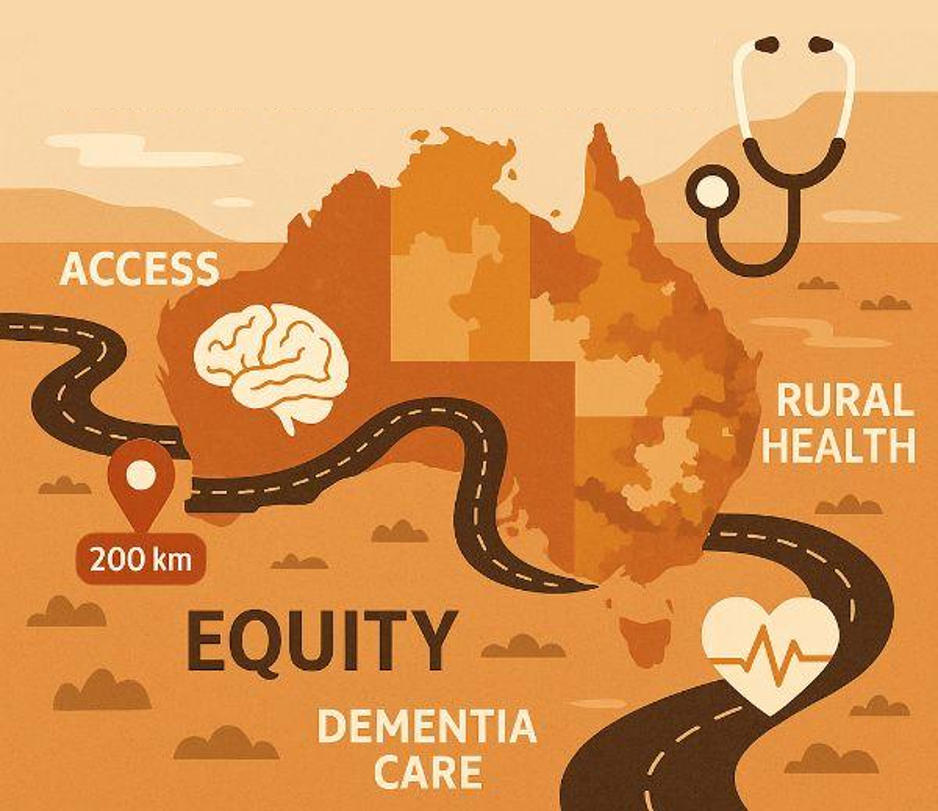
Australia presents a unique challenge in this space. It is one of the most geographically vast countries in the world, yet its population is relatively small and heavily concentrated in metropolitan areas. This means that large portions of the country are sparsely populated, with communities often located hundreds of kilometres from major health services. These geographic realities create significant barriers to timely and equitable dementia care, particularly in regional and remote areas.
Historically, rural communities have faced systemic disadvantages in healthcare access due to under-resourcing, workforce shortages, and geographic isolation. These challenges are particularly acute in dementia care, where timely diagnosis and coordinated management are essential. Our research highlights the urgent need for targeted, place-based strategies to ensure rural populations are not left behind.
What we heard from rural communities
We conducted a qualitative study involving semi-structured interviews with individuals who had experienced the dementia diagnosis process either as patients, family members or friends. Participants were drawn from metropolitan, inner regional, and outer regional areas, allowing us to compare experiences across geographic contexts.
These classifications are based on the Australian Statistical Geography Standard, which defines areas by how far people must travel to access services. Metropolitan areas have the highest access, inner regional areas have moderate access, and outer regional areas are more remote with limited services. This framework helps illustrate how geography influences access to dementia care.
While some challenges were universal, such as long wait times and complex care pathways, rural participants consistently faced more obstacles. These included limited availability of specialists, long travel distances, and fragmented service delivery.
“We live rurally and were like three hours from anywhere.”
— Eleanor, Daughter, Small rural town, Outer Regional Australia
“There’s no specialists here. You have to wait weeks to see people. A geriatrician came over who I thought was terrific. He’s the only person that I found in the whole experience who was useful and sensible… But he’s three hours away. He only came over occasionally.”
— Abigail, Daughter, Medium rural town, Outer Regional Australia
Other participants echoed similar frustrations, pointing to the need to “make do” with limited local resources. In addition to geography, the study also revealed how factors such as affordability, availability, and acceptability shaped people’s experiences, often in overlapping and intersecting ways that influenced how, when, and whether they accessed dementia-related care.
Looking ahead: bridging the gap
Our findings reinforce the idea that significant health inequities persist between rural and metropolitan communities, and these must be prioritised in efforts to promote equitable dementia care. As clinical practice evolves, rural communities’ risk being excluded unless deliberate action is taken.
There are promising opportunities to improve access, including telehealth and outreach services. These approaches must be thoughtfully designed with rural users in mind, taking into account infrastructure, digital literacy, and cultural appropriateness. Strengthening the rural health workforce and developing localised service models are also essential steps toward building sustainable and responsive care systems.
This study contributes to a growing recognition that rurality is a social determinant of health. Addressing geographic inequity is not just a logistical challenge — it’s a matter of justice.
What we hope happens next
We hope this research helps bring rural voices to the forefront of dementia policy and service design. As new diagnostics, treatments, technologies and care models emerge, they must be developed with, not just for, rural communities. Equity in dementia care will only be achieved when access is no longer determined by postcode, and when every person, regardless of where they live, can receive timely, appropriate, and compassionate support.
Follow the Topic
-
International Journal for Equity in Health
This journal presents evidence relevant to the search for, and attainment of, equity in health across and within countries and publishes research which improves the understanding of issues that influence the distribution of health and healthcare within populations.

Related Collections
With Collections, you can get published faster and increase your visibility.
Health Inequities’ Lethal Impact
Advancing our collective understanding of health inequities remains essential for addressing the complex and often lethal consequences of systemic disparities in health outcomes. While significant progress has been made in recognizing the role of social determinants of health (SDOH), there is an urgent need to further investigate the structural injustices that perpetuate income inequality, racial and ethnic disparities, and the disproportionate burden of chronic disease—particularly among historically marginalized and underserved populations.
This Collection centers on the lethal impact of health inequities, with a primary focus on mortality and the systemic conditions that lead to preventable deaths. While morbidity—defined as the burden of disease and disability—plays a critical role in shaping health trajectories, it is the escalation to premature mortality that underscores the urgency of this research. Authors are strongly encouraged to examine how inequities contribute to death and life-shortening outcomes, rather than submitting work that addresses health equity in general without engaging with its fatal consequences.
Recent research has revealed that the relationship between morbidity and mortality is complex and non-linear. Some populations endure prolonged suffering due to chronic conditions, while others face abrupt and avoidable death due to systemic neglect. These patterns reflect the cumulative impact of adverse SDOH, such as housing insecurity, food instability, limited education, and lack of access to timely care.
Communities facing intergenerational trauma, persistent socioeconomic disadvantage, and discrimination—including Indigenous populations and other minoritized groups—are disproportionately affected. Individuals living in areas of high social vulnerability experience significantly higher all-cause mortality rates, and those with multiple concurrent adverse SDOH face the poorest health outcomes.
Ongoing examination of these issues is vital for informing evidence-based decision-making and equipping policymakers with the insights needed to foster equity in health. Beyond identifying policy failures, this Collection seeks to highlight mechanisms for translating research into equitable policy action. By bridging the gap between evidence and implementation, we aim to surface practical pathways for systemic change—whether through legislative reform, community-led initiatives, or integrated health system strategies.
We invite researchers to contribute to this special Collection, Health Inequities’ Lethal Impact. Topics of interest include, but are not limited to:
-Structural injustice and health
-The role of income inequality in health outcomes
-Racial and ethnic disparities in chronic disease
-Health inequities in Indigenous communities
-Policy interventions for reducing preventable deaths
-Mechanisms for translating evidence into equitable policy action
-Social determinants of health and morbidity
-Community-based approaches to health equity
-Examining policy failures in health systems
-Intersections of morbidity and mortality in vulnerable populations
This Collection supports and amplifies research related to SDG 3, Good Health and Well-Being and SDG 10, Reduced Inequalities, reinforcing the global imperative to ensure equitable access to health.
All submissions in this collection undergo the journal’s standard peer review process. Similarly, all manuscripts authored by a Guest Editor(s) will be handled by the Editor-in-Chief. As an open access publication, this journal levies an article processing fee (details here). We recognize that many key stakeholders may not have access to such resources and are committed to supporting participation in this issue wherever resources are a barrier. For more information about what support may be available, please visit OA funding and support, or email OAfundingpolicy@springernature.com or the Editor-in-Chief.
Publishing Model: Open Access
Deadline: Nov 02, 2026
Racism and Health
The ongoing advancement of our understanding of how racism impacts health - both directly and structurally - is crucial for addressing the deep-rooted health inequities that persist globally. Structural racism shapes health outcomes among racialized populations, contributing to inequities in healthcare access and quality, and impacting social, political, or environmental determinants of health. Existing research also connects direct and visible manifestations of racism, such as major and everyday discrimination, to negative health outcomes. At the same time, racism does not operate in isolation. A growing body of research shows how it intersects with other systems of oppression—such as classism and patriarchy—and with broader social determinants of health, producing compounded and context-specific inequities. An intersectional lens is therefore essential to understand how overlapping structures of power and exclusion shape health and healthcare experiences. These insights are essential in conducting rigorous and thorough health research, guiding anti-racist health policy, and ultimately, ensuring equitable health for all.
Looking forward, research holds the potential to develop new methodologies and indices and unveil complexities in how racism manifests within healthcare systems and societal structures. By deepening our collective understanding, we can develop more effective interventions that target the root causes of health inequities.
We invite researchers to contribute to this special Collection on Racism and Health, focusing on advancing our understanding and addressing health inequities. Topics of interest include but are not limited to:
- Racism as a structural determinant of health
- Racism as a direct determinant of health
- Racialized health outcomes in different populations
- Intersectionality and inequities in health, healthcare access and quality
- Nexuses between social, political, and environmental determinants of health and systemic discrimination
- Anti-racist health policy frameworks and systems
- Impact of racism on mental health
- Health inequities in reproductive, maternal, and child health
- Obstetric and reproductive violence
- Community-based interventions for equitable health
- Decolonizing health research and global health epistemologies
We strongly encourage contributions from racialized scholars and authors with lived experience or expertise in addressing systemic discrimination in health research.
This Collection supports and amplifies research related to SDG 3, Good Health and Well-Being and SDG 10, Reduced Inequalities.
All submissions in this collection undergo the journal’s standard peer review process. Similarly, all manuscripts authored by a Guest Editor(s) will be handled by the Editor-in-Chief. As an open access publication, this journal levies an article processing fee (details here). We recognize that many key stakeholders may not have access to such resources and are committed to supporting participation in this issue wherever resources are a barrier. For more information about what support may be available, please visit OA funding and support, or email OAfundingpolicy@springernature.com or the Editor-in-Chief.
Publishing Model: Open Access
Deadline: Nov 14, 2026