Climate change and human activities amplify runoff variability risks in lower reaches of large rivers
Published in Earth & Environment and Mathematics



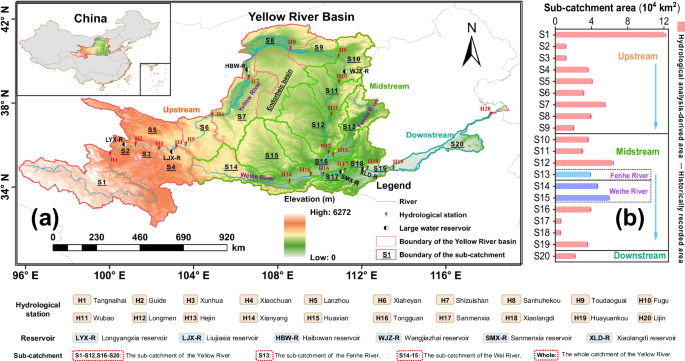

Climate change and human activities are profoundly altering runoff in major rivers. Meanwhile, cross-regional interactions among sub-catchments along river systems exacerbate the risk of runoff variability in downstream areas. Therefore, understanding the key drivers and spatial interaction mechanisms behind runoff changes in large rivers is essential for sustainable basin management and water resource allocation.
Rivers serve as critical channels for transporting water resources between upstream and downstream regions. Changes in downstream runoff are closely linked to climate change and human activities upstream. However, through literature review, we found that the contributions of climate change and human activities to runoff variation have been examined in multiple individual basins, but the upstream-downstream cross-regional interaction relationships remain underexplored.
To address this, we delineated the Yellow River Basin into 20 sub-catchments using the spatial distribution of hydrological stations along the main stem and major tributaries. Using 70 years of monthly runoff data (1952-2021), as well as meteorological data, population density, and land use data across the basin, we applied a three-tiered attribution analysis framework based on the Budyko water-energy balance theory to investigate the spatiotemporal patterns, underlying drivers, and upstream-downstream interactions of runoff change under climate and human impacts.
The results indicate that the longitudinal cumulative effects of climatic (ranging from -8.6% upstream to 7.1% downstream relative to the whole basin) and anthropogenic disturbance (15.2%-92.9%) factors lead to higher risks of runoff variations in downstream regions, with more pronounced seasonal fluctuations (particularly in reservoir-regulated reaches).
Moreover, human-induced water demand in downstream areas can influence runoff contributions from upstream sub-catchments, thereby affecting runoff changes throughout the basin. For instance, upstream sub-catchments may increase their runoff contribution through human activities such as reducing local water consumption or enhancing local water supply.
Notably, the water storage capacities of glaciers, lakes, and reservoirs cause lagged effects in the impact of climate change and human activities on runoff variations. For example, climate warming in the source region of the Yellow River initially increased runoff due to glacial melt, but as meltwater declined, runoff decreased significantly despite increased precipitation. Thus, the water storage capacity of the watershed emerges as a key factor enabling cross-regional water resource regulation.
These findings hold significant theoretical and practical implications for formulating climate adaptation strategies and assessing the effectiveness of water resource management policies. They will also provide direct guidance for optimizing governmental water management strategies.
In the foreseeable future, the impact of climate change and human activities on river runoff variability is expected to intensify. The importance of water resources for human survival and development is increasingly evident, and the inter-regional connections of water resources between upstream and downstream regions, even across large basins, will become tighter. Therefore, the allocation and scheduling of water resources must place greater emphasis on interregional interactions.
Here, we sincerely thank the editors of Communications Earth & Environment and the anonymous reviewers for their valuable comments, which significantly enhanced the quality of this paper. We also extend our heartfelt gratitude to our funders and data providers (both platforms and experts), whose contributions made this work possible. 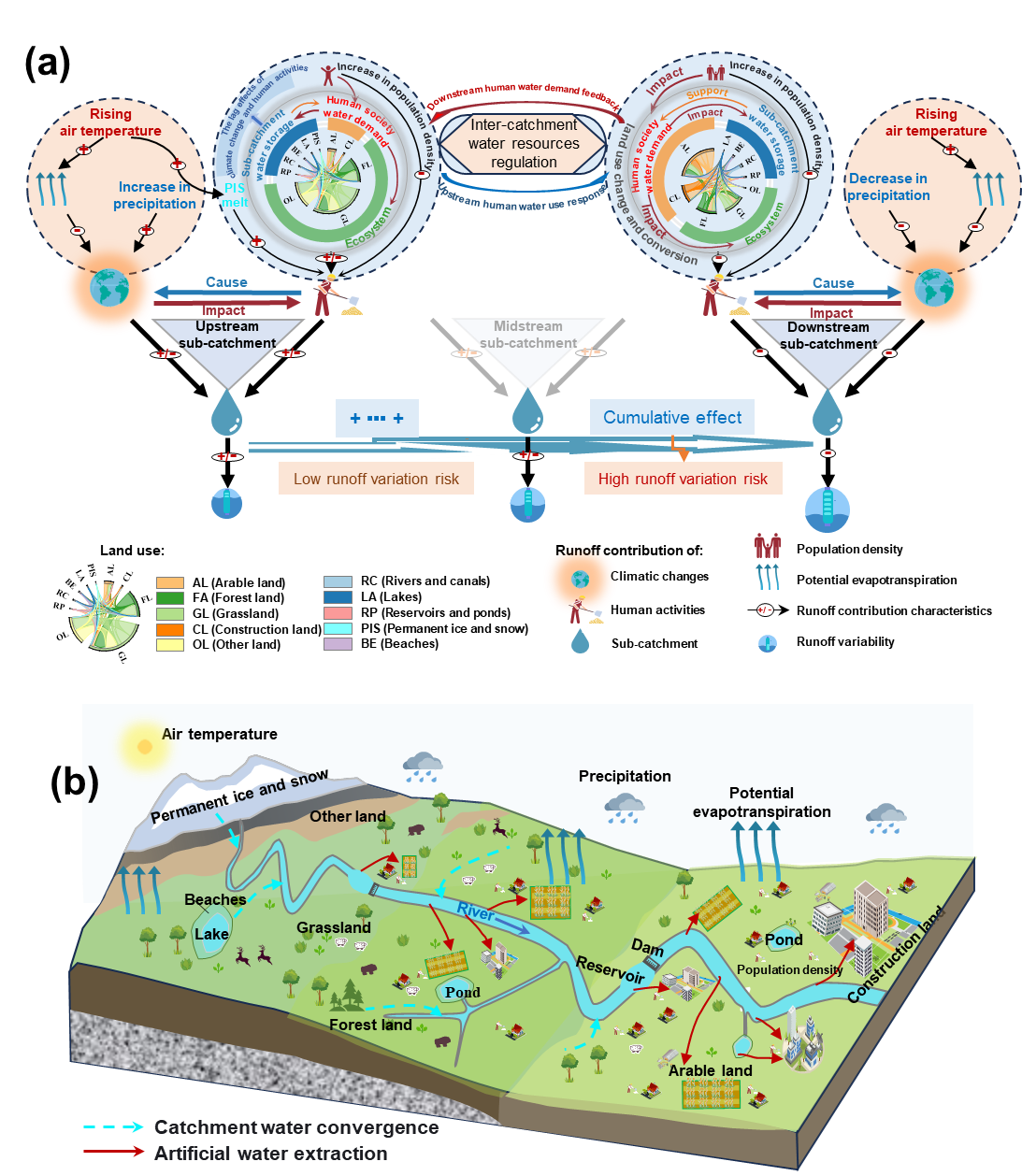
Conceptual framework illustrating the upstream-downstream interaction of runoff variation in large river basins under the context of climate change and human activities.

Li Chunhui, professor,School of environment, Beijing Normal University, doctoral supervisor, major researches include water resources assessment and management, agricultural water saving and integrated watershed management, etc.. In recent years, he hosted and participated in more than 40 research projects, and published more than 250 journal articles and conference papers.
Follow the Topic
-
Communications Earth & Environment
An open access journal from Nature Portfolio that publishes high-quality research, reviews and commentary in the Earth, environmental and planetary sciences.

Related Collections
With Collections, you can get published faster and increase your visibility.
Hazards in Mountain Regions
Publishing Model: Open Access
Deadline: Nov 02, 2026
Carbon Dioxide Removal
Publishing Model: Hybrid
Deadline: Jan 16, 2027




Please sign in or register for FREE
If you are a registered user on Research Communities by Springer Nature, please sign in
If you are interested in this research, please contact me, Chunhuili@bnu.edu.cn,School of environment, Beijing Normal University,China