Controlled Hydrogenation into Defective Interlayer BiOCl via Vacancy Engineering
Published in Chemistry



Hydrogenation is an effective approach to improve the performance of photocatalysts within defect engineering methods1. Recently, theoretical studies revealed that hydrogen can be easily captured by vacancy sites in semiconductors because vacancies always possess high surface energy 2, 3. These studies imply that hydrogenation may promote photocatalytic performance of semiconductors not only by creating defects but also through hydrogen doping at these defect sites. Nevertheless, the experimental examination of this hypothesis is limited by technical barriers to visualizing atomic positions and the chemical dynamics of doped hydrogen atoms/ions due to their small atomic radius as well as small atomic mass. Meanwhile, the mechanism of hydrogenation and synergetic effects between hydrogen atoms and local electronic structures, however, remain unclear due to the limits of available photocatalytic systems and technical barriers to observation and measurement.
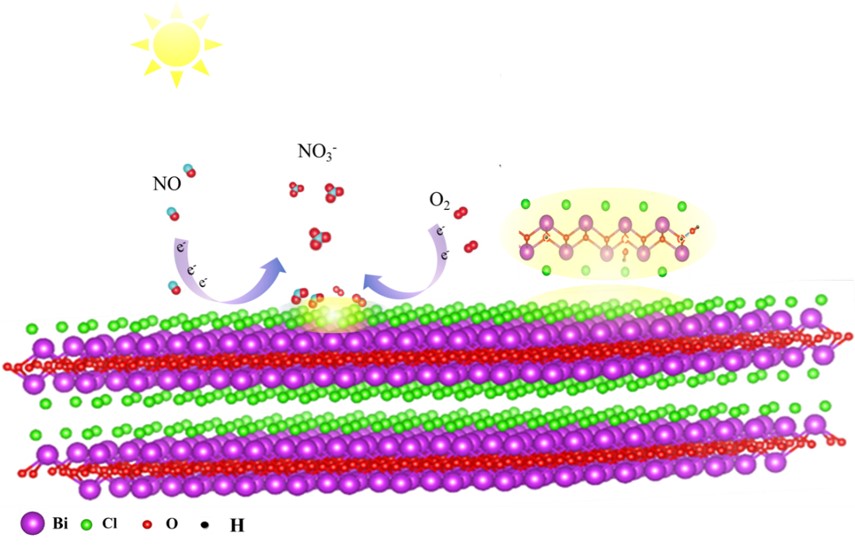
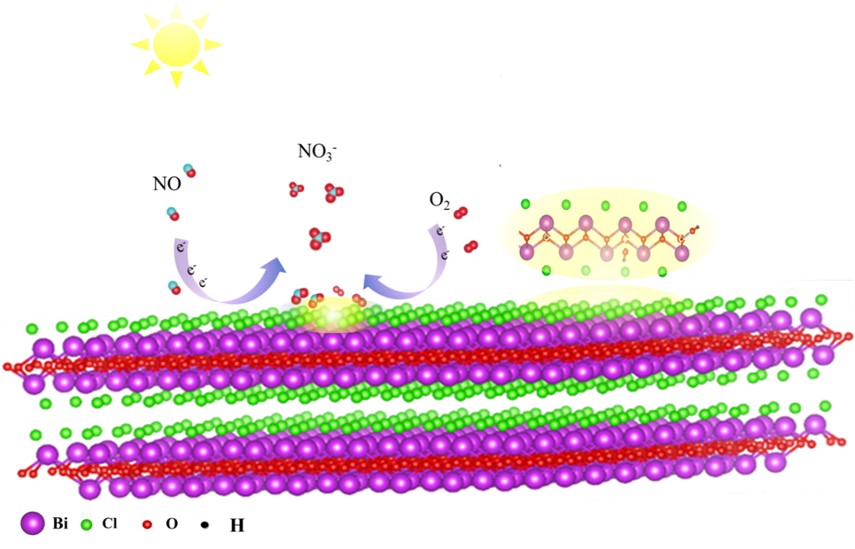
Schematic diagram of NO oxidation by H-BiOCl OV
Here we utilize oxygen vacancies as residential sites, successfully anchor the hydrogen atoms at defect sites of BiOCl by controlling hydrogenation. Through experimental characterization and theoretical simulation, it is clearly proved that hydrogen atoms show a preference to occupy the oxygen vacancies` states and hybridize with nearby atoms. This leads to the creation of new trap states among the impurity states and upshift the position of the valence band and improve the efficiency of photo-generated carrier separation and transfer. Finally, the NO oxidation activity and selectivity of defective BiOCl were significantly enhanced.
Our work clearly reveals the role of hydrogen atoms in defective crystalline materials and provides a promising way to design catalytic materials with controllable defect engineering. Meanwhile it could guide future efforts to use semiconductors with defect sites (such as vacancies) as templates, to be further modified via different atoms in order to build multiply synergistic semiconductors.
The full-text of related article can be accessed by using the following link:
This work cannot be done without the valuable collaborative efforts from Prof. Weichang Hao, A/Prof.Yi Du. Prof. Fan Dong and Dandan Cui, Kang Xu, Xingan Dong, Dongdong Lv.
Reference:
- hen, X. et al. Properties of disorder-engineered black titanium dioxide nanoparticles through hydrogenation. Sci. Rep. 3, 1510 (2013).
- Szûcs, B. et al. Physics and chemistry of hydrogen in the vacancies of semiconductors. Phys. Rev. B 68. 085202 (2003).
- Van de Walle, C. G., Neugebauer, J. Hydrogen in Semiconductors. Annu. Rev. Mater. Sci. 36, 179-198 (2006).
Follow the Topic
-
Communications Chemistry
An open access journal from Nature Portfolio publishing high-quality research, reviews and commentary in all areas of the chemical sciences.

Related Collections
With Collections, you can get published faster and increase your visibility.
Chemical modification of proteins
Publishing Model: Open Access
Deadline: Sep 30, 2026
Soft materials for drug delivery
Publishing Model: Open Access
Deadline: Dec 10, 2026