Diamond in the Rock: How a Chance Discovery Changed Our View of Earth
Published in Earth & Environment







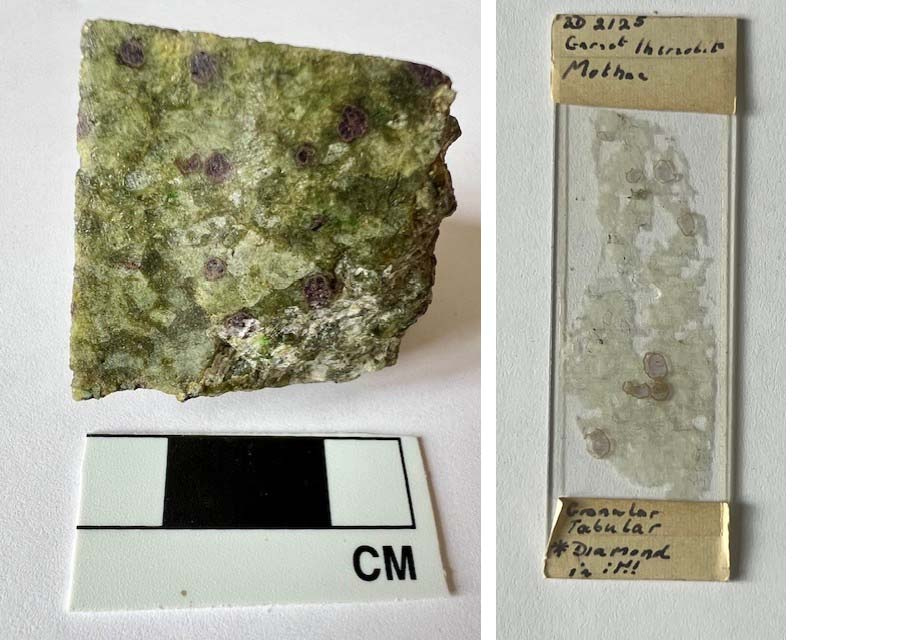
In the early 1970s, igneous petrologist Barry Dawson was sawing through a chunk of mantle rock from southern Africa when his blade screeched to a halt. The culprit? A diamond, locked inside the rock since deep time.
It was the first time a diamond had been found in situ—preserved in its original host rock from Earth’s mantle. Until then, scientists believed diamonds formed in magma. But Dawson’s 1975 Nature paper, co-authored with Joe Smith, proved otherwise: diamonds can crystallize far below the surface, hundreds of kilometres down.
Fast-forward 50 years, Dawson’s former student, Professor Sally Gibson and researchers at the University of Cambridge, have revisited that very same diamond-bearing rock. And it’s still rewriting the story of early Earth.

A Treasure from the Archaean
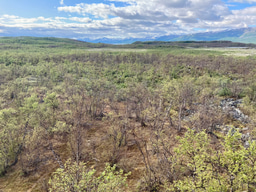
The rock comes from the Archaean Eon (3.5–2.5 billion years ago), when the deep roots of Earth’s first continents—known as cratons—were taking shape. These ancient continental cores, including Africa’s Kaapvaal Craton, remain some of the most stable and long-lived parts of the planet.
Since we can’t drill to such depths, the only way to study the mantle is when volcanic eruptions bring up xenoliths—rock fragments from deep below. Dawson collected hundreds of them from Lesotho in the 1960s, building one of the world’s finest mantle xenolith collections.
“These samples are an invaluable scientific resource,” said Gibson, who now curates and studies much of Dawson’s mantle xenolith collection.
New Secrets in an Old Sample
The diamond-bearing rock that once amazed Dawson is still yielding surprises. Professor Sally Gibson, working with her former PhD students Charlotte Jackson and James Crosby, along with researcher Jason Day, has re-examined the sample in search of volatile elements—chemical fingerprints of Earth’s deep past.
What they found was striking: Analyses from state of the art mass spectrometers at the University of Edinburgh showed unusually high concentrations of water, carbon, fluorine and chlorine. These elements are typically linked to subduction zones, where oceanic plates sink into the mantle and release fluids.
This suggests that even in the Archaean, billions of years ago, subduction was already cycling water and carbon deep into the Earth where they have been stored for billions of years. “These processes are fundamental to Earth’s volatile cycle, continent stability and habitability,” Gibson explained.
Why Diamonds Matter
Among all the samples studied, the diamond-hosting rock contained the highest levels of volatiles—especially carbon, fluorine and water. That enrichment may have been the key to the diamond’s formation.
“I always tell my students: when you see a diamond ring, remember the deep-Earth processes behind it,” said Gibson.
Old Rocks, New Insights
Today, Dawson’s collection—including that famous diamond-studded rock—resides in Cambridge’s Sedgwick Museum. But the discoveries keep coming.
“This study shows that even archived samples, decades old, can still unlock new and exciting scientific discoveries,” Gibson said.
A diamond may be forever—but so, it seems, are the scientific treasures it reveals.
Read more
Gibson, S. A., Jackson, C. J., Crosby, J. C., & Day, J. A. F. (2025). The role of COHF-Cl fluids in the making of Earth’s continental roots. Nature Communications, 16(1), 7842.
Dawson, J. B., & Smith, J. V. (1975). Occurrence of diamond in a mica–garnet Iherzolite xenolith from kimberlite. Nature, 254(5501), 580-581.
https://www.esc.cam.ac.uk/news/diamond-studded-mantle-rock-tells-new-tales-about-ancient-earth

Follow the Topic
-
Nature Communications
An open access, multidisciplinary journal dedicated to publishing high-quality research in all areas of the biological, health, physical, chemical and Earth sciences.

Related Collections
With Collections, you can get published faster and increase your visibility.
Women's Health
Publishing Model: Hybrid
Deadline: Ongoing
Tumor Microenvironment Crosstalk and Therapeutic Implications
Publishing Model: Hybrid
Deadline: Nov 02, 2026