February 2026 Highlights from the Health & Clinical and Life Sciences Research Communities: Rare Disease Day
Published in Cell & Molecular Biology, Biomedical Research, and General & Internal Medicine



Rare Disease Day 2026 reminds us that while each rare condition may affect a small number of people, together they impact 300 million people worldwide. Across the Research Communities this month, authors have shared powerful stories, research insights, and reflections such as policy alignment, patient advocacy and lived experiences of diagnosis.
Here, we highlight five standout posts that explore the realities of rare disease research and care, and the people working to drive change.
Zainab Alani‘s story of Myasthenia: more than muscle weakness
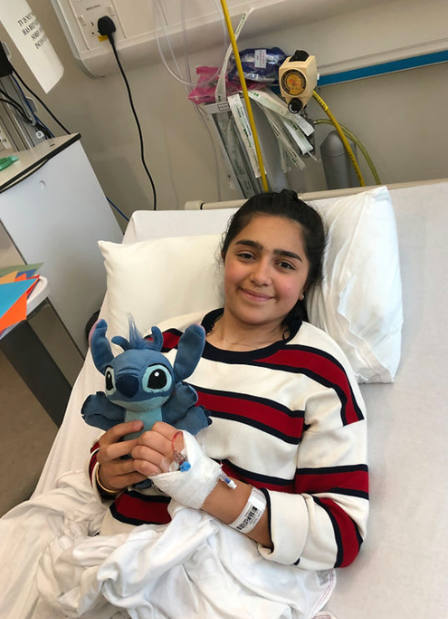
In this deeply personal Life in Research post for Rare Disease Day 2026, @Zainab Alani, Medical Student at the University of Glasgow, shares her journey of living with generalised Myasthenia Gravis - a rare, incurable autoimmune condition that reshaped her daily life, medical training, and sense of identity. Zainab shares how she navigated diagnosis and relapse and became a national advocate featured on BBC Scotland. She reflects on the realities of chronic illness, the strength of family support, and her mission to empower other young people through initiatives like Rarely Social.
Read the full post for an honest, uplifting account of life beyond a rare diagnosis, and a powerful reminder that rare does not mean invisible.
Uniting for Rare Diseases
Progress in rare disease research depends not only on discovery, but on coordination. In this Behind the Paper post, @María Sánchez, Researcher at the Institute for Rare Diseases Research, reflects on her team’s article published in Health Research Policy and Systems. Drawing on five years of work within the European Joint Programme on Rare Diseases, the paper examines how better alignment between national strategies, funding, and research priorities can accelerate progress for the 300 million people affected worldwide. From mapping unmet needs to establishing National Mirror Groups, the post reveals the collaborative effort behind building a more connected rare disease ecosystem.
Read the full post to explore why alignment across countries, policies, and stakeholders is essential to delivering more equitable diagnosis, care, and innovation.
Navigating Lupus, race and the struggle for health equity
Lupus is more than a medical condition. It is shaped by race, gender, bias, and the systems meant to provide care. In this powerful News & Opinion piece, @India Sapsed-Foster shares the story of Madonna Grant, who reflects on delayed diagnosis, systemic inequities, and the lived reality of navigating lupus as a Black woman. Through candid discussion of bias within the NHS, gaps in clinical research, and the disproportionate impact of lupus on Black women, the post highlights why inclusive research, culturally competent care, and action on the Sustainable Development Goals are essential to achieving true health equity.
Read the full post for a deeply human perspective on chronic illness, and a call to ensure that equity in healthcare is more than an aspiration.
An update from the 2023 Student Voice Prize
Rare diseases are often defined by uncertainty in diagnosis, in treatment decisions, and in daily life. In this Rare Disease Day 2026 update, @Iman Muzafar reflects on their experience as runner-up in the Student Voice Prize and her ongoing collaboration with Cavernoma Alliance UK. The post revisits their original piece, Endless Uncertainty: Living with a rare condition, and explores the realities of cavernomas, rare vascular malformations affecting the brain and spinal cord, alongside the complex decisions patients face. Iman highlights how patient advocacy groups help drive research, improve information, and provide vital peer support.
Read the full post to discover how lived experience, research, and advocacy continue to shape progress for people navigating rare neurological conditions.
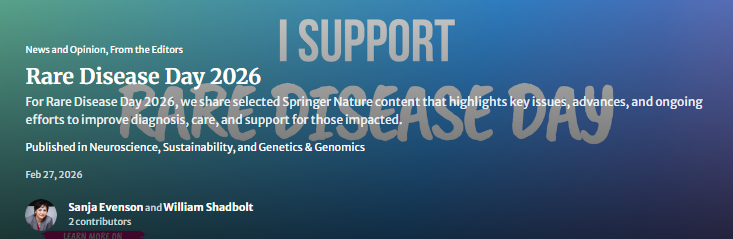
How is Springer Nature highlighting Rare Disease Day?
Although each rare disease affects a small number of people, together they impact millions worldwide, making awareness, research, and collaboration more important than ever. In this Rare Disease Day 2026 roundup, @Sanja Evenson and @William Shadbolt spotlight selected content from Springer Nature journals including Orphanet Journal of Rare Diseases, Scientific Reports, and Human Genome Variation. The post highlights new calls for papers, advances in AI-supported diagnostics, clinical research updates, and initiatives aimed at improving care and coordination worldwide.
Read the full post to explore the latest research and discover how you can get involved.
February’s round-up focusing on Rare Disease Day shows that progress in rare diseases depends on visibility, inclusion, and collective action. Whether through research, advocacy, or storytelling, every contribution helps move us closer to earlier diagnoses, fairer access to care, and stronger global alignment. Explore the full posts to learn more and share your thoughts in the comments.
Further reading:

Helping researchers connect, collaborate, and communicate their work. Specialising in Medicine and Life Science and passionate about making science more visible and accessible.
Follow the Topic
-
Scientific Reports

An open access journal publishing original research from across all areas of the natural sciences, psychology, medicine and engineering.
-
Orphanet Journal of Rare Diseases

An open access, peer-reviewed journal that encompasses all aspects of rare diseases and orphan drugs and publishes high-quality reviews on specific rare diseases.
-
Health Research Policy and Systems

This journal covers all aspects of the organisation and use of health research – including agenda setting, building health research capacity, and how research as a whole benefits decision makers, practitioners in health and related fields, and society at large.
-
Human Genome Variation

This is an online-only, full open access journal that contains articles and reports about variation and variability in human genomes and the consequences, implications and future impacts for the study of human genomics.
Your space to connect: The Primary immunodeficiency disorders Hub
A new Communities’ space to connect, collaborate, and explore research on Clinical Medicine, Immunology, and Diseases!
Continue reading announcementRelated Collections
With Collections, you can get published faster and increase your visibility.
Obesity
Publishing Model: Hybrid
Deadline: Apr 24, 2026
Approaches for identifying pathogenic variants causing rare diseases
Publishing Model: Open Access
Deadline: Jul 16, 2026




Please sign in or register for FREE
If you are a registered user on Research Communities by Springer Nature, please sign in