Fire-insect interaction in Mediterranean stone pine forests
Published in Earth & Environment, Ecology & Evolution, and Agricultural & Food Science
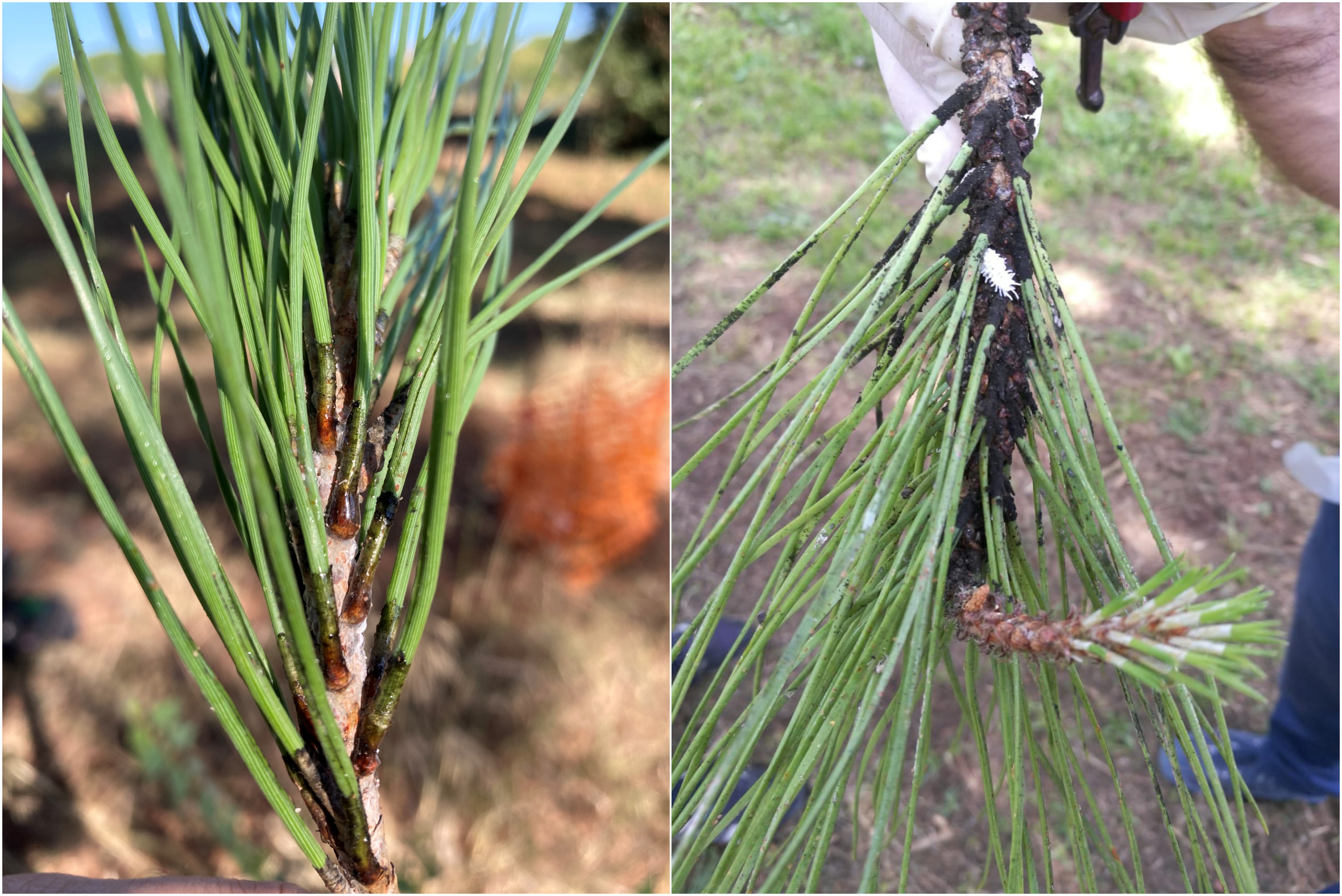


Take a look at our latest article published in the Fire Ecology Journal by Saulino et al. 2025. The study demonstrated that outbreaks of the non-native sap-feeding insect T. parvicornis can influence fire behavior by rearranging crown fuels (mainly honeydew) from the canopy down to the forest floor. Following fuel redistribution, fires can climb up into the canopy, changing the behavior and severity of fires in both thinned and unthinned stands of P. pinea forest.

Follow the Topic
-
Fire Ecology
This is the international scientific journal of the Association for Fire Ecology. It publishes peer-reviewed, impactful articles on all ecological and management aspects relating to wildland fire.

Related Collections
With Collections, you can get published faster and increase your visibility.
Pyro-ecophysiology: Unraveling the physiological connections between climate, fuel dynamics, fire behavior and fire effects
Pyro-ecophysiology is a novel discipline that bridges gaps between traditional fire ecology, plant physiology and combustion science. It explores the interdependent mechanisms governing the impacts and interactions of fire on living plants, shifting the paradigm from solely relying on moisture content as an indicator.
This evolving field seeks to explain fire behavior and fire effects phenomena through physical and physiological processes at the leaf, whole plant, species and plant functional type scales; and explores how these factors scale across landscapes.
This Collection of new knowledge will help improve process-based ecological models as well as fire behavior and fire effects models.
Students and Early Career Researchers (especially SAFE members) are encouraged to submit their research to this collection and take advantage of the SERC incentive.
Pre-submission enquiries are welcome.
Keep up with the latest Fire Ecology content by signing up for article alerts today!
Publishing Model: Open Access
Deadline: Dec 31, 2026
3D Fuels: characterizing the structure and composition of wildland fuels in three dimensions
Wildland fuel characterization is foundational to fire behavior, consumption, and smoke modeling with cascading impacts to post-fire vegetation dynamics, carbon, smoke production, and air quality. All fire behavior and effects models require inputs on wildland fuel characteristics, but the detail and resolution at which fuels are represented have been typically generalized into coarse, two-dimensional representations. The 3D Fuels project provides invaluable datasets for the development of wildland fuel characterization and mapping for prescribed fire decision support.
Using a hierarchically scaled approach, this collection of articles combines airborne and ground-based remote sensing with field sampling to inform realistic, three-dimensional (3D) characterization and mapping of wildland fuels. Articles within this collection detail the object-based classification methods and 3D fuel mapping approaches for next-generation models of fire behavior and smoke.
Students and Early Career Researchers (especially SAFE members) are encouraged to submit their research to this collection and take advantage of the SERC incentive.
Pre-submission enquiries are welcome.
Keep up with the latest Fire Ecology content by signing up for article alerts today!
Publishing Model: Open Access
Deadline: Dec 31, 2026