For the Birds (and the people): why parks are important for biodiversity and how they differ
Published in Ecology & Evolution and Zoology & Veterinary Science




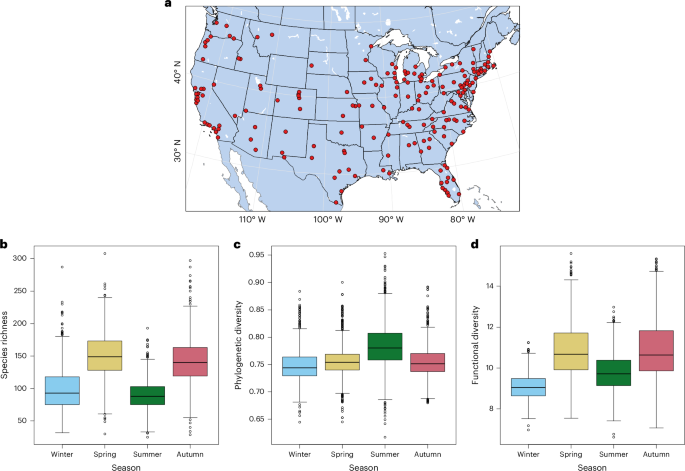

As our understanding of urban ecosystems has grown during this century, particularly through a comparative analysis of cities, we have gained increasing insight into the role that urban green spaces, and parks in particular, play in supporting biodiversity. However, there has not been a general assessment of what factors influence urban park biodiversity across regions and seasons at a continental extent. Understanding if there are consistent factors that influence biodiversity is important as it can be used to inform park design and management for the purposes of supporting biodiversity.
Using birds as model taxa and millions of bird observations from volunteer bird watchers, we sought to evaluate the degree to which urban parks across the contiguous United States support biodiversity across seasons. Because there are numerous ways in which to measure biodiversity, we used three complementary approaches (species richness, phylogenetic diversity and functional diversity) that provide a more complete picture of each park’s bird diversity. We then explored how these measures of bird diversity varied over 935 urban park polygons from 186 different cities based on park area, amount of tree canopy cover, amount of water, habitat variability, park shape, distance to other parks, and the isolation of the park within the city.
When developing the study, we had expected several relationships based on previous research. In particular, we expected larger parks to have more species, but we did not expect larger parks to have higher phylogenetic or functional diversity. We also expected the amount of tree canopy cover and water within the park, as well as habitat variability, would all be positively associated with the three measures of bird diversity. Finally, we expected that parks that were shaped more like a circle, that were closer to other parks, and that were closer to the edge of the city would have higher bird diversity.
Unsurprisingly, we found that park area was closely related to the number of species, which follows classic ecological theory that species richness has a positive relationship with area. However, beyond this finding, and somewhat defying our expectations, we found that how bird diversity is measured and where the city is located in the US mattered to the degree that defies a standard generalization for all parks. Specifically, parks that were closer to urban boundaries had higher phylogenetic diversity, parks with lower habitat heterogeneity had higher functional diversity, and parks with water contained higher species richness and phylogenetic diversity but not functional diversity. Surprisingly, variation in park shape had no effect on any of the measures of bird diversity. Furthermore, the effect of tree canopy cover varied across the continent, with positive relationships for cities in the Intermountain West but negative relationships for cities in the East in the case of species richness and phylogenetic diversity, with an opposite relationship for functional diversity. Because the three measures of bird diversity capture different aspects of the bird community it may not be surprising to see differences amongst them. What this means, however, is that not all bird species are equally affected by urbanization. Birds that occur in parks have been filtered from the regional species pool by a variety of factors related to park design and location that determines the resulting bird community.
While urban parks contain only a subset of the bird species that exist in the surrounding region, they clearly provide an important resource for bird diversity across seasons. The fact that there are no universal set of guidelines that will promote bird diversity in all cities, aside from park area, means that for conservation, management, and policy to be successful, cities need multiple parks containing different combinations of features. Thus, for birds to thrive in cities across seasons, practitioners need an understanding of each city’s unique ecological setting and the combinations of features that will enhance each aspect of bird diversity.
Follow the Topic
-
Nature Cities
This journal aims to deepen and integrate basic and applied understanding of the character and dynamics of cities, including their roles, impacts and influences — past, present and future.