Forested catchments as hydrological hotspots: a global synthesis on runoff processes
Published in Earth & Environment





Forested catchments are among the most important hydrological hotspots on Earth. They supply a large share of the world’s clean freshwater, regulate streamflow during storms and droughts, and support several ecosystems. Yet, despite decades of intensive research, our understanding of how water actually moves through these systems has remained surprisingly fragmented.
The reason is simple. Hydrologists have mostly traditionally worked in individual catchments. Each forested catchment is shaped by a unique combination of climate, soils, rocks, topography, and vegetation, making local studies invaluable but difficult to generalize. What has been missing until now is a global view—one that connects local insights into a coherent picture of how forested catchments function worldwide.
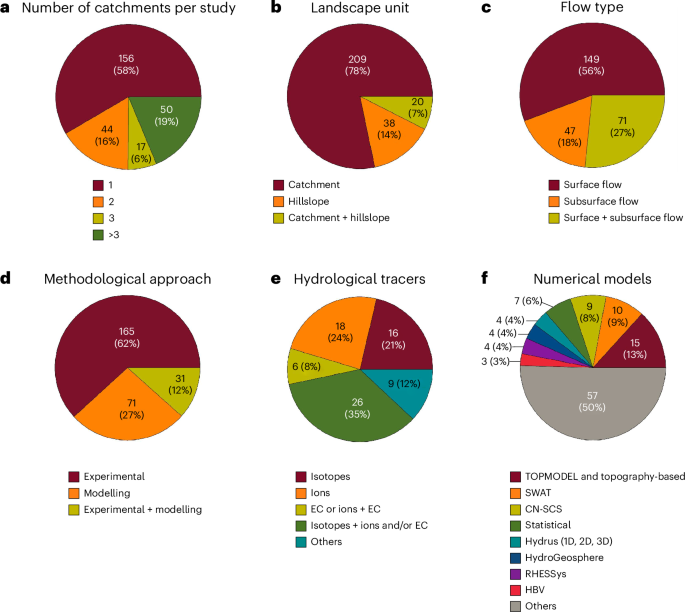
A new global synthesis brings together evidence from 691 forested catchments, drawn from 267 scientific studies published over more than 30 years. For the first time, runoff processes in forested catchments are analyzed systematically at the global scale, allowing long-standing hypotheses to be tested across climates, continents, and landscapes. Particularly, the study explicitly tests eight hypotheses about how runoff is generated, how streams respond to rainfall and snowmelt inputs, and how well these responses can be predicted. Seven of these hypotheses are well known in catchment hydrology but have never been evaluated globally for forested environments. The eighth is original, asking whether climate is truly the dominant control on runoff processes at the global scale.
One of the messages emerging from this synthesis is that the hydrological response of forested catchments is often governed by thresholds. These threshold behaviors appear across climates and continents and are most often controlled by soil moisture: once soils reach a critical wetness, the system rapidly shifts, activating flow paths and increasing streamflow.
Another key finding concerns the origin of stream water. When storms occur, streams in forested catchments are not fed primarily by the rain or snow that has just fallen. Instead, they are dominated by pre-event water—water that was already stored in the catchment before the rainfall or snowmelt event. Groundwater, more than shallow soil water, is the main contributor to streamflow. Storms act as triggers that mobilize stored water rather than simply delivering new water to streams. This reinforces the view of forested catchments as systems that store, mix, and release water over time in a complex way, rather than as simple “water conduits”.
Water in forested catchments moves predominantly as subsurface flow, flowing through soils, along the soil–bedrock interface, and within fractured rock. Preferential flow pathways created by roots, soil cracks, and macropores allow water to move rapidly underground, often reaching streams much faster than through the soil matrix only. Soil properties—such as permeability, texture, depth, and the presence of macropores—emerge as key controls on these processes, frequently outweighing climatic factors.
At the same time, the synthesis challenges a long-standing assumption: that overland flow is almost absent in forested catchments. While subsurface flow dominates overall, surface runoff is documented in many forested catchments worldwide. Surprisingly, a large fraction of this runoff occurs because rainfall intensity exceeds the soil’s infiltration capacity, not because soils are already saturated. This finding contradicts traditional views and shows that forested catchments can generate rapid surface responses under specific conditions.
Subsurface hydrological connectivity between hillslopes and streams is another defining feature of these hydrological hotspots. The global analysis reveals that subsurface connectivity is shaped most strongly by topography and vegetation patterns, rather than by rainfall amount and wetness conditions alone. Catchment topography determines where water accumulates and how it moves, while the spatial distribution of vegetation influences evapotranspiration and subsurface flow paths. In forested catchments, the structure of the landscape therefore plays a decisive role in organizing subsurface water movement between hillslopes and streams.
When it comes to the magnitude of streamflow response—the factors determining how large floods become—the global synthesis shows that rainfall amount is only part of the story. Antecedent conditions, such as how wet the catchment already is, are often more important than the storm itself. Geological and geomorphological characteristics further shape the response, emphasizing that the “memory” of the system matters greatly in hydrological hotspots.
The global analysis also sheds light on streamflow prediction. Despite —or perhaps, due to —the wide range of hydrological models used worldwide, no single factor appears to consistently control model performance. Instead, predictions are influenced by a combination of soils, vegetation, topography, and hydrological conditions. Landscape properties are particularly influential, highlighting a limitation of many models: they often treat catchments as static systems, while real forested catchments are dynamic and evolving.
Perhaps the most novel result emerges from the eighth hypothesis. Contrary to common belief, climate is not always the dominant control on runoff processes in forested catchments at the global scale. Geological, pedological, and hydrological factors exert greater influence overall. Climate influence changes with soil moisture, interacting with vegetation and catchment topography, with different fingerprints in wetter versus drier regions.
This global synthesis represents a major step forward for catchment hydrology. Its novelty lies not only in the size of the dataset, but in the process-based approach used to integrate decades of site-specific knowledge into a unified global framework. By explicitly testing eight hypotheses across nearly 700 forested catchments, the study moves beyond isolated case studies and offers a robust foundation for runoff processes generalization.
In a world facing increasing climate variability and growing pressure on water resources, understanding how runoff is generated and how catchments function is more important than ever. This work shows that protecting and managing forested catchments requires recognizing their complexity, their heterogeneity, and the deep connections between water, soil, rock, and vegetation. Using global datasets can allow exploring interfunctional relationships among catchments across diverse climates, fostering a more process-based comprehension of the factors governing water movements and availability worldwide.

Follow the Topic
-
Nature Water
This journal publishes research on the evolving relationship between society and water resources on a monthly basis. It covers the natural sciences, engineering, and social sciences, with a particular interest in regards to interdisciplinary research.