From a mother's hands to a deep understanding—preserving Algerian culinary heritage
Published in Social Sciences and Agricultural & Food Science



Explore the Research
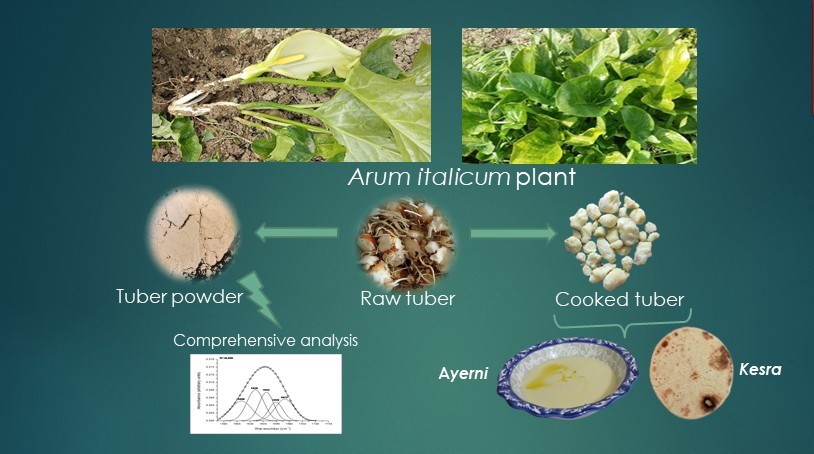
Production process, rheology, and sensory characterization of Algerian porridge and flatbread derived from Arum italicum tubers
The scientific study began not in a laboratory environment, but in a kitchen. By observing a mother from a mountainous area of Algeria preparing traditional porridge and flatbread made from Arum italicum tubers, just as her ancestors did before her. Her desire to preserve and promote this knowledge truly motivated this research. She continues to practice this ancestral method today, even though such traditions are rapidly fading among the younger generations.
Inspired by her commitment, we decided to record and scientifically study these traditional practices—not only with the aim of preserving culinary heritage but also to examine their nutritional and functional potential. Our work included both field surveys and laboratory studies. The research conducted allowed us to establish the traditional diagrams for the preparation of Kesra (flatbread) and Ayerni (porridge), while the scientific study focused on the physicochemical and structural properties of the tuber powders, as well as the rheological and sensory analysis of the two products made from the Arum italicum tuber.
Tubers with remarkable nutritional and functional properties
The results corroborated what local experts had already suggested: these tubers have a high energy value (366.88 kcal/100 g) and are extremely rich in carbohydrates (80.86%), exhibiting a remarkable water-retention capacity and outstanding solubility. The FT-IR analysis revealed a predominantly β-sheet structure, indicating a high-value starch composition. Rheological examinations have demonstrated that the consistency of the porridge was more uniform, while sensory analysis indicated that both products were equally well-received by the new generation.
Traditional products are made from a dough derived from tubers that have been previously boiled and steamed repeatedly to eliminate their toxicity related to the presence of alkaloids and calcium oxalate crystals. The cooking methods practiced by previous generations can eliminate the toxicity of the tubers. If this method has been passed down orally by previous generations, scientific results have validated its effectiveness, thereby reinforcing the relevance of this ancestral knowledge.
Three strategic areas of enhancement.
The exploitation of Arum italicum tubers is part of a sustainable and local development perspective, addressing three fundamental challenges:
- Highlighting Algerian culinary heritage through the development of healthy products inspired by traditions.
- Establishment of economic opportunities by facilitating the integration of natural and accessible raw materials into new commercial circuits.
- Promotion of local agroecological practices by supporting small producers and strengthening the resilience of food systems.
This article goes beyond the scope of a simple scientific report—it pays homage to a mother's knowledge, highlights the importance of oral traditions, and underscores the crucial role of women as preservers of culinary heritage. By recording these traditions and confirming their nutritional value, our goal is to contribute to food sustainability while honoring the wisdom passed down through generations.

A professor of food science with over 12 years of experience at the University of Constantine 1, Algeria, teaching students in the fields of nutrition, food, and agri-food technology. Making scientific research with different international peer-reviewed publications on food science and cereal fields, especially on celiac disease and gluten-free products.
Follow the Topic
-
Discover Food
This is a transdisciplinary, open access journal that provides a leading platform for the rapid dissemination of knowledge and advances covering the research and innovation that is taking place across the food sector.

Related Collections
With Collections, you can get published faster and increase your visibility.
Advancing the Understanding of Food Structure and Processing in Sensory Perception, Eating Behaviour, and Nutrient Retention
The structure and processing of food are critical in shaping sensory perception, influencing satiety, guiding eating behaviour, and determining nutrient retention. As global food systems evolve, understanding these complex interactions is crucial for developing products that are not only appealing to consumers but also promote health and well-being. This area of study is increasingly significant in the context of personalised nutrition, where tailoring food structures and processing techniques can optimise health outcomes.
This topical collection invites researchers, scholars, and industry professionals to contribute their latest findings on the interplay between food structure, oral processing, and their effects on sensory perception, eating behavior, and nutrient retention. To differentiate this collection and ensure it provides fresh and valuable insights, we encourage submissions that focus on specific emerging trends, innovative approaches, and cutting-edge methodologies. Topics of interest include, but are not limited to:
• The potential use of artificial intelligence and machine learning to optimise food structure and processing for enhanced sensory experiences, satiety, and nutrient retention.
• Application of state-of-the-art imaging (e.g., MRI, CT, and electron microscopy) and analytical methods to study food microstructures and their transformations during food processing as well as oral processing.
• Novel approaches to creating food matrices that modulate sensory properties, digestion, and nutrient release.
• Exploration of the role of texture and rheology in oral processing and its impact on sensory perception and satiety.
• Investigations into how emerging processing methods (e.g., pulsed electric field, high-pressure processing) influence nutrient retention, bioaccessibility, and functional properties of foods.
• Research focused on food structures and formulations tailored for demographic groups with unique nutritional needs, such as elderly populations or individuals with specific metabolic conditions.
Through highlighting novel approaches and innovative technologies in the study of food structure and processing, this collection aims to provide a platform for groundbreaking research that pushes the boundaries of current knowledge. We encourage contributions that explore these cutting-edge areas and offer new perspectives that are not widely covered in existing literature.
Keywords:
• Food structure
• Sensory perception
• Oral processing
• Nutrient bioavailability
• Satiety
• Eating behaviour
• Food matrix design
• Texture and rheology
Publishing Model: Open Access
Deadline: Dec 31, 2026
Innovations in Food Fermentation for Nutrition, Sustainability and Health
Fermentation is a cornerstone of food innovation, now revitalized by cutting-edge science and technology. This Collection will showcase advances in precision fermentation, novel microbial consortia, and omics-driven design, with a strong focus on health, nutrition, and sustainability. Particular emphasis will be given to innovations linking fermentation to microbiome modulation, valorization of agricultural by-products, and the exploration of underutilized substrates such as new legumes, mushrooms, and alternative protein sources. Together, these perspectives highlight how fermentation can contribute to resilient food systems and global health.
Keywords:
Fermentation; Precision fermentation; Microbiome; Sustainable proteins; Food innovation; Valorization; Functional foods; Omics technologies; Alternative substrates; Nutrition and health
This Collection supports and amplifies research related to SDG 2, SDG 3, and SDG 12.
Publishing Model: Open Access
Deadline: Feb 28, 2027