From Crystal to Collapse
Published in Social Sciences, Earth & Environment, and Civil Engineering

When the history of mining is told, it is usually framed around metals that are immediately recognizable as valuable. Gold, silver or copper fit comfortably into this narrative because their worth appears obvious. Yet some of the most revealing examples of how geology shapes society come from materials that seem, at first glance, ordinary. Their importance lies not in rarity or intrinsic value, but in the specific problem they solve at a particular moment in technological history.
In Roman Hispania, one such material quietly transformed an entire regional economy. It was not a metal, but a variety of gypsum known as lapis specularis.
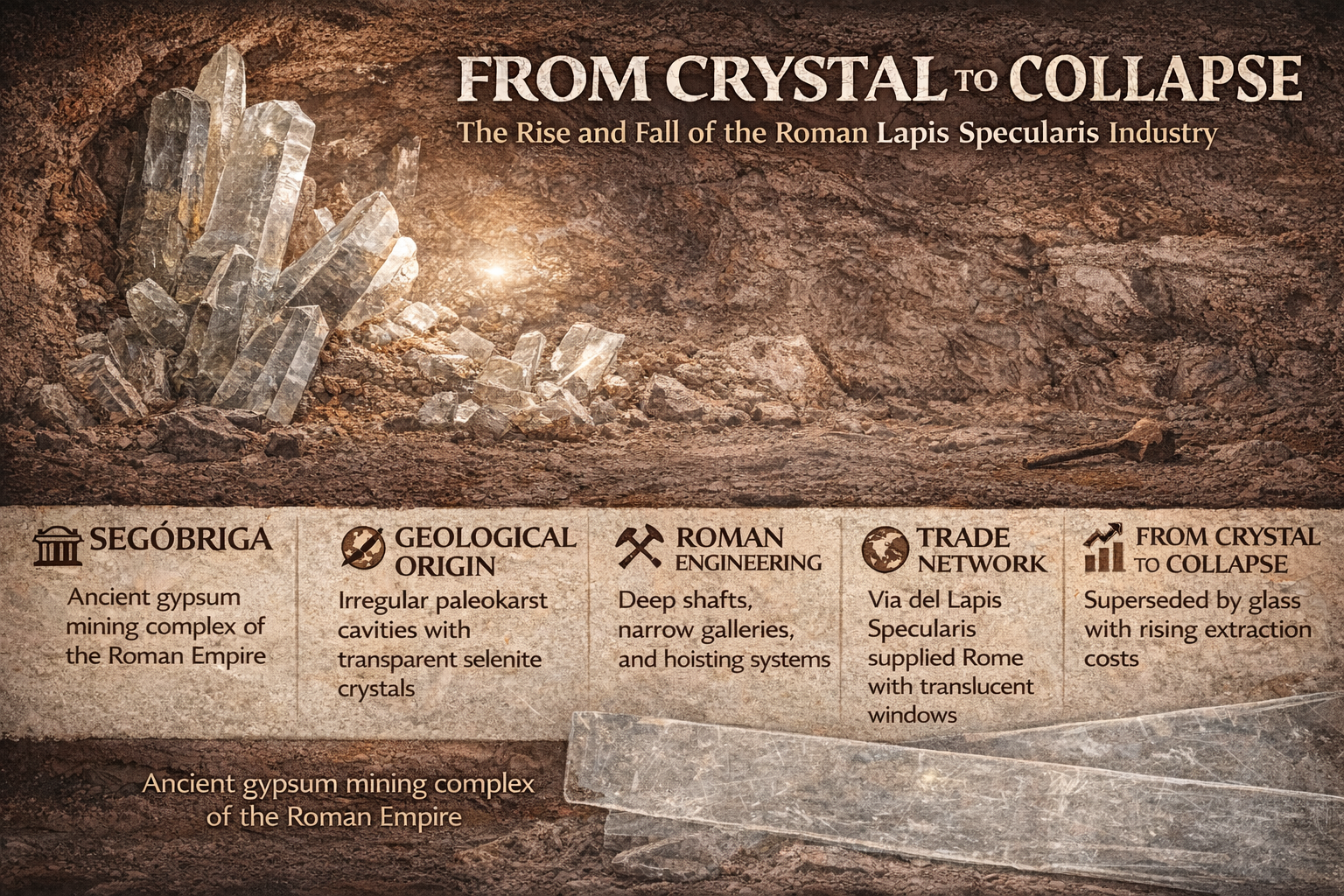
This transparent, laminar mineral could be cleaved into thin sheets that transmitted light while shielding interiors from wind and cold. Today this function sounds trivial, since glass performs it effortlessly. Two thousand years ago, however, it was revolutionary. Buildings were either open to the elements or dark inside. Lapis specularis made it possible to enclose space without losing daylight. Roman baths, villas, greenhouses and public buildings became brighter and more comfortable. In effect, the mineral acted less as a raw material and more as a construction technology.
Our recent study examines how this seemingly modest geological resource supported the growth of the Roman city of Segóbriga and how the same system later disappeared once a technological alternative became available. The full paper can be found in Geoheritage here: https://doi.org/10.1007/s12371-026-01268-9
What the archaeological and geological evidence reveals is a story that feels strikingly contemporary.
The first point that becomes clear is that exploitation of lapis specularis was not superficial or opportunistic. The deposits did not form convenient layers that could be quarried easily. Instead, they developed inside irregular cavities created by dissolution and recrystallization within evaporitic rocks. The geometry was unpredictable. Crystals appeared in pockets and lenses rather than continuous beds. Roman miners therefore had to adapt their excavations to the mineralization itself, following the shapes dictated by the host rock.
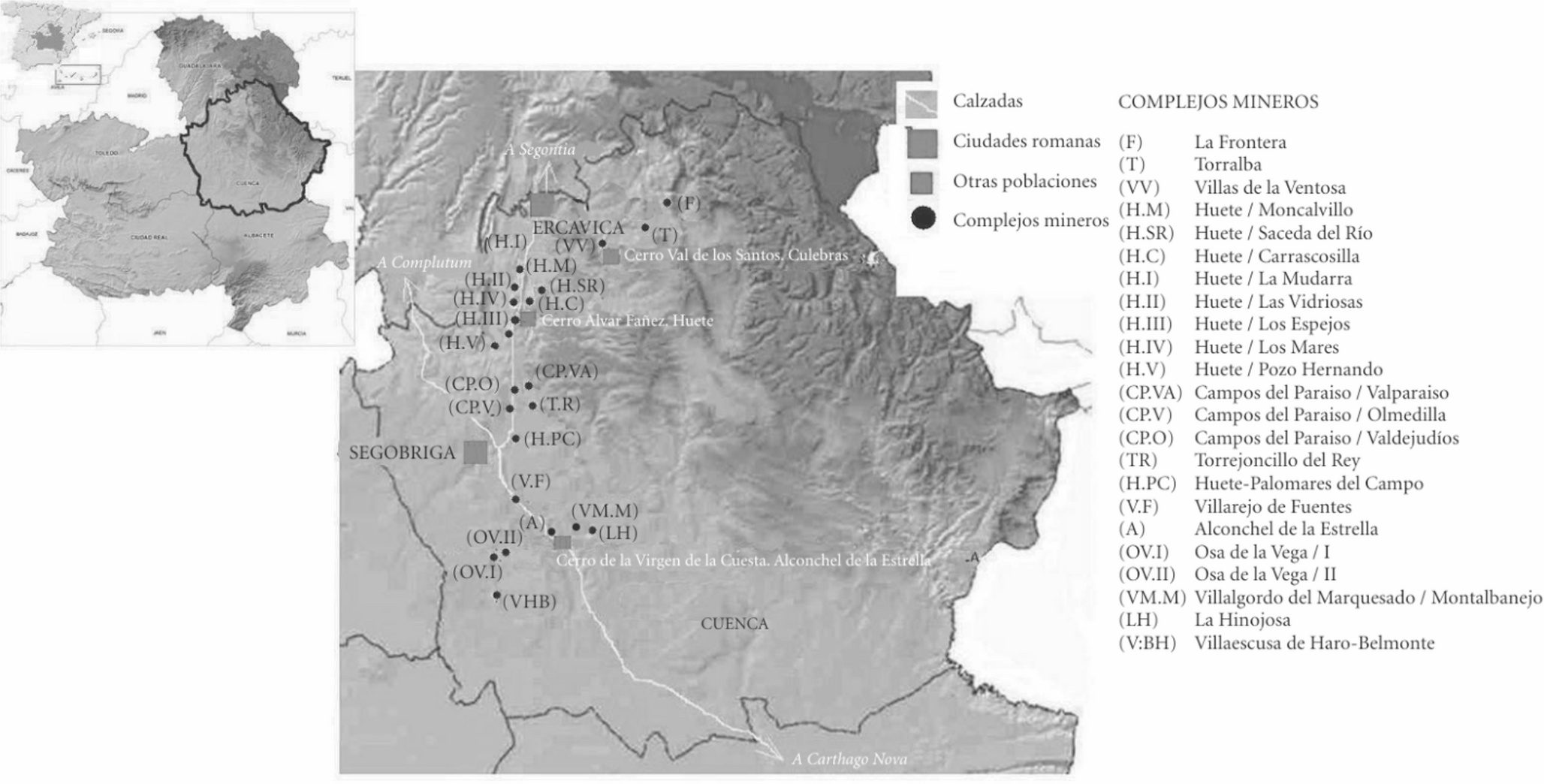
This constraint produced an unexpectedly sophisticated underground landscape. Shafts, galleries, ventilation passages and carefully planned extraction chambers indicate organized engineering rather than casual extraction. The scale suggests coordination of labour and logistics that goes beyond local craftsmanship. Segóbriga functioned as a specialized mining district integrated into broader trade networks of the Empire.
The second point concerns the relationship between the mines and the city. Segóbriga displays monumental architecture that seems disproportionate for an inland settlement. Its theatre, amphitheatre and public infrastructure imply sustained investment and wealth. The most plausible explanation is that lapis specularis generated a steady export economy. The mineral moved outward to Mediterranean markets where translucent architectural materials were in demand, and economic benefits returned in the form of urban development. In modern terms, geology created a competitive advantage and anchored a regional specialization.
Yet the very characteristics that enabled this prosperity also introduced fragility.
Extraction was labour intensive. The crystals were delicate. Transport required care. Production costs were inevitably high. As long as lapis specularis remained the best solution for admitting light into enclosed spaces, these disadvantages were acceptable. Once an alternative appeared, they became decisive weaknesses.
That alternative was flat glass. Roman glassmaking improved progressively during the first centuries of the Empire. Even if early glass was not perfect, it offered something that gypsum could never provide. It could be produced almost anywhere. It did not depend on rare geological conditions. It could be standardized and manufactured at scale. From an economic perspective, this flexibility outweighed the qualities of specular gypsum.
The result was not a gradual geological decline but an abrupt economic one. The deposits did not run out. The mines did not become inaccessible. Instead, the market simply stopped needing the product. The industry collapsed because a new technology fulfilled the same function more efficiently.
This distinction is important. It shows that the life cycle of a mineral resource is often governed less by depletion than by substitution. A resource may remain physically abundant while becoming economically irrelevant.
The pattern is familiar in modern history. Whale oil was displaced by petroleum. Natural ice by refrigeration. Photographic film by digital sensors. In each case, entire supply chains disappeared not because the raw material vanished, but because innovation changed demand. Segóbriga represents an early example of this same dynamic.
For researchers and professionals working today on mineral resources and critical materials, this episode offers a useful perspective. Discussions about supply security often focus on reserves, production capacity or geopolitical risk. These factors matter, but they are only part of the story. A material’s value depends fundamentally on the technologies that use it. When those technologies change, the relevance of the resource can change just as quickly.
Segóbriga therefore serves not only as a heritage site but also as a lesson in economic resilience. It preserves a complete system in which geology, engineering, trade and innovation intersect. It reminds us that prosperity derived from a single application can be vulnerable. Diversification and adaptability matter as much as abundance.
Walking through the remnants of these mines today, one can still see the galleries that once supplied a material essential to Roman architecture. They are tangible evidence of how strongly human societies depend on geological circumstances, and how rapidly that dependence can shift when technology evolves.
Sometimes the most instructive stories in mining history are not about discovery or wealth, but about replacement. A simple mineral sheet that once illuminated Roman buildings ultimately teaches a broader truth. Resources create opportunities, but only innovation determines how long those opportunities last.
Further details on this work and related research can be found in the published article in Geoheritage:
https://doi.org/10.1007/s12371-026-01268-9
More of my publications and perspectives on mineral resources, mining history and geoheritage are available on my Springer Nature author profile:
https://www.springernature.com/gp/authors/antonio-alonso-jimenez
Follow the Topic
-
Geoheritage
An international journal dedicated to discussing all aspects of our global geoheritage, both in situ and portable.

Related Collections
With Collections, you can get published faster and increase your visibility.
Palaeontological Heritage: Methods, assessment and geoconservation
ICPH-9 is an event dedicated to the palaeontological and palaeoarchaeological heritage to communicate and exchange of novelties in the topics linked with the preservation and enhancement of palaeontological and archaeological heritage. Organizing a congress on palaeontological heritage serves several important purposes: (i) Knowledge Sharing, (ii) Conservation and Management, (iii) Education and Outreach, (iv) Policy Development, (v) Cultural and Economic Benefits of Palaeontological heritage. The main objectives of the Special Issue are (1) to give the current state and future direction in the geoconservation and protection strategies of the geo- and palaeontological heritage, (2) to bring in light all the most attractive and relevant original researches on inventory, assessment and geoconservation strategies of new geosites, palaeontological, archaeological and diversity sites, (3) to introduce new methodologies for the classification, inventory and assessment of geosites, geosites, palaeontological, archaeological and diversity sites, (4) to discuss the legislative aspect of the protection of geoheritage by reviewing the achievements, (5) to approach the pedagogical problem of teaching palaeontology. Topics included in the Special Issue are: (1) Palaeontology and Geology (fossiliferous sites, identification and inventory). (2) Palaeoanthropology, and prehistory (sites, identification and inventory). (3) Geoconservation of Palaeontological and geoheritage (Protection, enhancement and management). (4) Geoparks, Palaeoparks and museums (Establishment, procedures and management). (5) Palaeontological heritage and local actors (Involvement of local communities and associations, as well as customs). (6) Legislation on Geoheritage (all related aspects; protection, preservation promotion, geotourism, … etc.). Overall, publishing a Special Issue on Palaeontological heritage provides a database for advancing scientific knowledge, promoting conservation efforts, fostering public engagement, and enhancing the cultural and economic value of palaeontological resources through selected papers.
Publishing Model: Hybrid
Deadline: Ongoing