High-performance ferroelectric field-effect transistors with ultra-thin indium tin oxide channels for flexible and transparent electronics
Published in Materials
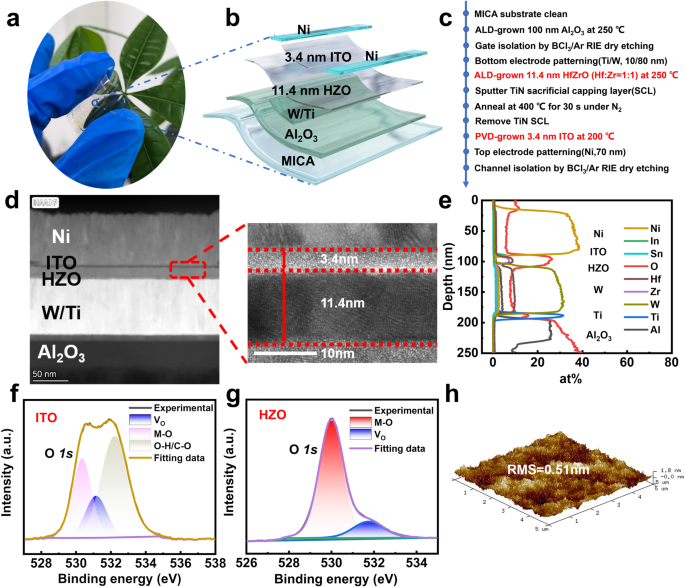

The discovery of hafnium-based ferroelectrics (FE) promoted the development of ferroelectric field-effect transistors (FeFETs), which have ultra-low power consumption, fast erasing speed and strong scalability, making them occupy a place in the field of non-volatile memory (NVM). Since the preparation process of FeFETs requires high temperature, it is difficult to be compatible with flexible substrates, which limits its application in the wearable field. Moreover, the requirements for the use scenarios are strict, and the performance in the bending state is difficult to be guaranteed, which limits their practical applications. And with the scaling of transistor sizes, there is a higher demand for ultra-thin channel materials. However, these materials usually have high contact resistance with metal electrodes and are easy to form interface traps. More importantly, their preparation processes are not compatible with CMOS.
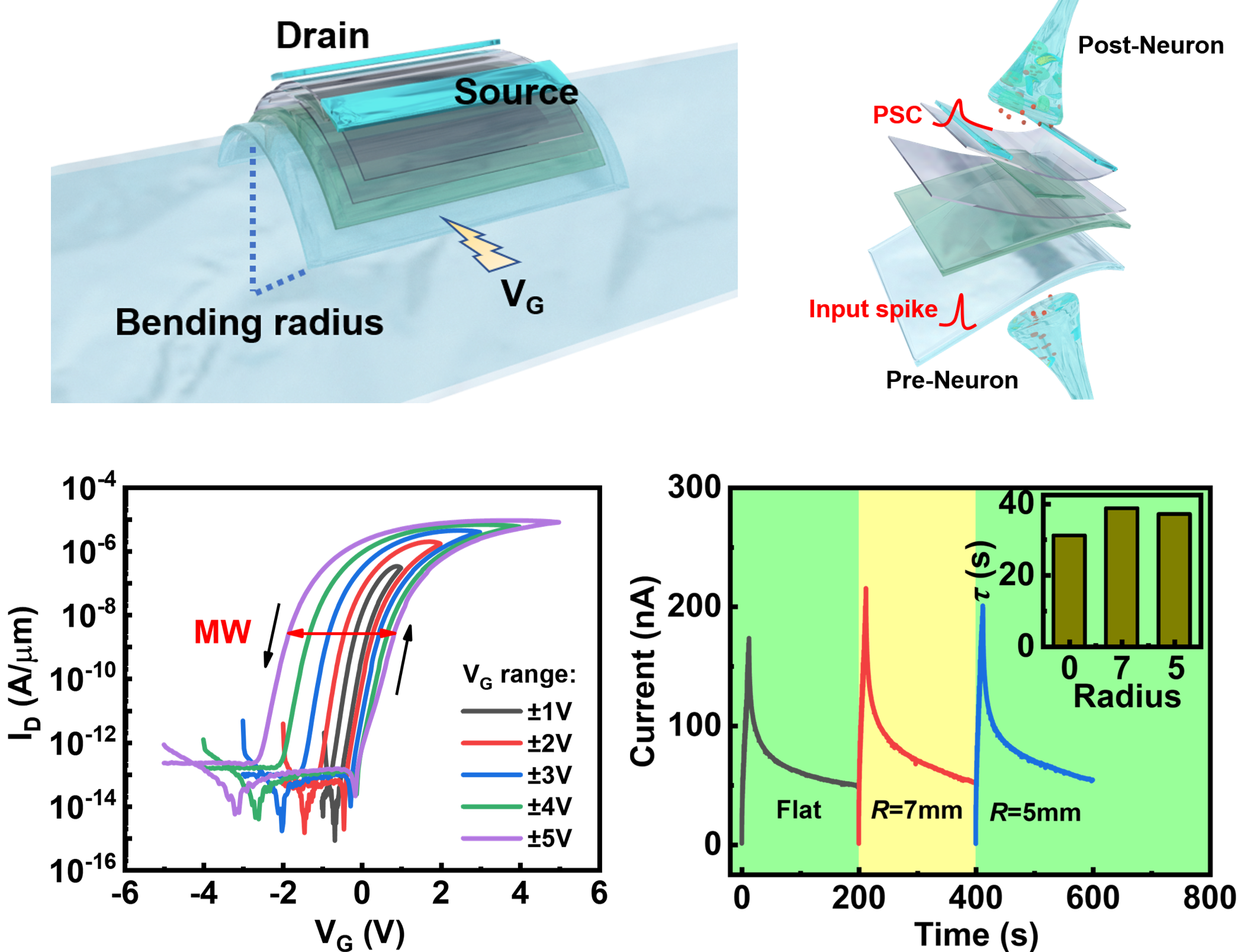
In this work, we report a BEOL-compatible high-performance FeFET memory device based on HZO and ultrathin ITO channels on a flexible MICA substrate, which outperforms rigid substrates. The proposed FeFET has a minimum subthreshold swing (S.S.) of 33 mV/decade, a current on/off ratio (ION/IOFF) ratio of over 108, and a very large and stable memory window (~2.78 V). FeFET has high endurance of over 107 cycles and good retention characteristics estimated to be over ten years. Under different bending conditions, the conductance modulation of the device has high stability and reliability. In addition, FeFET has excellent pulse cycles endurance (>5×10⁵) at a small bending radius (R=5 mm). Additionally, we demonstrate the application of this device in neuromorphic computing. The excellent performance of flexible FeFET has greatly broadened the application of devices in the wearable field.

Follow the Topic
-
Nature Communications
An open access, multidisciplinary journal dedicated to publishing high-quality research in all areas of the biological, health, physical, chemical and Earth sciences.

Related Collections
With Collections, you can get published faster and increase your visibility.
Women's Health
Publishing Model: Hybrid
Deadline: Ongoing
Tumor Microenvironment Crosstalk and Therapeutic Implications
Publishing Model: Hybrid
Deadline: Nov 02, 2026