High‑Temperature Stealth Across Multi‑Infrared and Microwave Bands with Efficient Radiative Thermal Management
Published in Materials
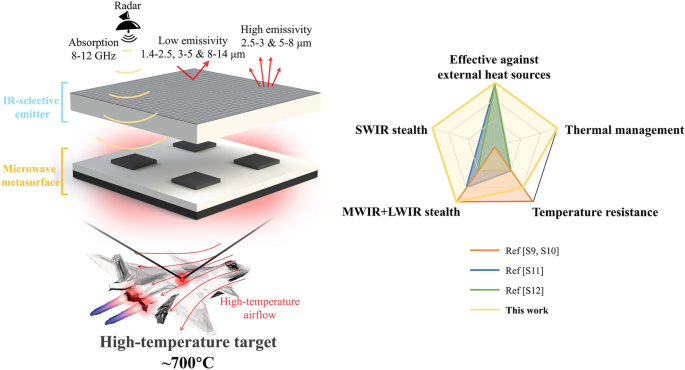

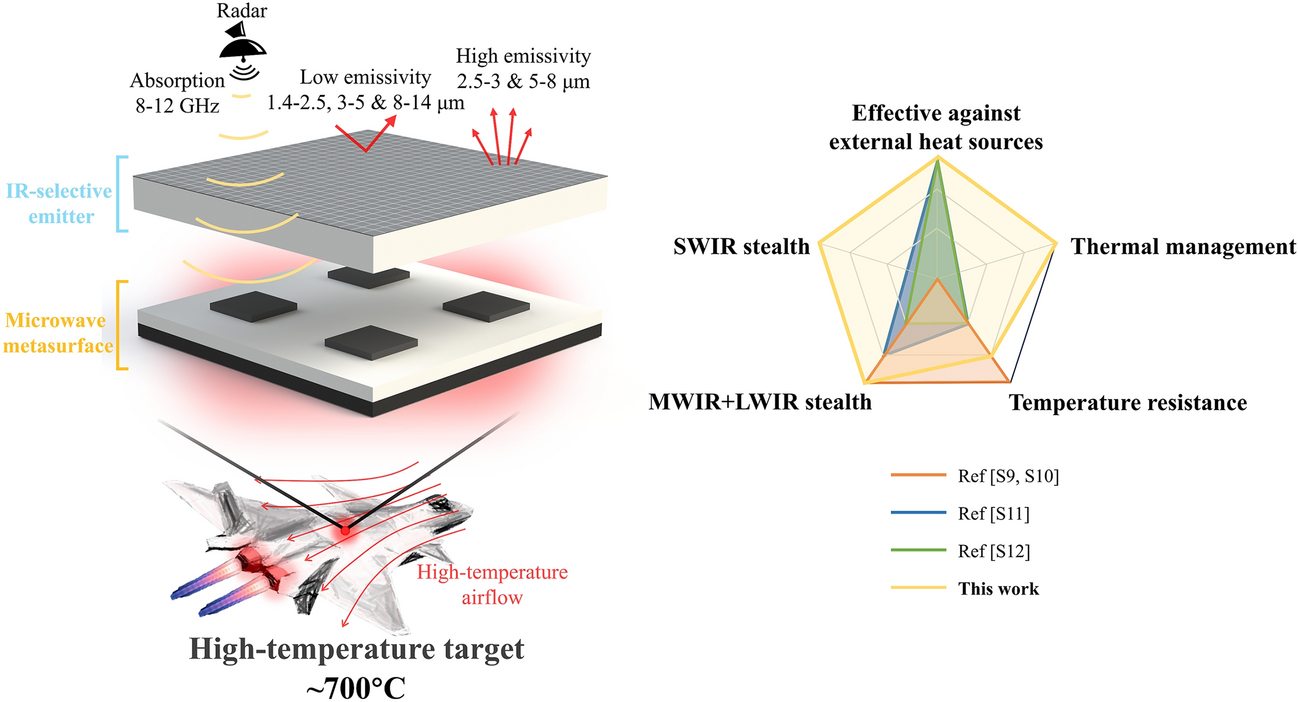

As hypersonic vehicles, scramjet nozzles and high-speed drones push beyond Mach 2, their skins glow at 700 °C—shining like a beacon in every thermal and radar band. Now, researchers from Zhejiang University and Westlake University, led by Dr. Qiang Li and Dr. Meng Zhao, have unveiled a single, scalable coating that hides platforms from SWIR, MWIR, LWIR and X-band radar while actively shedding 9.6 kW m-2 of waste heat. The work delivers a turnkey architecture for survivability in extreme flight regimes.
Why Multispectral Stealth Matters
• Peak-Shift Problem: At 700 °C black-body radiation peaks at 2.8 µm—inside the short-wave IR (SWIR) window—making conventional MWIR/LWIR-only camouflage obsolete.
• Radar-IR Conflict: Low-emissivity metals that suppress IR are perfect microwave reflectors, while radar absorbers glow fiercely at high temperature.
• Heat-Accumulation Trap: Thick thermal insulators cool the inner airframe but cook the outer skin when aerodynamic heating strikes, leading to catastrophic IR signature spikes.
Innovative Design & Features
• IR-Selective Emitter: A laser-etched Mo/Si multilayer (total < 1 µm) delivers ε ≤ 0.38/0.44/0.60 across MWIR/LWIR/SWIR yet jumps to ε = 0.82 in the 5–8 µm “non-atmospheric” window—turning the surface into a high-power radiator exactly where the sky is transparent.
• TiB2 Metasurface: Embedded square blocks create an impedance-matched Salisbury screen that sucks in 9.6–12 GHz microwaves with < −3 dB reflection while surviving 700 °C in air.
• Monolithic Integration: Both functional layers are deposited by standard e-beam evaporation and picosecond-laser diced on a single Al2O3 tile, enabling wafer-scale fabrication and direct bonding to curved aerosurfaces.
Applications & Future Outlook
• 72 °C Cooler: Under 17.3 kW m-2 aerodynamic heating (Mach 2.2 equivalent) the hybrid surface runs 72.4 °C colder than low-emissivity molybdenum, translating into a 270 °C lower radiative temperature in the LWIR band—an unambiguous “vanishing” act for thermal imagers.
• Five-Band Cloaking: Experimental IR cameras confirm signal suppression of 37–64 % versus black-body references in SWIR, MWIR and LWIR up to 700 °C, while X-band radar cross-section drops by > 90 % across 2.4 GHz of bandwidth.
• Beyond Hypersonics: The same stack doubles as a radiative heat sink for satellite bus panels, turbine shrouds and reusable launch-vehicle leading edges, offering a universal thermal-management skin for any high-flux, high-risk platform.
Challenges & Opportunities: The team highlights next steps—boosting SWIR emissivity below 0.5, pushing operating temperature to 1000 °C through high-entropy-ceramic spacers, and roll-to-roll transfer of the metasurface onto polymer-matrix composites for flexible hypersonic wings.
This work provides a photonics-first route to simultaneous multispectral stealth and self-cooling, promising a new generation of survivable, energy-efficient platforms for both military and civilian extreme-environment missions.

Editor of Nano-Micro Letters, which is an Open-Access, peer-reviewed journal reported papers that have at least one dimension ranging from a few sub-nanometers to a few hundreds of micrometers. The journal is published by Springer Nature and indexed by SCI, EI, SCOPUS, Pubmed, etc. The 2025 JCR Impact Factor is 38.5. The 2025 CiteScore is 58.9.
Follow the Topic
-
Nano-Micro Letters
Nano-Micro Letters is a peer-reviewed, international, interdisciplinary and open-access journal that focus on science, experiments, engineering, technologies and applications of nano- or microscale structure and system in physics, chemistry, biology, material science, and pharmacy.