How to tie a planet to a star
Published in Astronomy



Explore the Research
 Nature
Close-in planet induces flares on its host star - Nature
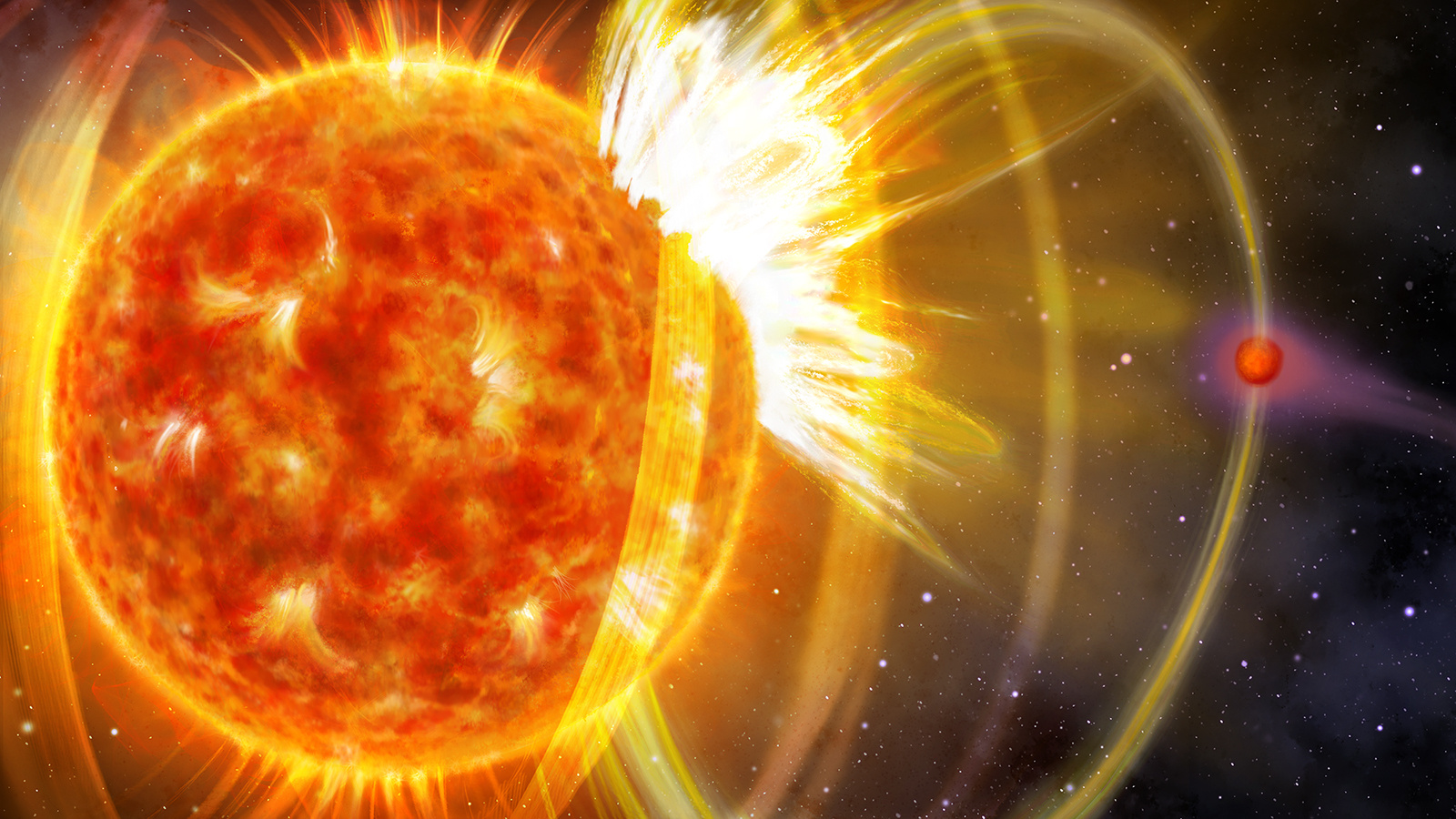
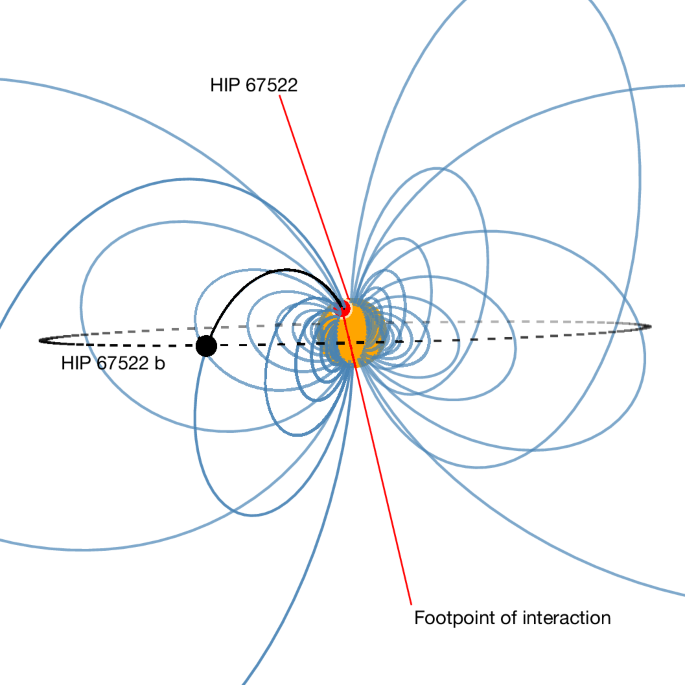
Planet-induced flares on HIP 67522, a 17 million-year-old G dwarf star with two known close-in planets, were detected.
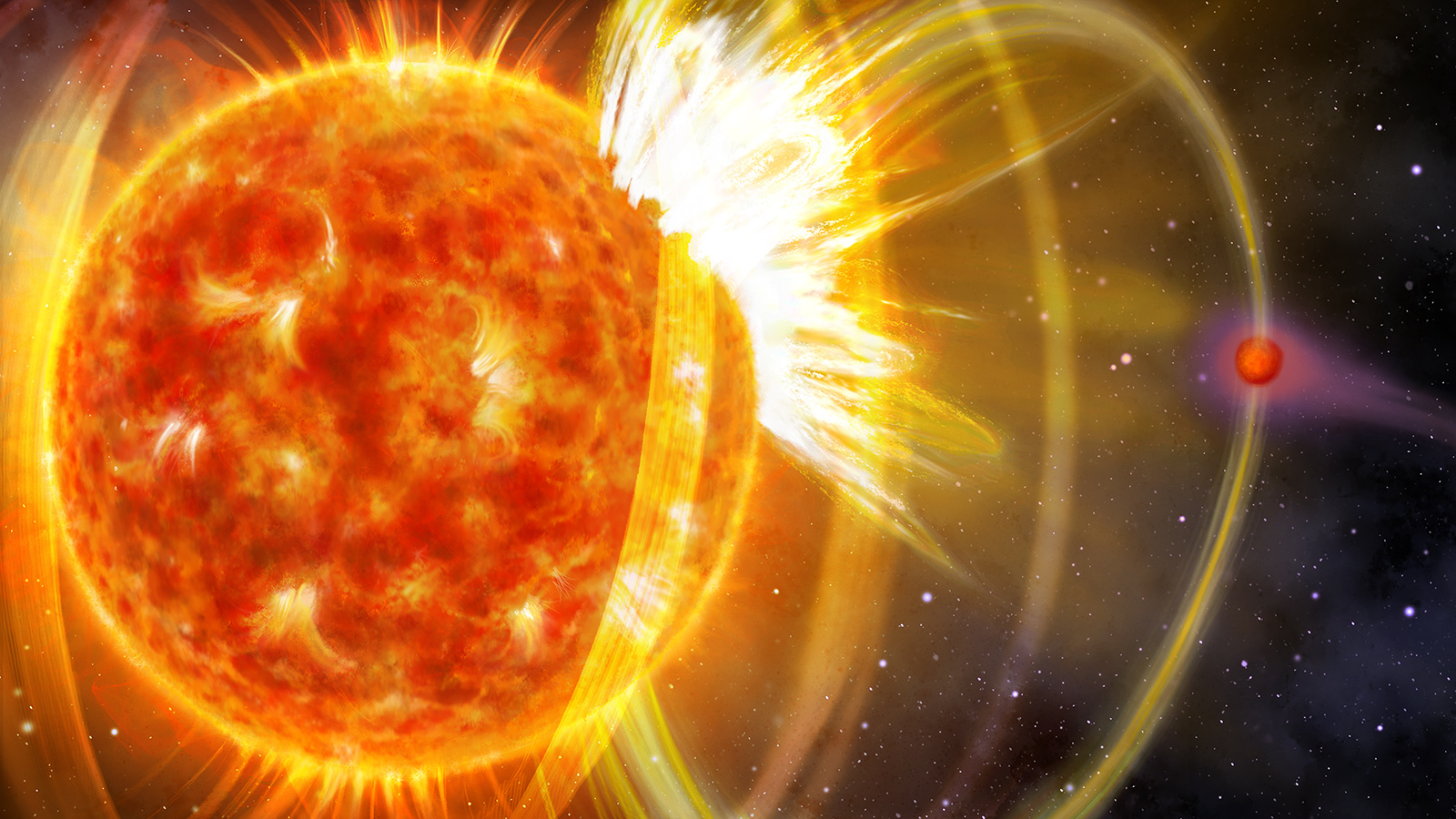
In 2018, my PhD supervisor introduced me to the idea of star-planet interactions. She had just joined the institute where I was about to complete my Master’s degree, to start a group that would set out to find signs of planets influencing their host stars. When I became Katja Poppenhäger's PhD student, my task was to find planets that trigger flares on their hosts.
The idea seemed intriguing to me. If a planet could magnetically alter its host star’s evolution, such planets—and their analogs—would be seen in a new light. We would no longer think that only the star shapes the fate of the planets in its orbit, as is the case for us on Earth, but also that the reverse is true. Any planet close enough to its host would be co-evolving with its sun in a feedback loop that would influence the properties of the star, such as rotation and magnetic field, and that, in turn, would fire back on the planet. As a consequence, the planet would experience more or less irradiation which determines how much of its primordial atmosphere it gets to keep, or whether it will be stripped to a bare rock in the process.
But it was unclear how this interaction would manifest -- the theory was underdeveloped. A dozen studies had attempted to find signs of this interaction comparing samples of stars with and without close-in planets, but the initially detected differences invariably seemed to reduce to observational biases or small sample effects. A few individual systems showed suspicious signs of interaction: A hot spot that tracked the orbital motion of the planet across the stellar surface; a bright burst in X-ray that occurred right when a planet in an eccentric orbit approached the closest point to its sun. But neither of these and other similarly intriguing measurements reproduced consistently in follow-up observations.
Perhaps, the interaction was weak, and undetectable with current instruments. Perhaps, it was seasonal, only to be seen, when the star's magnetic cycle was in a certain phase. The process of interaction itself could be complex. Factors unknown to us might turn the interaction on and off in different systems. In short, observers and theorists were fumbling in the dark. Any idea on what to look for was game, and so was looking for flares triggered by close-in planets.
I dug into the data. During my Masters project, I had spent quite some time searching for flares in optical time series. Exoplanet search missions that look for planets in transit, like NASA's Kepler and TESS missions, also detect these magnetically driven bursts as sudden optical brightenings of the star. Flares typically last for minutes to hours and briefly increase the stellar flux, sometimes only by a small fraction, sometimes by a factor of ten or more. Flares on old stars like the Sun rarely make it past a sub-percent increase in optical brightness. But younger and smaller stars regularly produce flares hundreds to thousands of times more energetic than any solar flare.
I was looking for flares that would cluster in phase with the innermost planet's orbit. Among several thousand star-planet systems, only about two dozen showed flares. This wasn't surprising, as planets are much easier to find around older, less variable stars, that also produce fewer flares. At first, the result seemed like all those prior studies -- a non-detection. I got distracted and spend time on other projects that seemed more promising at the time. By the end of my PhD in 2022, I had finally written up the paper about the flare search, and was ready to leave it at that.
However, I was bugged by the intuition that one system might deserve a second look -- a young star with a gas giant in a tight 7-day orbit. In my sample of flaring star-planet systems, it was among those with the strongest expected interaction, and the clustering signal was almost significant. I put in a proposal to observe the system with ESA's CHEOPS satellite. The first attempt was shot down, but on second try, we were granted almost 200 hours of high priority time.
By that time, I had joined Harish Vedantham's STORMCHASER project at the Netherlands Institute for Radio Astronomy as a postdoc. In the months while CHEOPS was collecting data in 2024, I was remotely steering the Australia Telescope Compact Array to point at the same system in order to find the radio counterpart to the flaring interaction. The radio observations turned out to be a dead end, a non-detection that could neither confirm nor rule out interaction. The CHEOPS data also challenged us.
I realized that the statistical test for clustering we used was unable to give us definitive answers. The significance varied stronger than expected depending on arbitrary parameters, so I discarded it as unreliable. Harish, who had just finished teaching a course on statistics, suggested we perform a Bayesian model comparison instead. To our delight, the results came out clear -- a flare-clustering model was clearly favored, and results held up regardless of binning or other arbitrary choices. Considering the high expected power of interaction and that the clustering was also found at the orbital phase where it would be expected based on system geometry, we could no longer deny that we had found the first case of flares triggered by a planet on its host star.
I suspect that many more such interacting systems are out there, and I am hoping for a chance to go and find them all.

Follow the Topic
-
Nature
A weekly international journal publishing the finest peer-reviewed research in all fields of science and technology on the basis of its originality, importance, interdisciplinary interest, timeliness, accessibility, elegance and surprising conclusions.

Related Collections
With Collections, you can get published faster and increase your visibility.
Carbon Dioxide Removal
Publishing Model: Hybrid
Deadline: Jan 16, 2027
Cancer Neuroscience: from mechanisms to therapy
Publishing Model: Hybrid
Deadline: Jan 30, 2027