Identification of an effective and rapidly degradable disinfectant from disinfection byproducts
Published in Earth & Environment

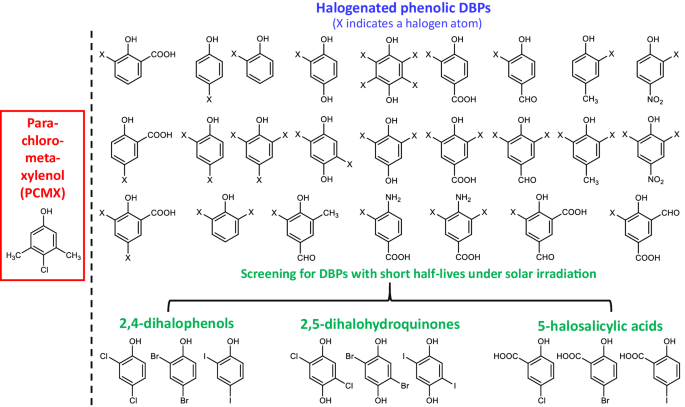

Disinfection practices ensure biosecurity for humans but pose challenges for environmental sustainability. This dilemma has been underscored during the global pandemic COVID-19, which has necessitated intensive practices of personal and environmental disinfection to safeguard public health. Chloroxylenol (PCMX), a widely used disinfectant worldwide before, during and after the global pandemic, has long been associated with eco-toxicological threats due to its massive consumption and high chemical stability. Recognizing the need for a more sustainable alternative, we turned the attention to halo-phenolic disinfection byproducts (DBPs), which share a similar chemical structure with chloroxylenol (see Figure 1) and have been shown to be rapidly degraded and detoxified through solar photolysis in our earlier studies.
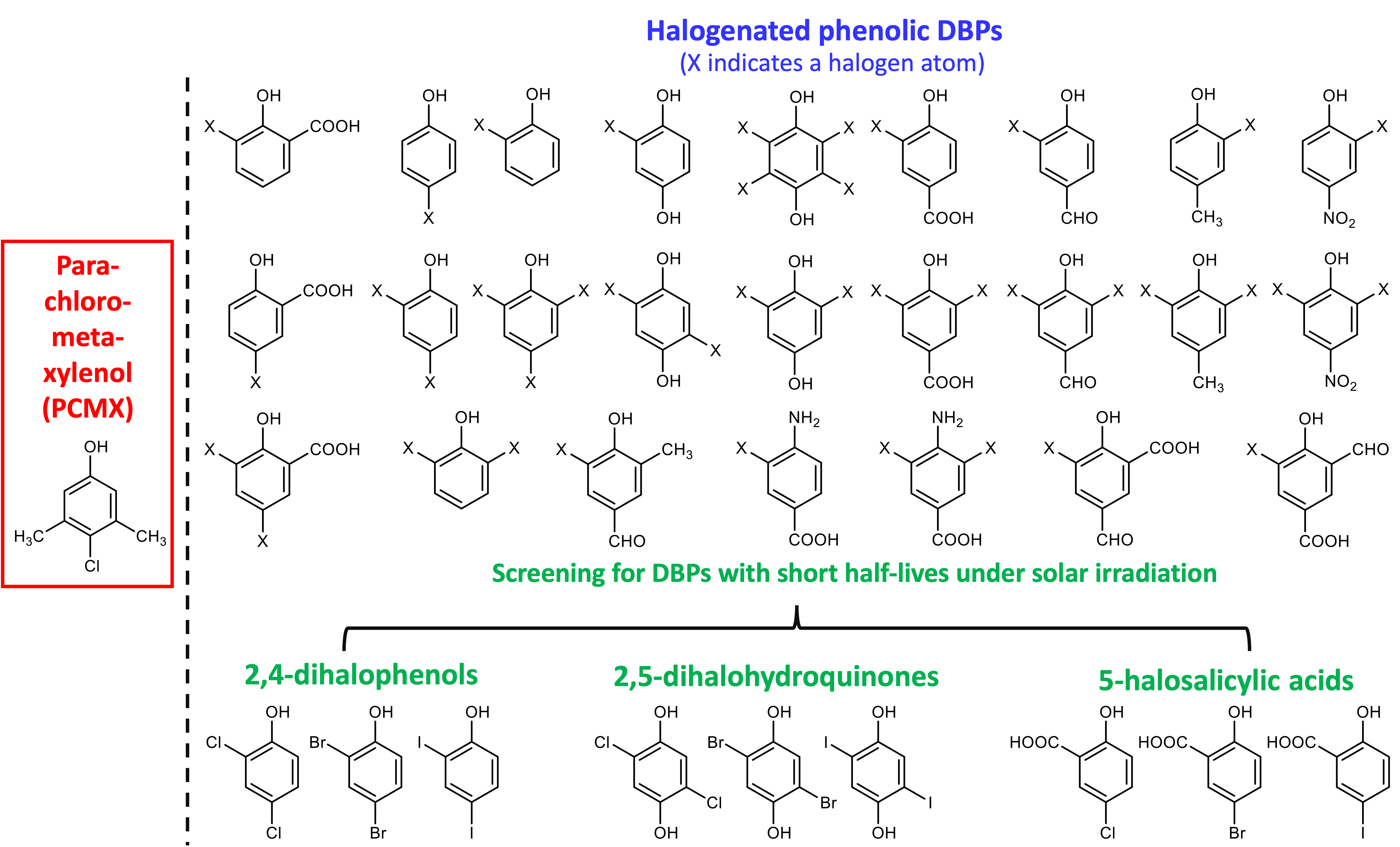 Figure 1. Selection of DBPs for potential disinfectants. Schematic illustration of screening halogenated phenolic DBPs for the potential disinfectants based on their structural properties and photodegradation kinetics.
To identify an effective and rapidly degradable alternative to chloroxylenol, initially we selected three groups of DBPs (Figure 1), 2,4-dihalophenols, 2,5-dihalohydroquinones, and 5-halosalicylic acids, out of >100 halo-phenolic DBPs. After evaluating their disinfection performance against pathogens and their degradation kinetics in receiving seawater, we found that 2,5-dihalohydroquinones and 5-halosalicylic acids were ineffective as disinfectants due to their instability and low pathogen inactivation capabilities. While 2,4-dihalophenols exhibited comparable disinfection power to PCMX, their slow degradation in the absence of solar irradiation and potential ecological risks made them less than ideal candidates.
Inspired by the varying degradation rates and disinfection efficiencies of 2,5-dihalohydroquinones with pH, we hypothesized that dihalobenzoquinones, the oxidation products of dihalohydroquinones, could possess potent antimicrobial activities. By focusing on 2,6-dichlorobenzoquinone (2,6-DCQ) as a representative, we found that 2,6-DCQ exhibited remarkable efficiency in inactivating bacteria, fungi, and viruses; its disinfection efficiency was 9.0–22 times higher than that of PCMX in these antimicrobial tests (see Figure 2).
Through investigation of its degradation kinetics and pathway, we found that 2,6-DCQ readily degraded in seawater via hydrolysis, even in the absence of solar irradiation (see Figure 2). The developmental toxicity of 2,6-DCQ to marine polychaete embryos decreased rapidly due to its rapid degradation in receiving seawater. After a 48-hour discharge into seawater, the developmental toxicity of 2,6-DCQ was 31 times lower than that of PCMX. This enhanced hydrolysis and detoxification of 2,6-DCQ in the marine environment can be attributed to the slightly alkaline nature of seawater.
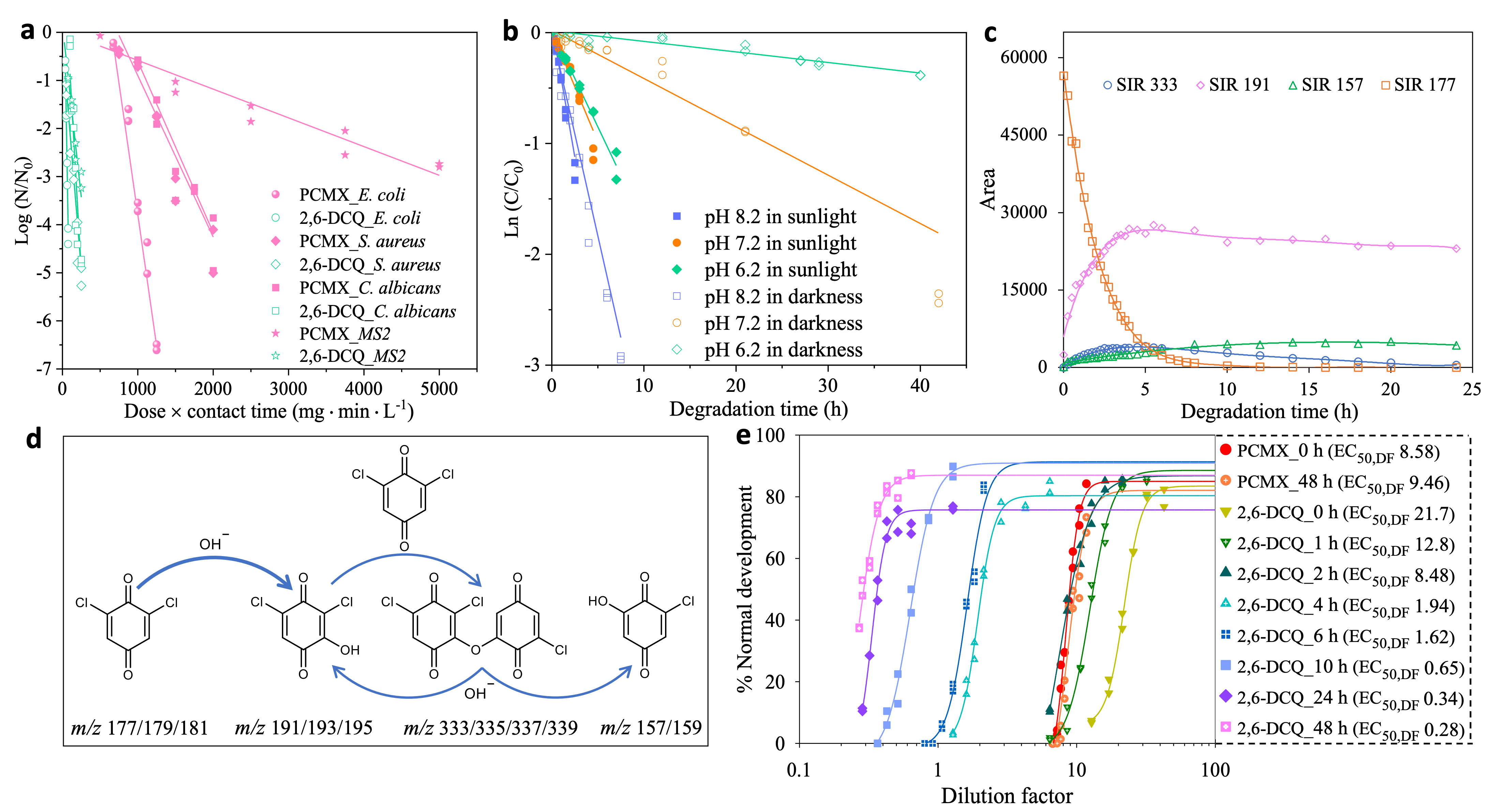
Figure 2. Antimicrobial activity, degradation kinetics and pathway, and developmental toxicity of 2,6-DCQ. a Survivorship of E. coli, S. aureus, C. albicans and MS2 against the dosage of 2,6-DCQ and PCMX at pH 7.2. b Degradation of 2,6-DCQ under different pH conditions with and without solar irradiation. c Peak area variations of 2,6-DCQ and its degradation products with time. d A proposed degradation pathway of 2,6-DCQ in seawater. e Comparative developmental toxicity of 2,6-DCQ and PCMX solutions with different degradation time in darkness.
Our study showcases the potential of 2,6-DCQ as a promising alternative to the commonly used PCMX. By identifying highly effective and rapidly degradable disinfectants, this study acts as a step towards enhancing biosecurity and environmental sustainability. Moreover, this study emphasizes the importance of leveraging the alkaline nature of seawater for developing green disinfectants and other green industrial products to address associated environmental challenges.

Follow the Topic
-
Nature Communications
An open access, multidisciplinary journal dedicated to publishing high-quality research in all areas of the biological, health, physical, chemical and Earth sciences.

Related Collections
With Collections, you can get published faster and increase your visibility.
Women's Health
Publishing Model: Hybrid
Deadline: Ongoing
Tumor Microenvironment Crosstalk and Therapeutic Implications
Publishing Model: Hybrid
Deadline: Nov 02, 2026



Please sign in or register for FREE
If you are a registered user on Research Communities by Springer Nature, please sign in